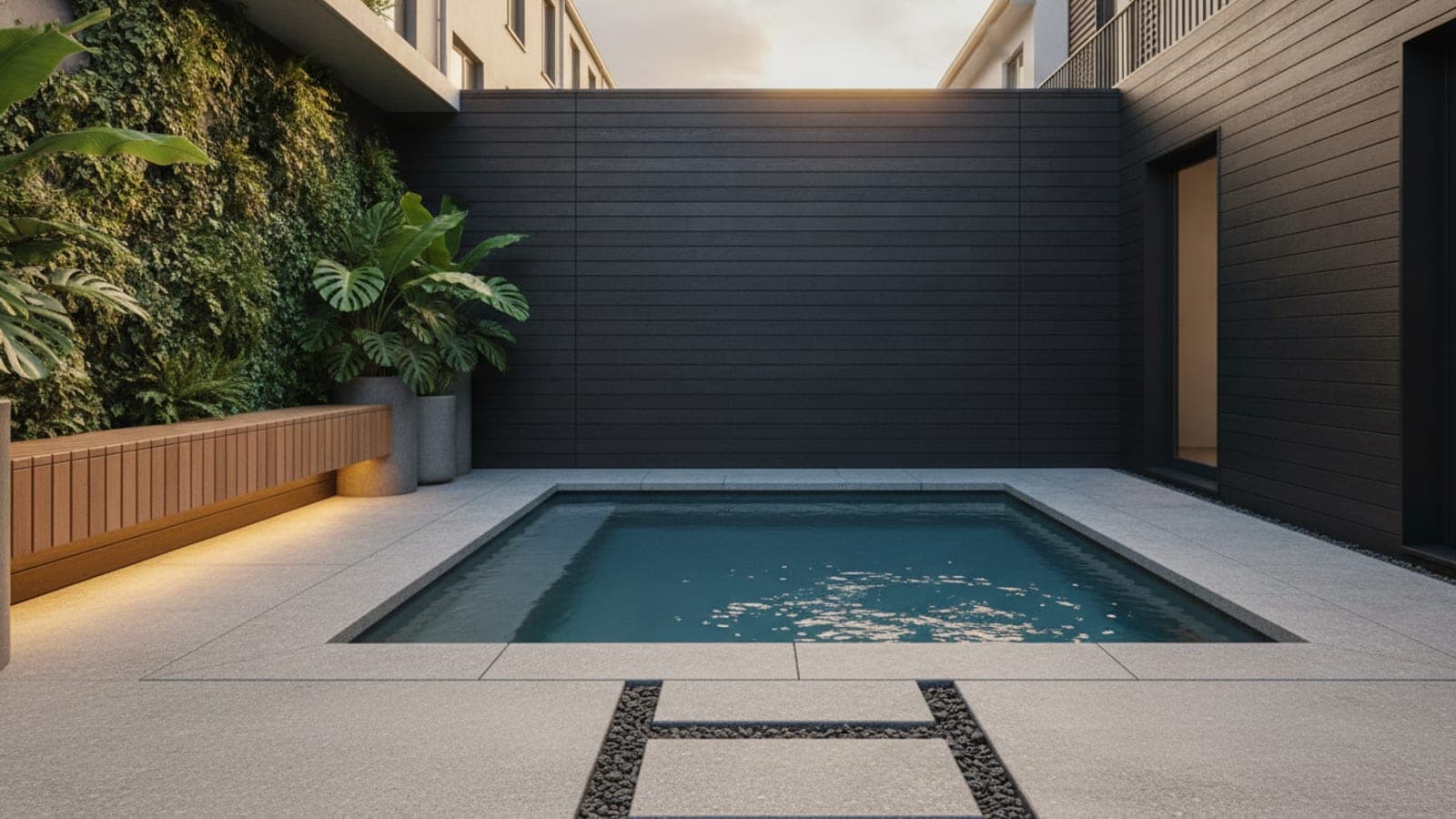
Plunge pools are great when you want real water in a smaller yard, but they are not tiny backyard toys. A plunge pool still needs safe access, a pump, a filter, testing, cleaning, heating decisions, code checks, and a budget that includes more than the pretty rectangle in the brochure.
Key takeaways
-
A plunge pool saves space, not responsibility. It still needs circulation, sanitizer, barriers, cleaning, and regular testing.
-
The pool shell is only part of the footprint. Decking, equipment, drainage, gates, setbacks, and service access matter.
-
Small water volume changes faster. One party, one storm, or one missed test can make the water annoying quickly.
-
A cover can matter more on a plunge pool than people expect because small pools are often heated or used as soaking pools.
-
The best plunge pool plan starts with how you will use it: cooling off, lounging, therapy, entertaining, or exercise.
What is a plunge pool?
A plunge pool is a small pool built mainly for cooling off, soaking, lounging, and light movement. It is usually smaller than a standard backyard pool, but it still behaves like a pool.
That last part matters. A smaller pool does not mean “no maintenance.” It means less water, which can be nice for heating and space planning, but less forgiving when the chemistry gets weird.
A plunge pool can be:
- Inground
- Semi-inground
- Concrete/gunite
- Fiberglass
- Vinyl-lined
- Precast
- Part of a patio or courtyard design
- Attached to a spa-like heating setup
The basic promise is simple: you get the feeling of a pool without giving up the whole yard. That promise is real. The mistake is thinking “smaller” means “simple.”
A plunge pool is still a permanent water feature. It can affect drainage, electrical planning, fencing, landscaping, resale, maintenance, and insurance. That is not meant to scare you away. It is meant to keep the brochure from doing all the talking.
Who is a plunge pool actually good for?
A plunge pool is best for homeowners who want a cool-off spot, a pretty backyard focal point, or a small soaking pool without building a full-sized swimming pool. It is less ideal if the main goal is lap swimming, big pool games, or hosting a small neighborhood by accident.
A plunge pool can make sense if you want:
- A small-yard pool
- A courtyard pool
- A cooling-off spot in a hot climate
- A simple lounge pool near a patio
- A heated soaking pool
- A lower-water-volume pool to maintain
- A pool that leaves room for grass, grilling, or seating
It may disappoint you if you want:
- Real lap swimming
- Deep diving
- Big pool floats everywhere
- Volleyball or basketball games
- A cheap shortcut to a luxury inground pool
- A no-maintenance backyard feature
Here is the brutally useful question: what will you do in it on a normal Tuesday?
If the answer is “sit, cool off, drink something cold, and not melt,” a plunge pool might be perfect. If the answer is “swim laps for fitness,” you probably need a swim spa, a longer narrow pool, or a gym membership you may or may not use.
How much space do you really need?
You need more space than the water rectangle. The pool footprint is only the beginning because the yard also needs safe walking room, equipment access, drainage, barriers, and a place where people can enter without doing a weird sideways crab walk.
Think in zones:
| Space item | Why it matters |
|---|---|
| Pool shell | The actual water area |
| Deck or coping | Safe entry, seating, cleaning access |
| Equipment pad | Pump, filter, heater, valves, service access |
| Barrier/gate area | Safety and code compliance |
| Drainage path | Keeps runoff from becoming a backyard soup situation |
| Storage | Test kit, skimmer, brush, cover tools, chemicals |
| Seating path | Where people stand, dry off, and avoid stepping into mulch |
Small yards fail when the plan only accounts for the pool shell. A plunge pool shoved into the last possible corner can look cute in a rendering and become annoying in real life.
Before you price anything, measure the usable space and mark it on the ground. Use stakes, rope, painter tape, a hose, or patio chairs. Then walk around it. Pretend you are carrying a skimmer, a towel, a test kit, and a plate of food. If you immediately hate the circulation path, fix the layout before you fix the tile color.
Use the pool volume calculator once you have a rough size. Gallons affect chemicals, heating, pump sizing, and how quickly the water reacts to weather and use.
What costs sneak up on plunge pool buyers?
The sneaky plunge pool costs are usually the boring ones: site work, access, decking, fencing, electrical, heating, drainage, covers, and equipment. The pool itself may be smaller, but the project still has grown-up pool costs.
Common cost buckets include:
| Cost bucket | What to ask before you sign |
|---|---|
| Excavation/site prep | Can equipment reach the yard without wrecking everything? |
| Pool shell/install | What is included and what is excluded? |
| Electrical | Does the equipment/heater need a dedicated circuit? |
| Plumbing/equipment | What pump, filter, valves, and automation are included? |
| Heating | Gas, electric, heat pump, or no heater? |
| Decking/coping | How much usable walking space is included? |
| Barrier/fence/gates | What does local code require? |
| Drainage | Where does stormwater go after the pool changes the yard? |
| Cover | Manual, solar, safety, automatic, or none? |
| Maintenance gear | Test kit, brush, vacuum/robot, chemicals, storage |
A small pool can still need expensive work. If the yard has bad access, difficult grading, poor drainage, or strict code requirements, a plunge pool can become much less “cute little project” and much more “why is there a trench near my patio.”
Use the pool cost calculator to separate the water feature from the whole project. That is the difference between a fantasy budget and a number you can actually plan around.
Should you heat a plunge pool?
Heating a plunge pool can be worth it if you want spa-like use, shoulder-season comfort, or evening soaking. It is less worth it if you mostly want a quick summer cool-off pool.
The big question is not “can it be heated?” It is “will you pay to keep it comfortable?”
A smaller pool can be easier to heat than a large pool, but heat loss still happens. Wind, air temperature, water temperature, pool surface area, and cover use all matter. A cover is not glamorous, but the U.S. Department of Energy says covering a pool when it is not in use is the single most effective way to reduce pool heating costs, with possible savings of 50% to 70%.
That makes covers especially important for plunge pools used like soaking pools. If you heat it and leave it uncovered, the backyard gets a very expensive steam hobby.
Good heating questions:
- Do you want warm water or just less-cold water?
- How many months per year will you use it?
- Will you cover it every time?
- Is gas available?
- Does a heat pump fit your climate?
- Is your electrical setup ready?
- Will the heater be noisy near seating or bedrooms?
Use the pool heater size calculator before you get emotionally attached to a heating plan. Heat is where many small pool budgets start acting large.
What equipment does a small pool still need?
A plunge pool still needs a pump, filter, sanitizer plan, return flow, testing routine, and cleaning method. Smaller water does not get a free pass from physics.
At minimum, plan for:
- Pump
- Filter
- Sanitizer system
- Test kit
- Brush
- Skimmer net
- Vacuum or compact robot
- Cover
- Chemical storage
- Safe access steps or bench design
Pump sizing matters. Oversizing can waste energy and create rough water movement. Undersizing can leave dead spots and weak filtration. ENERGY STAR notes that variable-speed and multi-speed pool pumps can help cut energy costs and often run quieter than single-speed pumps.
That does not mean every plunge pool needs the fanciest pump on earth. It means the pump should match the volume, plumbing, features, and usage. Use the pool pump size calculator instead of copying whatever your neighbor has.
For cleaning, the shape matters. Tiny plunge pools with benches, ledges, sharp corners, or steps may not be ideal for every robotic cleaner. A compact robot can be useful, but only if it fits the floor shape and does not spend the afternoon sulking in one corner.
How hard is plunge pool maintenance?
Plunge pool maintenance is usually less physical work than a large pool, but the chemistry can move quickly because there is less water to dilute mistakes. Small does not always mean easier; sometimes it means faster drama.
The routine looks familiar:
- Test sanitizer and pH.
- Empty baskets.
- Brush walls, steps, benches, and corners.
- Skim the surface.
- Run the pump long enough for the water and filter.
- Clean or backwash the filter as needed.
- Check water level.
- Use the cover when it helps.
A plunge pool that gets heavy use can need more attention than the size suggests. A few people in a small pool can have the same effect as a pool party in a larger one.
The important habit is testing before adding. Use the pool chemistry basics guide and the pool chemical shopping list builder to avoid buying the garage version of a chemistry aisle.
What safety details should you handle before the fun stuff?
Handle barriers, gates, alarms, drain safety, and supervision before you get distracted by tile, lights, and water features. Pretty pools are nice. Safe pools are non-negotiable.
CPSC’s Pool Safely program focuses on layers of protection, including supervision, barriers, alarms, and safer drain covers. CPSC also recommends barriers such as fences with self-closing, self-latching gates around pools.
For a plunge pool, safety planning should include:
- Local barrier and fencing requirements
- Self-closing, self-latching gates where required
- Door alarms if the house opens toward the pool area
- Anti-entrapment drain-cover checks
- Non-slip entry surfaces
- Clear nighttime lighting
- Safe steps or handholds
- A plan for children, guests, and pets
Do not treat a small pool as less risky because it is smaller. Small water can still be dangerous water. CDC drowning prevention guidance also warns not to rely on air-filled or foam toys as safety devices.
That matters if your plunge pool will be used by kids, guests, weaker swimmers, or anyone who thinks “I’m only stepping away for a second” counts as a safety plan. It does not.
What should you buy with a plunge pool?
The best plunge pool accessories are the ones that reduce testing, heat loss, cleaning frustration, and safety gaps. Skip the decorative pile of random floating cup holders until the boring kit is handled.
Useful add-ons:
| Item | Why it helps |
|---|---|
| Quality test kit | Small pools change quickly, so guessing gets expensive |
| Pool cover | Reduces debris, evaporation, and heat loss |
| Compact brush | Steps, benches, and corners need attention |
| Manual vacuum or compact robot | Small pools still collect dirt |
| Skimmer net | Leaves do not care how small the pool is |
| Chemical storage bin | Keeps products dry, separated, and safer |
| Thermometer | Helps if heating comfort matters |
| Safety alarm | Adds another layer, especially near house access |
| Replacement filter media | Avoids one dirty filter ruining the week |
This is a good page for affiliate links because the reader is already planning. Keep the recommendations practical. Do not push a giant robot onto a tiny plunge pool if a manual vac would be easier.
When should you skip a plunge pool?
Skip a plunge pool if you want a full swimming pool experience but only like the smaller price tag. A plunge pool solves space and design problems. It does not turn a six-person soaking pool into a lap lane.
You may want another option if:
- You want true lap swimming
- You host large pool parties
- You need deep-water play
- You dislike regular testing
- Your yard access makes construction brutal
- Local code makes the layout impractical
- You cannot spare space for equipment and barriers
- You will not use a cover on a heated pool
- You are stretching the budget before maintenance even starts
A plunge pool can be a great choice. It can also be an expensive compromise if you are trying to make it do every job a larger pool does.
The best decision is honest use-case matching. Do not ask a plunge pool to be a lap pool, spa, kid pool, party pool, and design feature all at once. That is how small pools develop big expectations.
What is the practical answer?
A plunge pool is worth considering if your real goal is cooling off, lounging, soaking, and keeping more usable yard. It is not a shortcut around planning, safety, maintenance, or cost.
Start with the boring questions:
- Where will it fit safely?
- What does local code require?
- How will you heat or cover it?
- What equipment does the water volume need?
- How will you clean it?
- Where will chemicals and tools live?
- What does the full project cost, not just the pool shell?
Then use the calculators. Estimate gallons, heating needs, pump size, and ongoing chemical costs before you fall in love with one rendering.
That is the grown-up version of pool shopping. Annoying, yes. Cheaper than regret, also yes.
Frequently asked questions
Are plunge pools cheaper than regular pools?
Plunge pools can cost less than larger inground pools, but they are not automatically cheap. Excavation, decking, heating, fencing, permits, plumbing, and finishes can still make the total project surprisingly serious.
Can a plunge pool fit in a small yard?
A plunge pool can fit in many small yards, but the pool shell is only part of the footprint. You also need room for access, equipment, code-required barriers, drainage, decking, and safe walking space.
Do plunge pools need pumps and filters?
Yes. A plunge pool still needs circulation, filtration, sanitizer, testing, and routine maintenance. Smaller water volume can actually change faster when chemistry gets ignored.
Is a plunge pool good for swimming?
A plunge pool is better for cooling off, soaking, lounging, and light movement than lap swimming. If exercise swimming is the goal, compare swim spas or longer narrow pools.
What should I buy with a plunge pool?
Plan for a properly sized pump/filter system, test kit, cover, safety equipment, cleaning tools, and either a compact robot or manual vacuum that fits the floor shape.