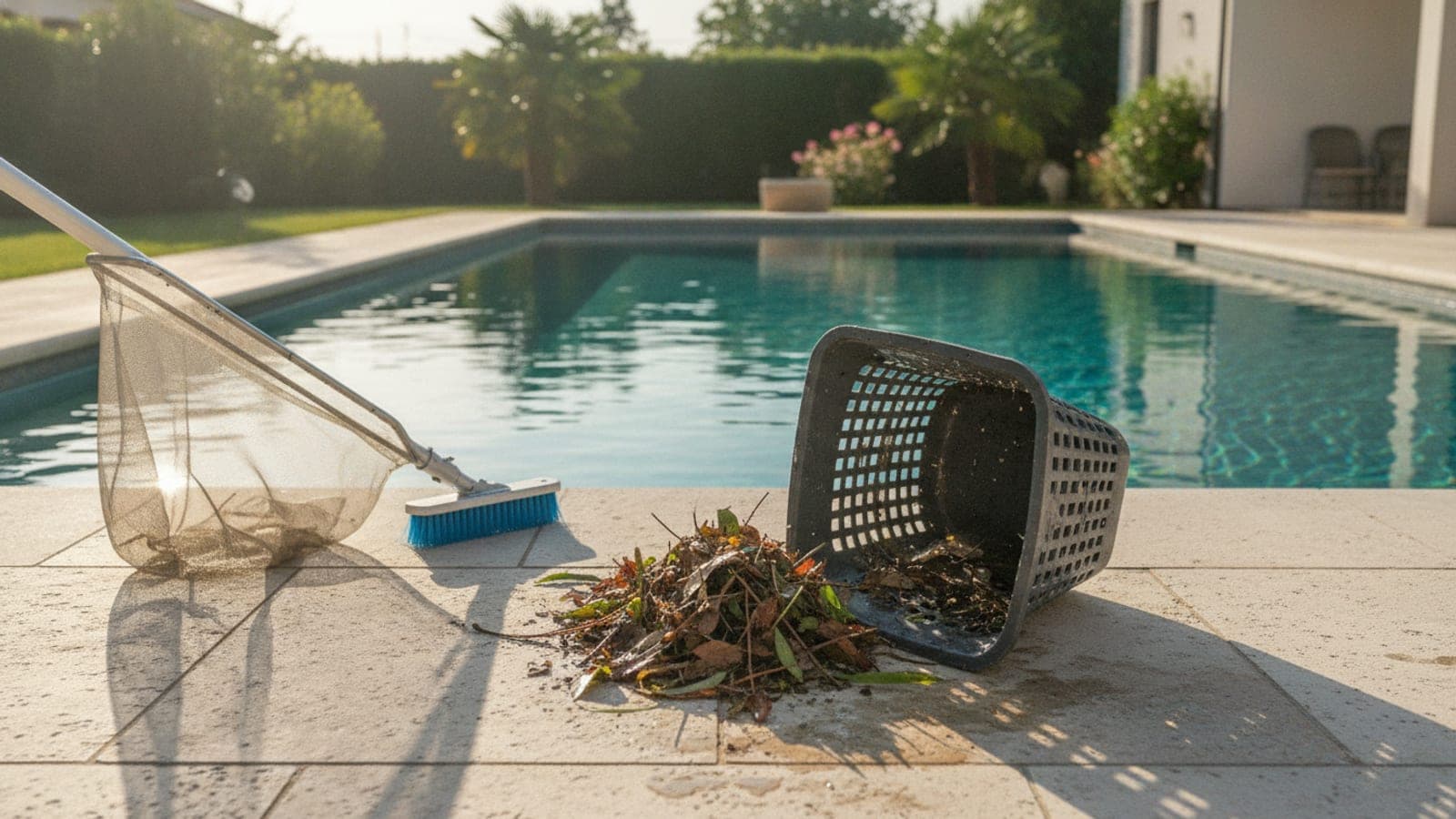
A weekly pool maintenance checklist should keep the water safe, clear, and boring in the best possible way. Test the water, clean what catches debris, brush the places circulation misses, check equipment, and fix small problems before your pool becomes a green emotional-support swamp.
Key takeaways
-
Weekly pool care is easier when you split it into testing, cleaning, circulation, equipment checks, and notes.
-
Chlorine and pH matter most for swimmer comfort and sanitation, but baskets, brushing, and filtration do a lot of the quiet work.
-
A robotic cleaner helps, but it does not replace brushing, testing, basket cleaning, or filter care.
-
Pump run time should be tied to water clarity, season, debris, pool use, and equipment type.
-
A written routine prevents the classic pool-owner cycle: ignore, panic, overspend, repeat.
-
How should the checklist change after rain or heavy swimming?
What should be on a weekly pool maintenance checklist?
A weekly pool maintenance checklist should include water testing, sanitizer adjustment, pH review, skimming, brushing, basket cleaning, filter checks, equipment inspection, and a quick note about what changed. That sounds like a lot until you stop treating it like one giant chore.
Think of the pool as five small systems.
| System | Weekly question | Why it matters |
|---|---|---|
| Water chemistry | Are sanitizer and pH in range? | Keeps water safer and more comfortable |
| Surface cleaning | Is debris removed before it sinks? | Reduces staining and chlorine demand |
| Brushing | Are walls, steps, and corners getting attention? | Prevents algae footholds |
| Circulation | Is water moving and filtering well? | Helps chemicals reach the whole pool |
| Equipment | Are baskets, filter, pump, and valves normal? | Catches small failures early |
If you only add chlorine, you are not maintaining the pool. You are feeding one part of the system while the other parts quietly plot against you.
A good site tool should let readers build a custom schedule based on pool type, trees, cover use, saltwater vs. chlorine, pump type, and season. The pool maintenance schedule generator can turn this checklist into something more useful than a fridge magnet.
What should you test every week?
Test free chlorine and pH first because they tell you whether the pool is ready for swimmers and whether the sanitizer can do its job. Then check total alkalinity, stabilizer, calcium hardness, and salt level as needed for your pool type.
CDC says disinfection and pH are the first defense against germs in swimming pools. For home pools, CDC recommends pH between 7.0 and 7.8 and gives chlorine guidance based on whether cyanuric acid is used. CDC home pool treatment and testing
Here is a practical home-pool testing rhythm.
| Test | Normal rhythm | Test more often when |
|---|---|---|
| Free chlorine | Several times per week in season | Hot weather, heavy use, rain, algae, cloudy water |
| pH | Several times per week in season | After acid/soda ash, high aeration, salt system changes |
| Total alkalinity | Weekly or when pH acts weird | pH keeps rising or crashing |
| CYA/stabilizer | Monthly or after water replacement | Chlorine disappears fast or seems weak |
| Calcium hardness | Monthly or seasonal | Plaster pool, hard water, scale, heater issues |
| Salt | Weekly to monthly for salt pools | Salt cell warning, heavy rain, drain/refill |
Use the pool chemistry basics guide if the numbers feel like they are speaking in appliance manual. Use the pool chlorine calculator when chlorine is low, and the pool pH calculator when pH needs a careful nudge.
What should you clean before it becomes a problem?
Clean debris before it sinks, rots, stains, clogs baskets, or burns through chlorine. Leaves are cute on trees. In the pool, they become tea bags with opinions.
The weekly cleaning list:
- Skim the surface.
- Empty skimmer baskets.
- Empty the pump basket.
- Remove toys, leaves, bugs, and seed pods.
- Clean the robot filter basket if you use one.
- Check the waterline for oily buildup.
- Vacuum or run the robot.
- Look at returns and drains for weak flow.
| Debris problem | First tool | Upgrade path |
|---|---|---|
| Leaves on surface | Leaf skimmer net | Robotic skimmer or pool cover |
| Sand or fine dirt | Manual vacuum or robot | Finer filter basket/panel |
| Pollen film | Skimmer sock, surface cleaning, filtration | Clarifier only after basics are right |
| Bugs | Skimmer net | Surface skimmer, cover, better lights placement |
| Hair and lint | Basket cleaning | Cartridge/filter cleaning |
If leaves are the weekly villain, link to how to clean leaves out of your pool. If the water is already cloudy, switch from routine mode to the cloudy pool diagnosis path.
How much brushing does a pool really need?
Most pools need brushing at least weekly during swim season, and more often when algae, dust, pollen, new plaster, or dead circulation spots show up. Brushing is not glamorous. Neither is dental floss. Both are annoying because they work.
Brush these areas first:
- Steps and benches.
- Corners.
- Around ladders and rails.
- Waterline.
- Behind pool features.
- Shaded walls.
- Areas with low circulation.
A robotic pool cleaner can reduce vacuuming, but it does not magically scrub every vertical surface, step edge, ladder pocket, tile line, and weird corner where algae starts its little garden.
| Pool surface | Brush note |
|---|---|
| Vinyl liner | Use a liner-safe brush, not a harsh stainless brush |
| Fiberglass | Use a soft brush and avoid abrasive scrubbing |
| Plaster/gunite | Nylon or blended brushes may be appropriate depending on surface age |
| Tile line | Use a surface-safe sponge or cleaner |
If you are building affiliate sections, this is a good spot for brushes, telescoping poles, waterline sponges, and robot cleaners. Keep it helpful, not pushy.
What should you check on the pump and filter?
Check pump flow, basket condition, filter pressure or flow, leaks, unusual noise, and the timer schedule every week. Circulation is the delivery truck for your chemicals. If the truck is parked, the products are not getting anywhere.
Weekly equipment checks:
- Pump primes normally.
- Water returns strongly to the pool.
- Pump basket is not packed with debris.
- Skimmer weirs move freely.
- Filter pressure is not unusually high or low.
- No new drips or wet spots around equipment.
- Timer schedule matches the season.
- Salt cell or heater display has no warning message.
ENERGY STAR says variable-speed and multi-speed pool pumps can cut energy costs and often run quieter, with slower filtration rates that can improve filtration effectiveness. That supports a smarter schedule rather than only blasting a single-speed pump longer out of fear. ENERGY STAR pool pumps
Use the pool pump run time calculator to estimate a starting schedule. Then adjust based on water clarity, chlorine stability, debris, and your actual equipment.
| Symptom | Possible cause | Next move |
|---|---|---|
| Weak return flow | Full basket, dirty filter, valve issue | Clean baskets, check filter pressure |
| High filter pressure | Dirty filter, blocked return | Clean/backwash per filter type |
| Low filter pressure | Air leak, low water, clogged impeller | Check water level and pump basket |
| Loud pump | Bearing, cavitation, debris, poor prime | Inspect before it gets expensive |
| Cloudy water | Chemistry, filtration, fine particles | Use cloudy pool diagnosis path |
How should the checklist change after rain or heavy swimming?
After rain, parties, heat waves, or heavy swimming, treat the pool like it had a busy week even if the calendar says Tuesday. Test sooner, clean baskets, brush problem areas, and check whether chlorine fell faster than normal.
The pool does not care that the barbecue was lovely. It remembers sunscreen, sweat, leaves, grass, toddlers, thunderstorm runoff, and the person who definitely did not rinse off.
| Event | What to do after |
|---|---|
| Heavy rain | Test chlorine, pH, water level, and debris load |
| Pool party | Test chlorine and pH, skim, clean baskets, brush steps |
| Heat wave | Test chlorine more often and check evaporation |
| Windy day | Skim, empty baskets, inspect filter load |
| Algae hint | Brush, test, and use the shock/green pool path |
| New fill water | Test pH, alkalinity, calcium, metals if relevant |
CDC recommends checking disinfectant and pH more often when pools are heavily used. That is especially useful for home pools during holidays, summer weekends, and any day the pool becomes the neighborhood splash airport. CDC pool safety guidance
What tools are worth keeping close?
The best weekly pool tools are the ones that prevent small problems from turning into Saturday plans you did not consent to. Start with testing, cleaning, and safety.
| Tool | Buy it early? | Why |
|---|---|---|
| Drop test kit | Yes | Better decisions than guessing |
| Test strips | Yes | Quick checks between full tests |
| Leaf skimmer | Yes | Removes debris before it sinks |
| Pool brush | Yes | Stops algae from finding corners |
| Telescoping pole | Yes | Runs half your tools |
| Manual vacuum | Maybe | Useful backup even with a robot |
| Robotic cleaner | Maybe | Saves time if debris is constant |
| Skimmer socks | Maybe | Helpful for pollen/fine debris |
| Pool cover | Maybe | Helps with debris, evaporation, and heat loss |
The U.S. Department of Energy says covering a pool when it is not in use is the single most effective way to reduce pool heating costs, with possible savings of 50% to 70%. A cover is not fun to wrestle with, but it can reduce heat loss and debris. DOE swimming pool covers
What should a simple weekly schedule look like?
A simple weekly pool schedule should separate quick checks from deeper cleaning. That keeps maintenance from becoming one giant task you avoid until the water starts sending smoke signals.
Here is a normal-person schedule.
| Day | Task | Time |
|---|---|---|
| Monday | Test chlorine and pH, empty skimmer basket | 5–10 min |
| Wednesday | Quick skim, check water level, test if hot/heavy use | 5–10 min |
| Friday | Test chlorine and pH before weekend swimming | 5–10 min |
| Saturday | Brush, clean baskets, vacuum/run robot, inspect equipment | 20–45 min |
| Monthly | Test CYA, calcium hardness, salt if applicable | 10–20 min |
Adjust for your pool. A screened Florida pool under no trees and a windy backyard pool under oaks do not need the same routine. One gets bugs. The other gets leaf soup.
A useful PoolPros tool should ask:
- Is the pool screened or open?
- Are there trees nearby?
- Is it saltwater or traditional chlorine?
- Is there a robotic cleaner?
- Is there a cover?
- Is the pump variable speed or single speed?
- Is the pool used daily, weekly, or occasionally?
Then it should generate a schedule instead of pretending every pool is the same rectangle in a brochure.
When should weekly maintenance turn into troubleshooting?
Weekly maintenance should turn into troubleshooting when the same problem repeats after normal testing, cleaning, and circulation. If chlorine keeps disappearing, pH keeps climbing, or cloudy water keeps coming back, the pool is asking for diagnosis, not more random bottles.
Use this decision path:
| Repeated issue | Go here next |
|---|---|
| Green water | How to clean a green pool |
| Cloudy water | How to clear cloudy pool water |
| Chlorine always low | Pool chlorine too low |
| pH always high | Pool acid calculator |
| Pump schedule confusion | Pool pump run time calculator |
| Constant debris | Best pool skimmers |
The point of a checklist is not perfection. It is rhythm. Test, clean, circulate, inspect, write down what changed, and keep the pool boring enough that you can actually swim in it.
Frequently asked questions
What should I do to my pool every week?
Test the water, adjust sanitizer and pH as needed, skim debris, brush walls and steps, clean baskets, check filter pressure or flow, inspect equipment, and confirm the pump schedule is working.
How often should I test my pool water?
For a home pool, test chlorine and pH several times per week during swim season and more often after heavy use, rain, heat, or chemical changes.
Do I need to brush if I have a robotic pool cleaner?
Yes. A robot helps with floors and debris, but steps, corners, waterline areas, and dead spots still need brushing.
How long should weekly pool maintenance take?
A normal weekly routine can often be done in 20 to 45 minutes if the water is already balanced. Neglected pools take longer because you are solving problems, not maintaining.
What is the biggest weekly pool maintenance mistake?
Only adding chlorine and ignoring circulation, brushing, baskets, filter condition, and pH. Clear water is a system, not one bottle.