Evaporation vs. leak calculator
You're losing roughly 561 gallons (0.29 in/day). That's within normal evaporation range for a warm, dry, or windy week.
The bucket test settles it: a bucket of pool water on the top step loses water to evaporation at the same rate as the pool. If the pool drops faster than the bucket, that difference is a leak.
A pool evaporation calculator helps you turn a dropping water line into gallons per day, then decide whether the loss looks like normal evaporation or a possible leak. It will not find a cracked pipe by itself, but it can stop you from staring at the skimmer like it owes you money.
Key takeaways
-
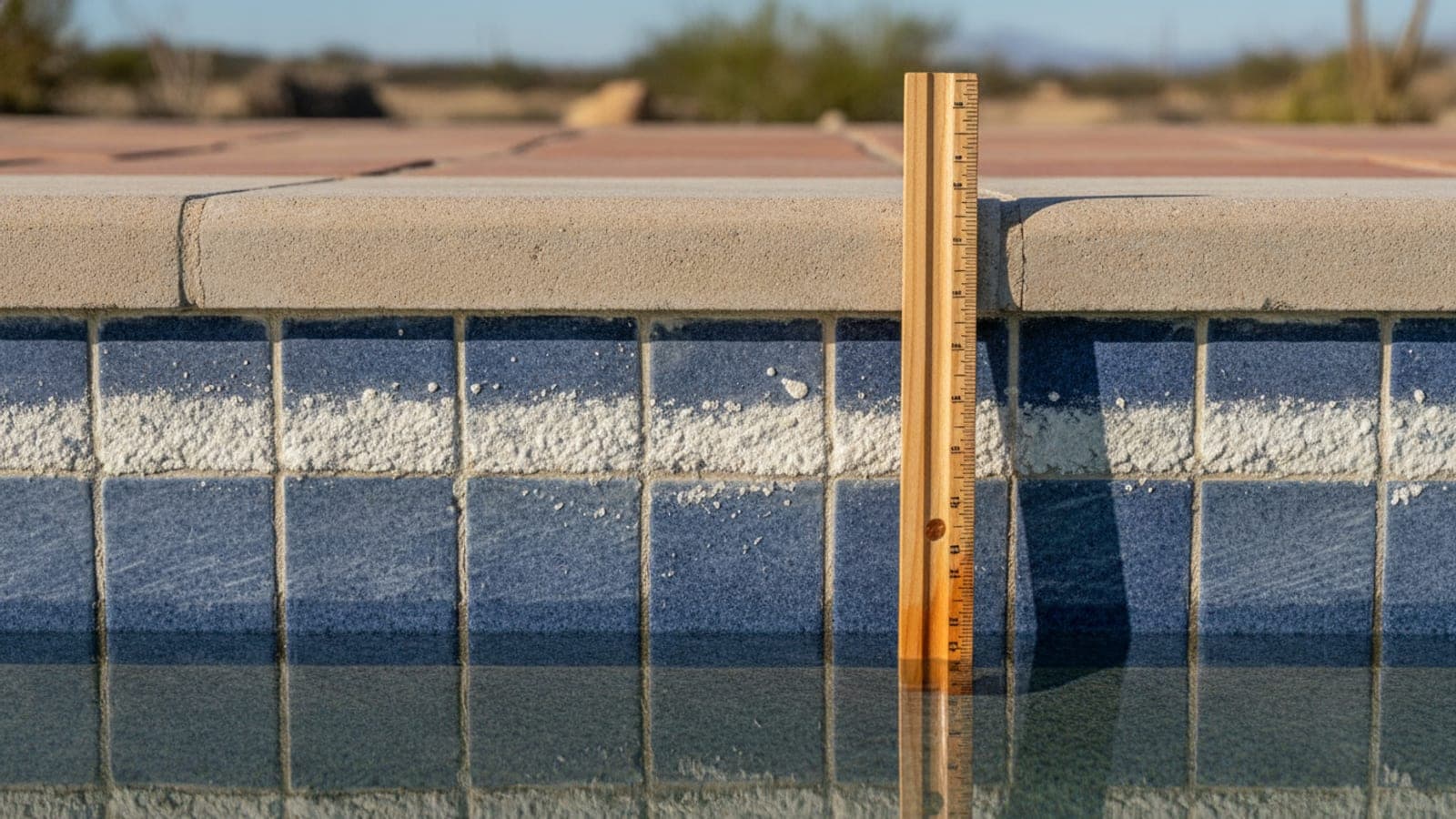
The calculator needs pool surface area, water-level drop, and the number of days measured.
-
One inch of water over one square foot equals about 0.623 gallons, so even a small drop can be a lot of water in a large pool.
-
Evaporation changes with sun, wind, humidity, temperature, splashing, and cover use.
-
A bucket test is the simplest way to compare pool loss against evaporation under the same conditions.
-
EPA WaterSense says pool covers can prevent up to 95 percent of pool water evaporation.
How does a pool evaporation calculator work?
A pool evaporation calculator estimates how many gallons your pool lost by multiplying surface area by water-level drop. The result helps you decide whether you are seeing normal weather-related evaporation or a possible leak.
The basic formula is:
Pool surface area × inches lost × 0.623 = gallons lost
Then divide by the number of days measured:
Gallons lost ÷ days = gallons lost per day
That gives the reader something more useful than “the pool looks lower.” A half inch can look small from the patio. On a wide pool, it can be a very real amount of water.
The calculator should not claim that a specific gallon number proves a leak. Evaporation is not a fixed number. A hot, windy, dry day can steal water like it has a side hustle. A covered pool on a still night may barely move.
The better result is a diagnosis path:
- Measure the loss.
- Convert it to gallons.
- Check weather and cover use.
- Run a bucket test.
- Inspect simple problem spots.
- Call a leak professional if the pool loses more than the bucket.
That is useful and honest.
What numbers do you need before using the calculator?
Before using the calculator, measure the pool's surface area, the water-level drop, and the number of days between measurements. If your pool has an autofill system, turn it off before testing or it will quietly hide the problem like a tiny plumbing accomplice.
For a rectangular pool, surface area is simple:
Length × width = surface area
For round pools:
Radius × radius × 3.14 = surface area
For oval or freeform pools, the calculator can use a rough estimate or ask the reader to choose “close enough” shapes. The goal is not surveyor-grade geometry. The goal is to know whether the loss is small, normal, suspicious, or expensive-looking.
| Input | Why it matters | How to measure it |
|---|---|---|
| Pool shape | Controls area formula | Rectangle, round, oval, freeform |
| Length and width | Gives surface area | Tape measure or property plan |
| Water drop | Main loss measurement | Tape, ruler, tile line, skimmer mark |
| Days measured | Converts total loss to daily loss | Use 24-hour blocks when possible |
| Cover use | Changes evaporation | Covered, uncovered, partial |
| Autofill status | Can hide water loss | Turn off during test |
| Rain or splash-out | Can distort results | Retest if the pool was used heavily or it rained |
The calculator page should link to the pool volume calculator, but the evaporation calculator mainly needs surface area. Volume matters for chemicals. Surface area matters for water disappearing into the sky.
How do you turn inches of water loss into gallons?
To turn inches of water loss into gallons, multiply the pool surface area by the inches lost and by 0.623. That 0.623 factor is the approximate number of gallons in one inch of water spread over one square foot.
Here is a worked example:
| Measurement | Example value |
|---|---|
| Pool size | 16 × 32 ft |
| Surface area | 512 sq. ft. |
| Water loss | 0.25 in. |
| Gallons per 0.25 in. | 512 × 0.25 × 0.623 = 79.7 gal |
| Days measured | 1 day |
| Estimated loss | About 80 gal/day |
That number can surprise people. A quarter inch does not sound dramatic. On a 16 × 32 pool, it is roughly 80 gallons.
Now change the pool size:
| Pool surface area | 0.25 in. loss | 0.5 in. loss | 1.0 in. loss |
|---|---|---|---|
| 250 sq. ft. | About 39 gal | About 78 gal | About 156 gal |
| 500 sq. ft. | About 78 gal | About 156 gal | About 312 gal |
| 750 sq. ft. | About 117 gal | About 234 gal | About 467 gal |
| 1,000 sq. ft. | About 156 gal | About 312 gal | About 623 gal |
This is why “my pool only dropped a little” is not enough. Surface area turns a little drop into a real water number.
When is water loss probably normal evaporation?
Water loss is more likely to be normal evaporation when the pool and a bucket of pool water lose about the same amount over the same time. It is also more likely when the weather is hot, dry, sunny, windy, or the pool is heated and uncovered.
Evaporation gets worse when:
- The pool is uncovered.
- The air is dry.
- The wind is strong.
- The water is warm.
- Nights are cool compared with the pool water.
- Water features are running.
- Swimmers splash a lot.
- The pool is heated.
The EPA WaterSense pool efficiency guidance says pool covers can prevent up to 95 percent of pool water evaporation. DOE also says pool covers reduce evaporation and pool heating costs. That is a big deal for any article about water loss.
But do not promise one “normal evaporation” number for every reader. A pool in humid central Florida behaves differently from a pool in dry, windy Arizona. A screened pool behaves differently from an uncovered pool with a waterfall running all afternoon.
A good calculator result should say:
Your pool lost about X gallons per day. If the bucket test loses the same amount, this points more toward evaporation and weather. If the pool loses more than the bucket, investigate for a leak.
That answer is better than pretending the internet can smell a broken return line.
How do you run the bucket test?
The bucket test compares water loss inside a bucket with water loss in the pool under the same outdoor conditions. If the pool drops more than the bucket, a leak becomes more likely.
Here is the simple version:
- Fill the pool to its normal operating level.
- Turn off autofill, if the pool has one.
- Fill a clean bucket with pool water.
- Place the bucket on a pool step or sun shelf so it sits in the pool water and will not tip.
- Mark the water level inside the bucket.
- Mark the pool water level outside the bucket.
- Wait 24 hours with no swimming or heavy splashing.
- Compare the two marks.
American Leak Detection's bucket test instructions use the same basic idea: compare the bucket water level against the pool water level after both have been exposed to similar conditions.
If it rains hard or the kids hold a cannonball competition, restart. The bucket test is simple, not magic. It needs boring conditions. Boring is good. Boring saves money.
What does the bucket test result mean?
The bucket test result tells you whether the pool is losing more water than a bucket exposed to the same weather. Equal loss points toward evaporation. Extra pool loss points toward a possible leak.
| Bucket test result | Likely meaning | Next step |
|---|---|---|
| Pool and bucket drop about the same | Evaporation/weather is likely | Track another day or use a cover |
| Pool drops more than bucket | Leak is more likely | Inspect visible areas and consider leak detection |
| Pool drops more only when pump runs | Pressure-side or equipment-related leak may be possible | Repeat with pump on/off and call a pro if confirmed |
| Water stops dropping at a fitting level | Leak may be near skimmer, light, return, or tile line | Do not keep guessing; document the level |
| Autofill keeps turning on | Water loss may be hidden | Turn off autofill and retest |
Do not tell readers to rip apart equipment after one test. Tell them to document:
- Date and time.
- Weather.
- Pump status.
- Cover status.
- Pool level change.
- Bucket level change.
- Whether water stopped at a fitting.
That information helps if they call a leak professional. It also keeps the article from sending them into backyard detective mode with a screwdriver and too much confidence.
What should you check before calling it a leak?
Before calling it a leak, check autofill, splash-out, backwash/waste lines, equipment pad drips, skimmer level, lights, returns, and whether the water loss changes when the pump runs. A leak diagnosis should start with obvious clues.
Check these first:
| Area | What to look for | Why it matters |
|---|---|---|
| Autofill | Running often or stuck valve | Can hide real water loss |
| Equipment pad | Wet spots, drips, pump lid leaks | Visible leaks may be easy to spot |
| Filter waste line | Water leaving during normal operation | Multiport valve issues can waste water |
| Skimmer throat | Cracks or level stopping near skimmer | Common suspicious area |
| Pool light | Water loss stopping near light | Possible niche/gasket issue |
| Returns | Air bubbles or level clues | Possible plumbing/fitting issue |
| Cover | Torn, missing, or unused | Evaporation control issue, not a leak |
| Landscaping | Wet soil near shell or equipment | Possible underground leak clue |
If water chemistry is also drifting, link readers to how to clear cloudy pool water. Constant fresh water can dilute chemicals and make pool care feel weirdly difficult. The pool may not be haunted. It may be refilling itself every night.
What should you buy if your pool keeps losing water?
If the pool keeps losing water, buy measurement and prevention tools before throwing random repair products at it. The right affiliate module should help readers test, cover, and document the problem.
What you need
| Product | Why it helps | When to use it |
|---|---|---|
| Leak detection dye | Helps check still-water leaks around fittings | After bucket test points toward a leak |
| Water level ruler or tape | Measures loss clearly | Before every test |
| Pool cover | Reduces evaporation | If bucket test points to normal evaporation |
| Cover reel | Makes regular cover use realistic | For larger covers |
| Skimmer weir | Helps skimmer operation | If missing/broken at skimmer |
| Autofill valve parts | Fixes obvious autofill issues | If autofill is stuck or masking loss |
Affiliate disclosure: We may earn a commission if you buy through links in this section. Product prices and availability can change.
Do not sell leak dye as a cure. Dye can help near fittings when the water is still. It will not map underground plumbing from across the yard like a superhero.
What should the calculator result show?
The calculator result should show gallons lost, gallons lost per day, possible evaporation context, bucket-test instructions, and next-step product links. The best result teaches the reader what to do next.
A strong result card should include:
- Measured water drop: inches over days.
- Estimated gallons lost: total and daily.
- Weather note: cover, wind, heat, rain, pump status.
- Bucket test prompt: “Run this before assuming leak.”
- Possible diagnosis: evaporation likely, retest needed, or leak possible.
- Next internal link: pool cover benefits or pool losing water.
- Product module: cover, dye, measuring tools, autofill parts.
The page should end with this stance:
Measure first. Bucket test second. Buy third. Call a pro when the pool loses more than the bucket or the water stops at a suspicious fitting.
That is the kind of advice people remember. It saves them from panic-buying three bottles of something blue with a confident label.
Frequently asked questions
How much pool water loss is evaporation?
It depends on sun, wind, humidity, water temperature, air temperature, and cover use. The best first check is to measure daily water loss and compare the pool against a bucket test.
How does a pool evaporation calculator work?
It estimates gallons lost by multiplying pool surface area by water-level drop. One inch of water over one square foot is about 0.623 gallons.
How do I know if my pool has a leak?
Run a bucket test. If the pool level drops more than the water inside the bucket under the same conditions, a leak is more likely than simple evaporation.
Can a pool cover reduce evaporation?
Yes. EPA WaterSense says pool covers can prevent up to 95 percent of pool water evaporation when used properly.
Should I add water before testing for a leak?
Bring the pool to its normal operating level before testing, then turn off autofill if you have it. Mark water levels clearly and compare after 24 hours.