PoolGearGuide

Pool Salt Calculator: How Much Salt Should You Add?

By the PoolGearGuide editorial team · Updated 2026-07-03

Share

Pool salt calculator

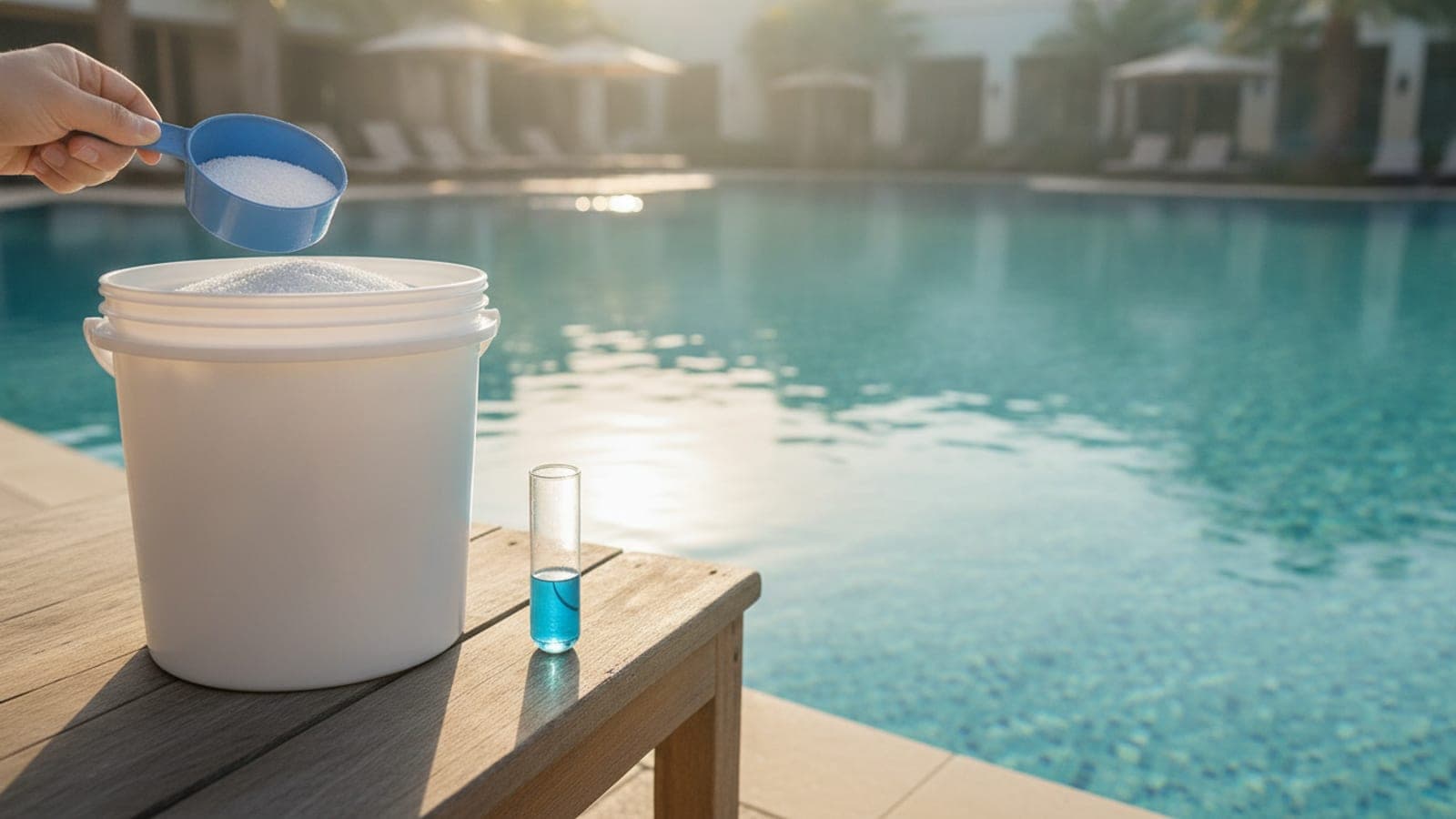
Add about 100 lbs of pool salt. Pour it in slowly around the shallow end and brush — the pool is not soup; do not season it by vibes.

Treat this as a starting dose: add less than the full amount when unsure, circulate for a few hours, retest, repeat. Always follow your product's label.

A pool salt calculator tells you how many pounds or bags of pool-grade salt to add without turning the pool into a salty science apology. Enter your pool volume, current salt reading, target salt level, and bag size, then add less than the full amount when you are unsure, circulate, and retest.

Key takeaways

How does the pool salt calculator work?

The calculator subtracts your current salt level from your target salt level, then converts that ppm gap into pounds of salt based on pool volume. The pool does not care how confident you feel. It cares how many gallons are in there.

Use this formula for the core calculator logic:

Salt pounds needed = ppm increase × pool gallons ÷ 120,000

That works because raising 10,000 gallons by 1,000 ppm takes about 83 pounds of salt. The calculator should also convert pounds into bags, because nobody at the store asks for “one hundred and sixty-seven pounds, emotionally.”

Example:

  • Pool volume: 15,000 gallons
  • Current salt: 2,400 ppm
  • Target salt: 3,200 ppm
  • Increase needed: 800 ppm

800 × 15,000 ÷ 120,000 = 100 pounds

If bags are 40 pounds each, that is 2.5 bags. A careful owner would usually add two bags, brush any piles, run the pump, retest, and then decide whether to add the remaining half bag.

That slow approach matters because salt does not evaporate. Water leaves. Salt mostly stays behind. Overdosing salt is much more annoying than underdosing it.

What numbers do you need before adding salt?

You need four numbers: pool volume, current salt ppm, target salt ppm, and bag size. If one of those is a guess, treat the calculator result as a starting point, not a dare.

Use this checklist before opening bags:

NumberHow to get itWhy it matters
Pool gallonsUse the pool volume calculatorEvery salt dose depends on water volume
Current salt ppmSalt strip, drop test, digital meter, or control boxShows the actual gap
Target salt ppmYour salt system manualDifferent systems want different ranges
Bag sizeProduct label, often 40 lbConverts pounds into shopping quantity

Do not skip the independent salt test if your control box suddenly screams “low salt.” A dirty cell, aging cell, cold water, poor flow, or sensor issue can make a salt system grumpy. Adding five bags because a blinking light hurt your feelings is how people create a second problem.

A good page design should put the calculator near the top, then put a “What you need” module right under it: salt test kit, pool-grade salt, gloves, brush, and the pool volume calculator.

What salt level should your pool target?

Your target salt level should come from the salt chlorine generator manual. Hayward says many of its salt systems work in the 2,700–3,400 ppm range, with 3,200 ppm as optimal. Pentair says 3,600 ppm is ideal for some IntelliChlor Plus and LT systems.

That is why the calculator should not force one target for everybody. It should include presets and a custom target field.

Equipment situationBetter calculator setting
Hayward AquaRite-style systemPreset around 3,200 ppm, then verify manual
Pentair IntelliChlor Plus/LTPreset around 3,600 ppm, then verify manual
Unknown salt systemUse a custom target from the manual
New homeowner, no manualFind the model number before adding salt
Cell says low salt but test says normalClean/check the cell before adding more

The big point: saltwater pool ownership is not “set it and forget it.” It is more like “set it, test it, and do not fully trust the plastic box when it is having a dramatic moment.”

If your salt system is producing less chlorine, also check the pool chlorine calculator, pool pH calculator, and saltwater pool maintenance guide. Low salt is only one possible reason chlorine is low.

How many bags of pool salt should you add?

Add the calculated amount in stages when the dose is large. For small corrections, one partial bag may be enough. For a first saltwater conversion, you may need many bags, but that is exactly when careful math matters most.

Here is a simple example table using a 3,200 ppm target from zero salt. These are rough planning numbers, not a replacement for your exact calculator result.

Pool volumeSalt needed from 0 to 3,200 ppm40 lb bags
10,000 gallonsAbout 267 lb7 bags
15,000 gallonsAbout 400 lb10 bags
20,000 gallonsAbout 533 lb14 bags
25,000 gallonsAbout 667 lb17 bags
30,000 gallonsAbout 800 lb20 bags

For a correction, the number is much smaller. A 20,000-gallon pool going from 2,800 ppm to 3,200 ppm needs about 67 pounds. That is not two pallets. That is less than two 40-pound bags.

The calculator should show:

  • Pounds needed
  • 40-pound bags needed
  • Kilograms needed
  • Recommended “add first” amount
  • Retest reminder
  • Warning if current salt is already above target

That last warning matters. If current salt is 4,200 ppm and target is 3,200 ppm, the answer is not “negative salt.” The answer is dilution math and patience, two things no one wants but everybody occasionally needs.

What should you buy before adding salt?

You need salt, but the salt is not the only useful purchase. The better affiliate module is the one that keeps the reader from messing up the job.

What you need

  • Pool-grade salt without additives your system does not allow
  • Salt test strips or a digital salinity meter
  • Full pool test kit for pH, chlorine, alkalinity, and CYA
  • Brush for moving salt piles off the floor
  • Chemical-resistant gloves
  • A maintenance log or app if the owner keeps forgetting what they added

This page should not push random gadgets before the calculator. The product module belongs after the calculator and the first explanation, when the reader understands what they need.

A good CTA block could be:

  • “Shop Pool Salt”
  • “Shop Salt Test Kits”
  • “Shop Full Water Test Kits”
  • “Compare Smart Water Monitors”

Keep Amazon and specialty-retailer links separate. Someone buying 20 bags of salt may prefer local pickup. Someone buying a salinity meter may prefer Amazon. The site should support both without making the reader play link roulette.

What if your salt level is too low?

If salt is truly low, add the calculated amount slowly and circulate the pool. Low salt can keep the salt chlorine generator from producing enough chlorine, but low chlorine does not automatically mean low salt.

Check these first:

  1. Test salt independently.
  2. Check the system manual’s target range.
  3. Inspect/clean the salt cell if the manual calls for it.
  4. Confirm pump flow is normal.
  5. Check water temperature if the system behaves differently in cold water.
  6. Add less than the full calculated dose when you are unsure.

Low salt is usually straightforward. The trap is assuming the machine is always right. Machines are wonderful. Machines also blink red lights for reasons that would embarrass them if they had shame.

If the pool is cloudy or green, use the salt calculator only after the sanitation problem is understood. Jump to how to clean a green pool, pool shock calculator, or pool stabilizer too high if chlorine is not holding.

What if your salt level is too high?

If salt is too high, the practical fix is usually dilution. Drain some water, refill with fresh water, circulate, and retest. Do not drain blindly if you have a high water table, fiberglass pool, vinyl liner concerns, drought restrictions, or local discharge rules.

The calculator can include a high-salt mode:

Drain fraction = (current ppm - target ppm) ÷ current ppm

Example:

  • Current salt: 4,000 ppm
  • Target salt: 3,200 ppm
  • Difference: 800 ppm

800 ÷ 4,000 = 0.20

That suggests replacing about 20% of the water. For a 20,000-gallon pool, that is around 4,000 gallons. In real life, you may do it in smaller steps, retest, and avoid causing new problems with water level, liner movement, or equipment.

High-salt situationBetter next step
Slightly above targetRetest before acting
Way above targetPlan dilution carefully
Salt reading disagrees with test kitTest again with another method
Cell reports high saltCheck manual for safe operating range
Pool is fiberglass/vinyl/high water tableAsk a pro before large draining

This section should link to pool volume calculator because the drain/refill amount depends on gallons. It should also link to pool chemical safety, because hauling heavy chemical bags around wet concrete has a way of humbling people.

Why does a salt pool still need regular testing?

A salt pool still needs testing because the salt system only makes chlorine. It does not magically balance pH, alkalinity, stabilizer, calcium hardness, or metal issues. It is a chlorine generator, not a tiny pool wizard.

CDC guidance for home pools gives pH and chlorine ranges for healthy swimming. Salt pool owners still need to test those numbers, especially when using cyanuric acid or stabilized chlorine products.

Watch these numbers:

TestWhy it matters
Free chlorineShows sanitizer level
pHAffects comfort and chlorine performance
Total alkalinityHelps buffer pH movement
CYA/stabilizerProtects chlorine but can make dosing more complicated
SaltHelps the generator operate in range
Calcium hardnessMatters for surfaces, scaling, and some equipment

The salt calculator should not be isolated. It should feed people into the broader chemistry cluster: pool chemistry basics, weekly pool maintenance checklist, and pool chemical shopping list builder.

Affiliate links should appear where they solve a real problem. The reader came to calculate salt, not to tour a digital aisle of every pool product ever made.

Best placements:

Page sectionProduct module
Under calculatorSalt, salt test kit, full test kit
“Before adding salt”Salinity meter, gloves, brush
“Too high” sectionTest kit, water meter, maintenance log
Bottom CTASaltwater maintenance starter kit

Avoid making the article feel like a checkout page wearing a mustache. A few useful product blocks are stronger than ten random buttons.

Recommended module copy:

What you need before adding salt

Use a current salt reading, a verified pool volume, and the right salt for your generator. These tools keep the calculator honest.

  • Shop pool-grade salt
  • Shop salt test kits
  • Shop digital salinity meters
  • Shop full pool test kits

Include the site disclosure before those links: “We may earn a commission when you buy through links on this page. As an Amazon Associate, we earn from qualifying purchases.”

What should you do after adding salt?

After adding salt, brush any piles, run the pump, give the water time to mix, and retest before adding more. The boring process is the good process.

A safe sequence:

  1. Confirm gallons with the calculator.
  2. Confirm current salt with a test.
  3. Set the target from the manual.
  4. Add 70–90% of the calculated salt if the dose is large.
  5. Brush salt piles off the floor.
  6. Run the pump.
  7. Retest after circulation.
  8. Add the rest only if the test supports it.
  9. Check chlorine production over the next day or two.
  10. Log the date and dose.

The final takeaway is simple: use the pool salt calculator to get close, then use testing to get right. The calculator is the map. The water test is the “you are here” sign. Ignore either one and the pool will find a way to make it your weekend.

Frequently asked questions

How does a pool salt calculator work?

A pool salt calculator uses your pool gallons, current salt reading, target salt level, and bag size to estimate how many pounds or bags of salt to add.

What salt level should my saltwater pool be?

Use your salt chlorine generator manual. Many Hayward systems target 2,700–3,400 ppm with 3,200 ppm as optimal, while some Pentair IntelliChlor systems list 3,600 ppm as ideal.

Can I add too much salt to a pool?

Yes. If salt gets too high, the usual fix is dilution through partial draining and refilling. There is not a simple chemical that removes excess salt.

Should I trust my control box salt reading?

Use it as a clue, but confirm with a salt test strip, digital salinity meter, or drop test before making a large salt addition.

How long after adding salt should I retest?

Circulate the pool and give the salt time to dissolve and mix. Many owners wait about a day before trusting the next reading, but your equipment manual should guide the exact process.

The weekly skim

One short email a week: what to test, what to buy, and what to skip. No daily drip. Unsubscribe anytime.

Keep reading