Pool shock calculator
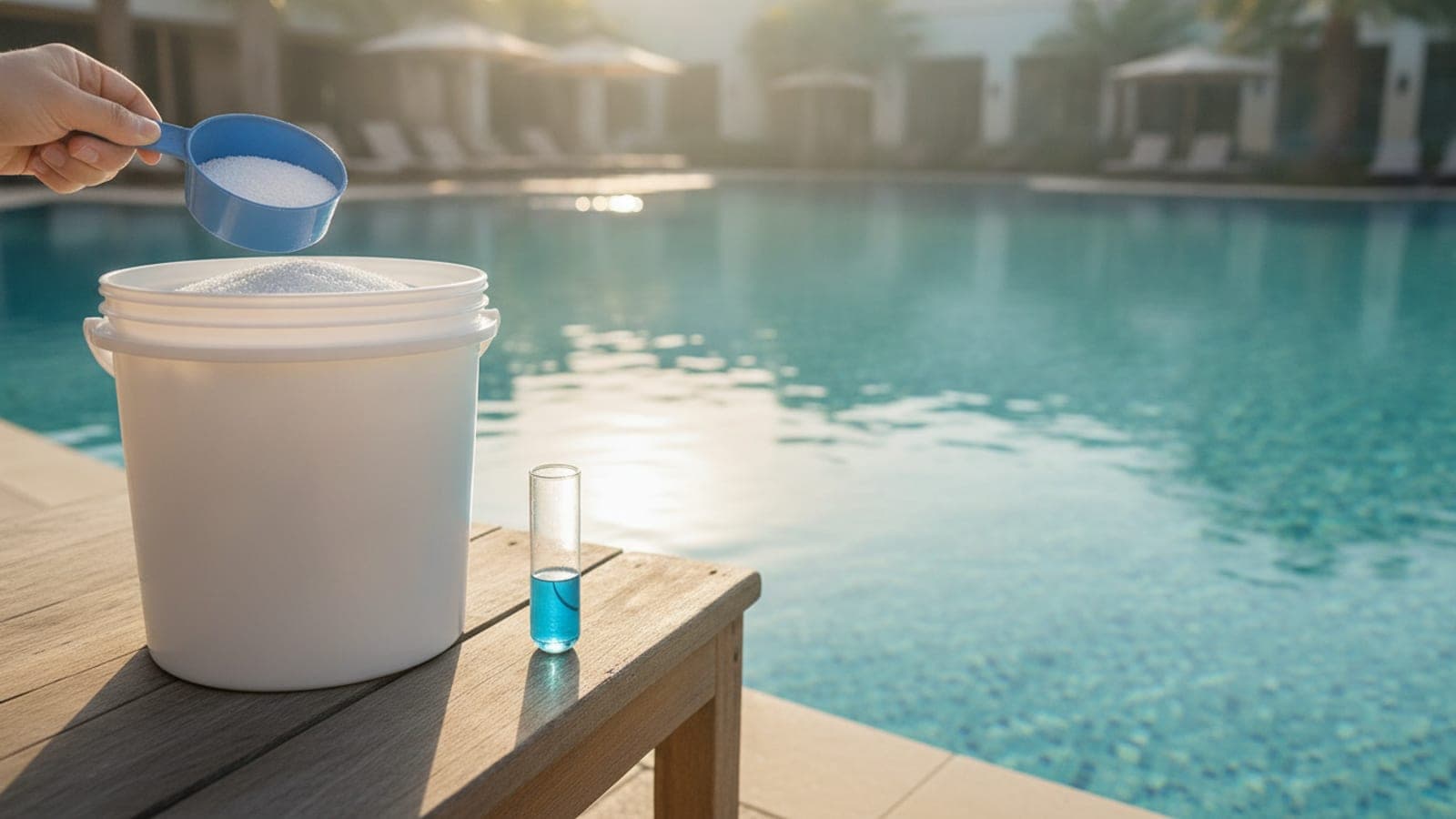
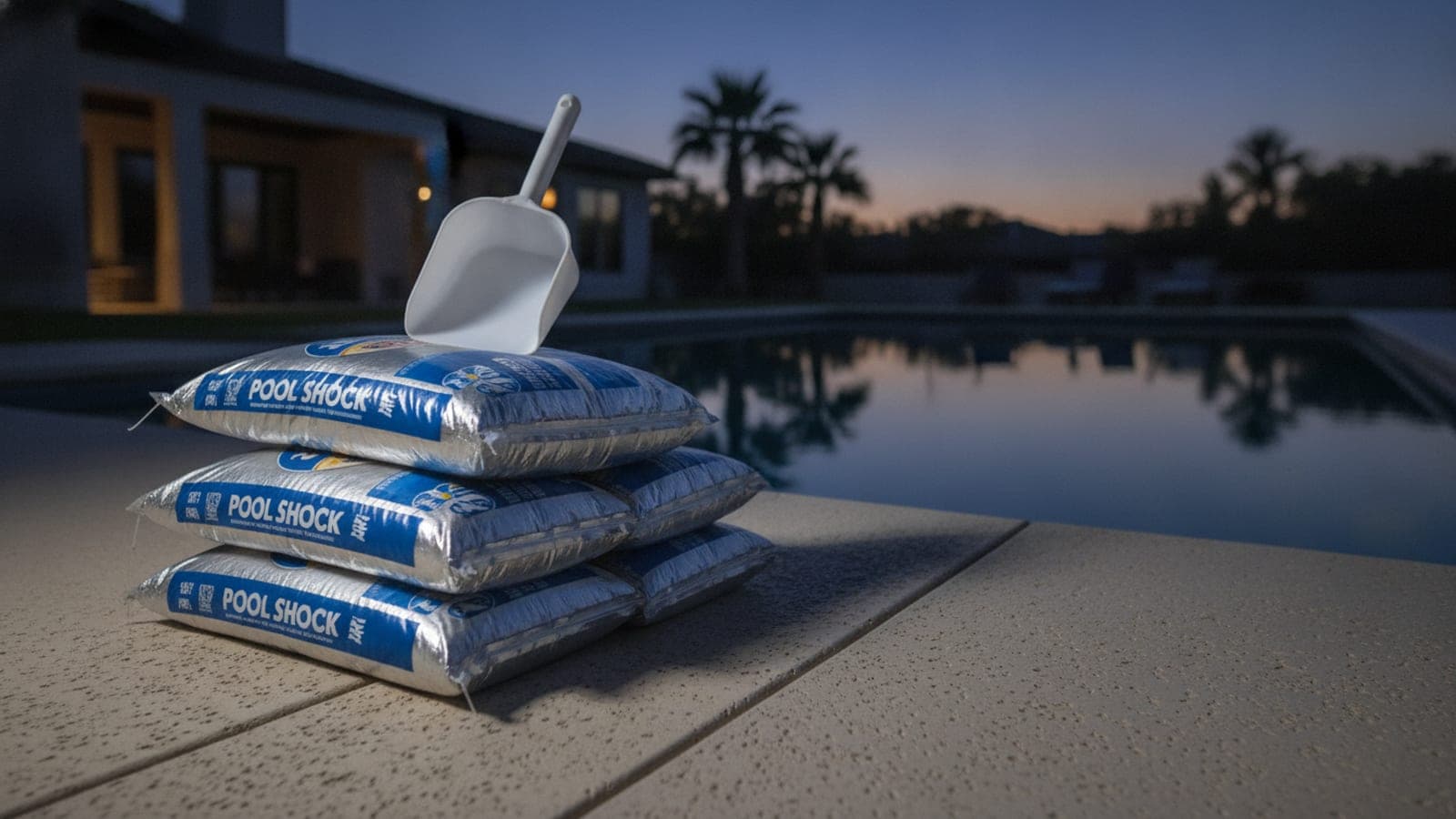
Use about 1.1 lbs of cal-hypo shock for a routine shock. Shock at dusk, run the pump overnight, and don't swim until free chlorine is back in range.
Treat this as a starting dose: add less than the full amount when unsure, circulate for a few hours, retest, repeat. Always follow your product's label.
A pool shock calculator estimates how much chlorine product you need to raise free chlorine from your current test result to a target level. It is useful because “one bag per pool” is not math. It is a guess wearing flip-flops.
Key takeaways
-
A shock calculator needs pool gallons, current free chlorine, target free chlorine, and product strength.
-
CDC recommends pH 7.0–7.8 and at least 1 ppm free chlorine in pools, or at least 2 ppm when cyanuric acid is used.
-
“Shock” means a treatment, not one exact chemical. Liquid chlorine, cal-hypo, dichlor, and non-chlorine oxidizers behave differently.
-
Always read the product label before dosing. Pool chemicals have safety rules, not vibes.
-
If the pool is green or cloudy, brushing and filtration matter as much as the shock dose.
How does the pool shock calculator work?
The calculator finds the gap between your current free chlorine and your target free chlorine, then converts that gap into a product dose based on pool gallons and product strength. The same 2 ppm increase takes twice as much chlorine in a 20,000-gallon pool as it does in a 10,000-gallon pool.
The calculator should not say “add one bag” unless the math actually points there. Bags come in different sizes. Liquid chlorine comes in different strengths. Some granular shock adds calcium. Some adds cyanuric acid. Some non-chlorine products oxidize waste but do not raise free chlorine the same way.
For the site, build the tool with these inputs:
| Input | Why it matters | Common user mistake |
|---|---|---|
| Pool gallons | Dose scales with water volume | Guessing the pool is 10,000 gallons because that sounds tidy |
| Current free chlorine | Shows where you are starting | Using total chlorine instead |
| Target free chlorine | Shows how much increase is needed | Picking a target without checking CYA or label guidance |
| Product type | Product strength changes the dose | Treating liquid chlorine and cal-hypo as interchangeable |
| Product strength | Determines the actual amount | Not reading the percentage on the label |
Link this calculator to the pool volume calculator because volume is where many bad shock doses are born. A pool that is 18,000 gallons but treated like 12,000 gallons is not being “careful.” It is being under-dosed with confidence.
What numbers do you need before shocking a pool?
Before shocking, test free chlorine, combined chlorine if your kit supports it, pH, and cyanuric acid. At minimum, get pool gallons and a current free chlorine result before you trust any dose.
CDC’s home pool guidance recommends pH from 7.0 to 7.8 and at least 1 ppm free chlorine in pools, or at least 2 ppm when cyanuric acid is used. That does not mean every shock target is 2 ppm. It means the water should not be treated like a mystery bucket. Read the CDC’s home pool water treatment guidance before turning the pool shed into a tiny laboratory.
Here is the practical testing order:
- Confirm the pump can run and water is circulating.
- Skim or rake out leaves and heavy debris.
- Test pH.
- Test free chlorine.
- Test cyanuric acid if you use stabilized chlorine or outdoor pool tabs.
- Confirm pool gallons with the pool volume calculator.
- Pick the product you actually have in your hand.
- Read the label before adding anything.
If the pH is far out of range, use the pool pH calculator first. Chlorine works better when pH is under control, and swimmers are happier when the water is not arguing with their eyes.
What target chlorine level should you use?
The target depends on why you are shocking, what sanitizer system you use, your cyanuric acid level, and the product label. A maintenance bump after heavy use is different from fighting a green pool.
Use these as decision buckets, not final label instructions:
| Situation | What the calculator should ask | Practical next step |
|---|---|---|
| After a pool party | Current free chlorine and target bump | Dose conservatively, circulate, retest |
| Cloudy water | pH, chlorine, filter condition | Diagnose before adding multiple products |
| Green pool | Volume, pH, chlorine, debris load | Brush, shock, filter, retest repeatedly |
| Combined chlorine problem | Free chlorine and combined chlorine | Follow product guidance for oxidation |
| Routine maintenance | Current chlorine and desired range | Avoid overcorrecting a pool that is already fine |
If you are clearing algae, the green pool cleanup guide should sit right below the calculator. It can explain the full process while the calculator handles the math.
The EPA notes that “shock treatment” and “super-chlorination” are commonly used for claims related to visible algae control. That matters because shock products are not just decorative pool-shelf confetti. Use registered products as labeled and avoid making up your own chemistry adventure.
Which shock product should you choose?
Choose the product based on the problem you are solving, your pool surface, your current chemistry, and the product label. The wrong product can fix one number while quietly annoying another.
| Product type | Best fit | Watch out for |
|---|---|---|
| Liquid chlorine | Quick chlorine boost, no added calcium or CYA | Strength varies, degrades over time, heavy jugs |
| Cal-hypo shock | Strong granular chlorine option | Adds calcium, can cloud temporarily, must be handled carefully |
| Dichlor shock | Stabilized chlorine option | Adds cyanuric acid, which can build up |
| Non-chlorine oxidizer | Oxidizing swimmer waste in some routines | Does not replace sanitizer in the same way chlorine does |
A useful affiliate module here is not “buy random shock.” It should show:
- Liquid chlorine or cal-hypo option.
- A proper test kit.
- Gloves and eye protection.
- A pool brush.
- A leaf rake if the water is green or swampy.
This gives the reader a real shopping list. Put the affiliate disclosure above it and label the links honestly. The reader should understand that the site may earn a commission, and they should still choose what fits their pool.
What should you buy before shocking the pool?
Before shocking a pool, buy the test kit and safety gear before the chemical pile. That sounds boring until you are standing beside green water wondering whether you need one pound, four pounds, or a priest.
What you need
- Full pool test kit: Needed for free chlorine, pH, and ideally CYA.
- Shock product or liquid chlorine: Match it to the calculator and product label.
- Chemical-resistant gloves: Useful when handling acid, chlorine, or granular products.
- Safety goggles: Not glamorous, but neither is a chemical splash.
- Pool brush: Algae sticks to surfaces. Brushing exposes it.
- Leaf rake: If there is debris on the floor, remove it before the filter has a nervous breakdown.
For maintenance supplies, send readers to /products/maintenance-supplies. For cloudy water, point them to how to clear cloudy pool water instead of pretending shock is the only move.
How do you shock a pool without making it worse?
Shock the pool by testing first, dosing from confirmed volume, adding product according to the label, circulating the water, brushing the surfaces, and retesting before swimming. The mistake is treating shock like a dramatic finale instead of one step in a cleanup process.
A sane process looks like this:
- Remove leaves and heavy debris.
- Empty baskets.
- Clean or backwash the filter if needed.
- Test pH and chlorine.
- Adjust pH first if it is far out of range.
- Use the calculator to estimate the dose.
- Add product according to the label, not internet folklore.
- Brush walls, steps, ladders, corners, and shady spots.
- Run the pump.
- Retest before anyone swims.
CDC’s pool chemical safety guidance and the EPA’s pool chemical storage alert both support the boring-but-important part: handle pool chemicals carefully, keep them dry, and do not mix incompatible products.
The pool will forgive many things. It will not forgive turning the equipment pad into a chemistry duel.
What should you do if the pool is still green or cloudy?
If the pool is still green or cloudy after shocking, do not automatically add more shock. First check whether the pool was brushed, the filter was cleaned, the pump ran long enough, and the water was retested.
Use this quick diagnosis:
| What happened | Likely meaning | Next move |
|---|---|---|
| Green became cloudy blue | Algae may be dead or dying | Keep filtering, brush, clean filter |
| Still bright green | Chlorine demand may still be high | Retest, brush, dose again if needed |
| Brown or tea-colored | Metals or debris may be involved | Stop guessing and test source water/metals |
| Clear but no chlorine holds | Sun, CYA, organics, or contamination may be consuming chlorine | Test CYA and combined chlorine |
| Cloudy after cal-hypo | Temporary clouding or high calcium/pH issue | Filter and test before adding clarifier |
The cloudy pool water guide should be the next internal link. It gives the reader another path instead of trapping them in the shock aisle forever.
What should the calculator show after the dose?
A good shock calculator should not just spit out ounces or pounds. It should explain the dose, show the assumptions, and tell the user what to do next.
The result box should include:
- Estimated product dose.
- Current chlorine.
- Target chlorine.
- Pool gallons used.
- Product type and strength used.
- Safety reminder to follow the product label.
- “Do not swim until test results and label guidance say it is safe.”
- Links to pH, volume, green pool, and cloudy water guides.
It should also show a warning when the user enters odd numbers. If someone enters 75,000 gallons for an above-ground pool or a current pH of 3.0, the calculator should pause and ask them to recheck the test. A helpful calculator catches the “wait, that cannot be right” moments.
That is how this page earns trust. It helps people dose better, buy only what they need, and stop playing chemical roulette with the backyard.
Frequently asked questions
How much shock do I need for my pool?
You need pool volume, current free chlorine, target free chlorine, and the strength of the shock product. The calculator estimates the dose, but the product label should control the final amount.
Can I swim right after shocking a pool?
No. Wait until the product label says swimming is allowed and the water tests back in the safe range. If free chlorine is still high, keep the pool closed and retest.
Is liquid chlorine the same as pool shock?
Liquid chlorine can be used for shock treatment, but shock is a treatment goal, not one exact product. Liquid chlorine, cal-hypo, dichlor, and non-chlorine oxidizers dose differently.
Should I shock a green pool once or more than once?
A green pool may need repeated testing, brushing, filtration, and chlorine additions. One bag tossed in once is often not enough if algae is active or the pool volume was guessed wrong.
Should I shock at night?
Many homeowners dose chlorine in the evening because sunlight can reduce chlorine faster during the day. The more important rule is to test, dose safely, circulate, and keep swimmers out until the water is safe.