Pool robot finder
Best match
Dolphin Nautilus CC Plus
Best overall for most in-ground pools
The default recommendation for in-ground pools up to 33 feet: reliable floor-and-wall cleaning, easy top-load filters, and Maytronics' service network behind it.
Read the review →Also consider
Dolphin Nautilus CC Plus Wi-Fi
Best proven midrange Dolphin
The proven Nautilus CC Plus with app control added: the popular midrange corded Dolphin, now with MyDolphin Plus scheduling.
Read the review →A good pool robot finder should not start with brands. It should start with your pool, your debris, your patience level, and what you secretly hate doing most. Then it should point you toward the right type of robotic cleaner before you compare exact models.
That is how you avoid buying a beautiful robot that is wrong for your pool. Pretty boxes are not pool maintenance plans.
Key takeaways
- Pool type, pool size, debris type, and wall-cleaning needs matter more than brand hype.
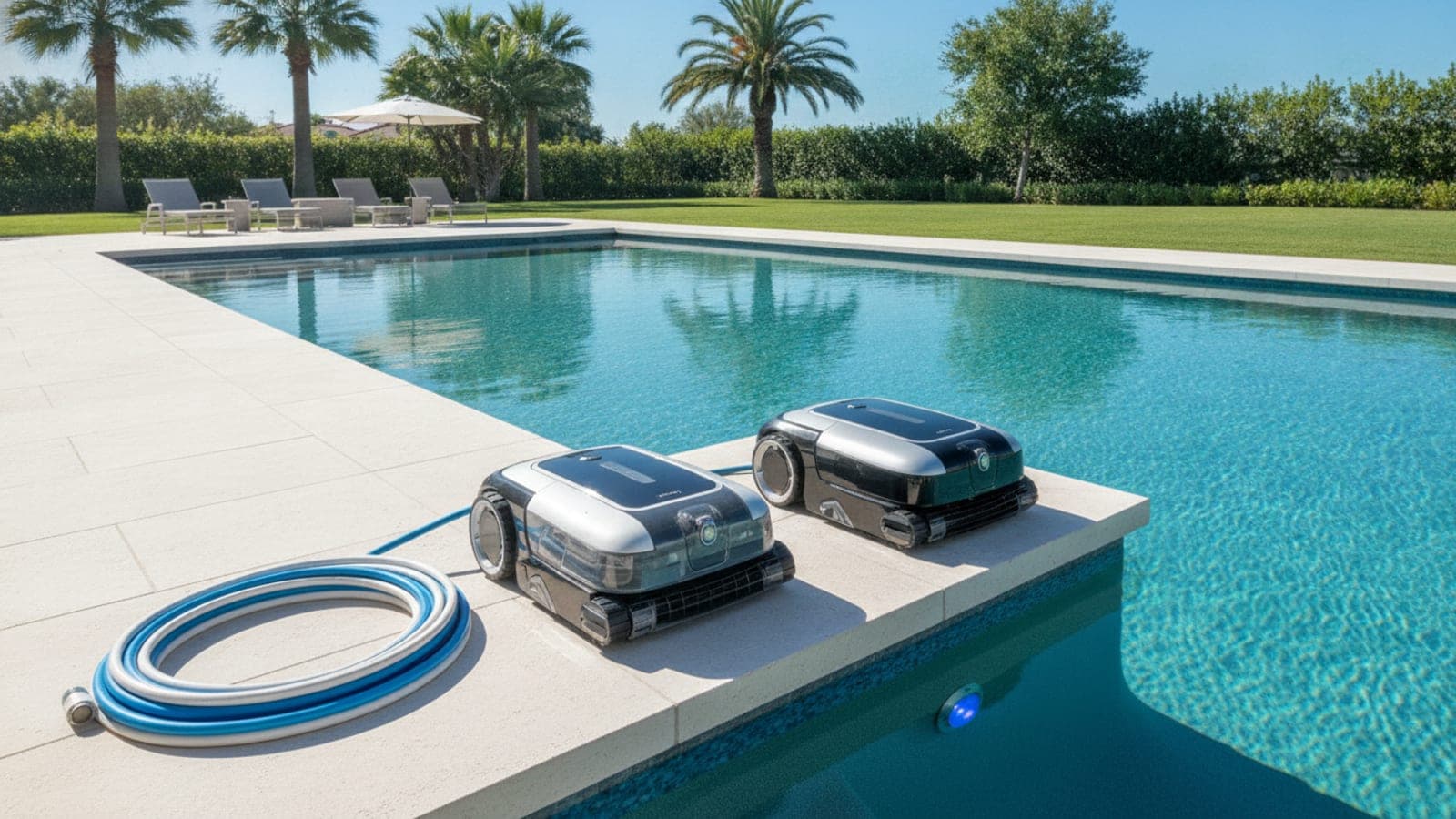
- Corded robots usually fit larger pools and long scheduled cleaning routines.
- Cordless robots usually fit owners who want easy drop-in cleaning and hate cables.
- Fine dirt, pollen, and dead algae require better filtration than leaves and bugs.
- The right quiz should recommend a category first, then specific models with clear tradeoffs.
Table of contents
- What should a pool robot finder ask first?
- How big is your pool?
- Is your pool above-ground or inground?
- What kind of debris are you fighting?
- Do you need walls and waterline cleaning?
- Should you choose corded or cordless?
- How much should budget shape the recommendation?
- What features sound fancy but may not matter?
- What should your result page include?
- What should you buy with a pool robot?
- What is the quick recommendation map?
What should a pool robot finder ask first?
A pool robot finder should ask about the pool before it asks about the product. The cleaner has to match the job. Otherwise you are just shopping by vibes, and vibes do not pick up acorns.
The quiz should ask:
- Is the pool above-ground or inground?
- What is the approximate pool size?
- What is the pool surface?
- Is the floor flat, sloped, or deep-ended?
- What debris causes the most trouble?
- Do walls need cleaning?
- Does the waterline need scrubbing?
- Do you prefer corded or cordless?
- How often will you run it?
- What budget range feels realistic?
That is enough to produce a useful recommendation without pretending the quiz knows the exact mood of your skimmer basket.
The output should not be one magical product. It should show three options:
- Best fit.
- Budget fit.
- Upgrade fit.
Each recommendation should explain what you gain and what you give up. That is where trust comes from.
How big is your pool?
Pool size decides how much cleaner you need. A small above-ground pool and a 40-foot inground pool should not receive the same recommendation just because both owners typed “pool robot.”
Use surface area or length if possible. Gallons help for chemistry, but robot coverage is more about floor area, shape, and cleaning path.
| Pool size | Good starting category | Watch out for |
|---|---|---|
| Small above-ground pool | Lightweight floor cleaner or cordless unit | Floor-only models may not clean walls |
| Medium above-ground pool | Cordless or light corded cleaner | Check liner compatibility |
| Small inground pool | Corded or cordless full-pool cleaner | Do not overpay for huge-pool features |
| Medium inground pool | Stronger robot with wall coverage | Compare filter and cycle options |
| Large inground pool | Corded or premium cordless with strong runtime | Battery limits and cord length matter |
If you do not know your pool volume, use the pool volume calculator. Volume is not the whole robot decision, but it helps you understand scale.
A robot rated for “up to 50 feet” may still be a bad fit if your pool has ledges, benches, a steep deep end, heavy leaves, and a drain cover that acts like a trap. Ratings are a starting point, not a personality test.
Is your pool above-ground or inground?
Above-ground and inground pools create different robot problems. Above-ground owners often need simple floor cleaning. Inground owners are more likely to care about walls, waterline, slopes, steps, and bigger debris loads.
For above-ground pools, look closely at:
- Flat-floor compatibility.
- Vinyl liner friendliness.
- Weight for lifting over the wall.
- Cord length or battery runtime.
- Whether it can handle coves or slight slopes.
- Easy basket cleaning.
For inground pools, look closely at:
- Wall climbing.
- Waterline scrubbing.
- Deep-end performance.
- Surface compatibility.
- Navigation quality.
- Fine filter options.
- Cable swivel or battery runtime.
Some above-ground robots are intentionally simple. That can be good. You may not need a wall-scrubbing robot with app scheduling if your real problem is bugs and leaves on a flat floor.
Some inground pools need more. If the waterline gets grimy, a floor-only robot will not fix it no matter how enthusiastically the product page smiles.
What kind of debris are you fighting?
Debris type may be the most underrated question in the whole pool robot finder. Leaves and pollen are not the same problem. Sand and acorns are not the same problem. Dead algae is a special little nuisance.
Match the cleaner to the junk:
| Main problem | What to prioritize | Why |
|---|---|---|
| Leaves | Larger basket and wide intake | Small baskets fill quickly |
| Acorns or seed pods | Strong intake and durable basket | Heavy debris can jam weak cleaners |
| Sand or fine dirt | Fine or ultra-fine filters | Standard filters may miss it |
| Pollen | Fine filter and frequent rinsing | Pollen clogs filters fast |
| Dead algae | Water chemistry first, fine filtration second | Robots collect debris, they do not sanitize |
| Bugs | Surface skimmer or floor cleaner depending where bugs collect | Bugs do not read the manual |
If your pool turns green first, do not buy a robot and expect it to act like chlorine with wheels. Use the green pool cleanup guide and fix the water.
If the water is clear but the floor is dirty, a robot can help a lot.
Do you need walls and waterline cleaning?
You need wall and waterline cleaning if the pool walls get film, algae dust, oily residue, sunscreen buildup, or a visible scum line. If the floor is the only dirty surface, you may not need to pay for full wall coverage.
There are three levels to compare:
- Floor only: Cleans the bottom, usually simpler and cheaper.
- Floor and walls: Climbs vertical surfaces but may not scrub the waterline aggressively.
- Floor, walls, and waterline: Best for pools with visible waterline grime.
Do not assume wall climbing means waterline scrubbing. Some robots climb. Some scrub. Some do both. Some try their best and then slowly slide down like a tired raccoon.
If wall cleaning matters, read the pool robot not climbing walls guide so you know what maintenance affects wall performance.
Should you choose corded or cordless?
Choose corded if you want dependable long cleaning cycles and do not mind managing a cable. Choose cordless if cable handling would make you avoid using the cleaner.
The quiz should ask this directly because owner behavior matters. A technically better robot that never leaves the shed is not better.
| Your answer | Better recommendation |
|---|---|
| “I want scheduled cleaning several times per week” | Corded or premium cordless with scheduling |
| “I hate cables and want simple drop-in cleaning” | Cordless |
| “My pool is large and gets heavy debris” | Usually corded |
| “My pool is small and easy to access” | Cordless or compact corded |
| “I forget to charge things” | Corded, please be honest |
For a deeper comparison, use corded vs cordless pool robots. That page should link back to the finder so readers can make the decision both ways.
How much should budget shape the recommendation?
Budget matters, but it should not be the first question. A cheap robot that cannot clean your pool is not a bargain. It is just a slower way to become annoyed.
A useful pool robot finder should sort budget after need:
- Required pool type.
- Required pool size.
- Required cleaning coverage.
- Required debris handling.
- Then budget.
That prevents silly recommendations. For example, if someone has a large inground pool with waterline grime and heavy leaves, the quiz should not recommend a tiny floor-only budget robot just because the price is cute.
Use budget bands like:
| Budget band | Reasonable expectation |
|---|---|
| Entry level | Floor cleaning, smaller pools, fewer extras |
| Midrange | Better filtration, more coverage, stronger routine cleaning |
| Premium | Better navigation, app features, waterline options, larger-pool fit |
| Very premium | Advanced features that may or may not matter to your pool |
The key is to explain tradeoffs. “Budget pick” should not mean “secretly perfect.” It means “good enough for the right pool.”
What features sound fancy but may not matter?
Some features are useful. Some are nice. Some mostly decorate the spec table.
Useful features for many owners:
- Easy-clean filter basket.
- Fine filter option.
- Wall cleaning if needed.
- Waterline cleaning if needed.
- Good weight and handle design.
- Replacement parts availability.
- Clear warranty.
Features that depend on the owner:
- App control.
- Wi-Fi.
- Cleaning schedules.
- Multiple cleaning modes.
- Remote steering.
- Water temperature display.
- Fancy notifications.
App control is great if you use it. It is not great if the robot misses leaves because the filter is wrong. Start with cleaning performance, then enjoy the gadgets.
Also check the manual. Manufacturer manuals often contain the practical details that retailer blurbs skip: charging rules, storage temperature, safe use warnings, filter cleaning, and maintenance steps.
What should your result page include?
The result page should feel like a helpful recommendation, not a trap door into affiliate buttons. It should explain why each cleaner type fits and what the buyer should double-check.
Each result should include:
- Recommended category.
- Three product cards.
- Best fit, budget fit, and upgrade fit.
- Why each was recommended.
- What each may not do well.
- Pool-size compatibility.
- Debris match.
- Corded or cordless note.
- Filter note.
- Warranty/return reminder.
- Amazon and specialty retailer buttons.
The affiliate buttons should be obvious, but the reasoning should come first. People click more confidently when they understand the recommendation.
Example result
| Quiz answer pattern | Recommended cleaner type | Why |
|---|---|---|
| Small above-ground, light leaves, hates cables | Cordless floor cleaner | Easy handling matters most |
| Medium inground, fine dirt, walls dirty | Full-pool robot with fine filters | Filtration and walls matter |
| Large inground, heavy leaves, frequent cleaning | Strong corded robot | Runtime and basket capacity matter |
| Pool with waterline scum | Waterline-capable robot | Floor-only cleaner will disappoint |
That is useful. “Here are five popular robots” is not.
What should you buy with a pool robot?
A cleaner needs the right support gear. Otherwise you buy the robot and then discover the filter basket is not the one you needed.
What you need
- Fine or ultra-fine filter panels for pollen, sand, and dead algae.
- Standard debris basket for leaves and bugs.
- Robot caddy for heavier or corded cleaners.
- Retrieval hook for cordless models if compatible.
- Replacement brushes or tracks for long-term ownership.
- A proper pool test kit so you are not blaming the robot for chemistry problems.
Affiliate note: Place product cards here based on quiz results. Each card should have “Shop Amazon” and “Shop Specialty Retailer” buttons with a disclosure above the module.
What is the quick recommendation map?
Use this quick map when you do not want to overthink it.
| Pool situation | Start here |
|---|---|
| Small above-ground pool | Lightweight cordless or compact floor robot |
| Large above-ground pool | Stronger above-ground-compatible robot |
| Small inground pool | Midrange corded or cordless full-pool cleaner |
| Large inground pool | Strong corded or premium cordless cleaner |
| Heavy leaves | Large basket and strong intake |
| Fine dirt or pollen | Fine filter support |
| Dirty walls | Wall-climbing model |
| Waterline ring | Waterline-scrubbing model |
| Hate cords | Cordless |
| Hate charging | Corded |
| Main drain obstacle | Obstacle handling and clearance matter |
The Pool Robot Finder should make this feel easy. Not dumbed down. Easy. There is a difference.
A good recommendation does not say, “This is the best robot for everyone.” It says, “For your pool, this is the kind of cleaner that makes sense, here are the tradeoffs, and here is what to check before you buy.”
Frequently asked questions
How does the Pool Robot Finder choose a cleaner?
It should match your pool type, size, surface, main debris problem, wall and waterline needs, cord preference, cleaning frequency, and budget to cleaner categories instead of pushing one random model.
What is the most important pool robot feature?
The most important feature is fit. A cleaner must match your pool size, pool surface, debris type, and cleaning expectations before app control or fancy extras matter.
Do I need a wall-climbing pool robot?
You need wall climbing if your walls get visible dirt, algae film, or waterline buildup. If your pool floor is the only problem, a floor-focused robot may be enough.
Should I choose corded or cordless?
Choose corded for larger pools and longer repeat cleaning. Choose cordless if cable handling would stop you from using the robot regularly.
What should I check before buying a pool robot?
Check pool-size rating, cleaning coverage, filter type, cord or battery details, weight, warranty, return policy, and whether replacement filters and brushes are easy to buy.