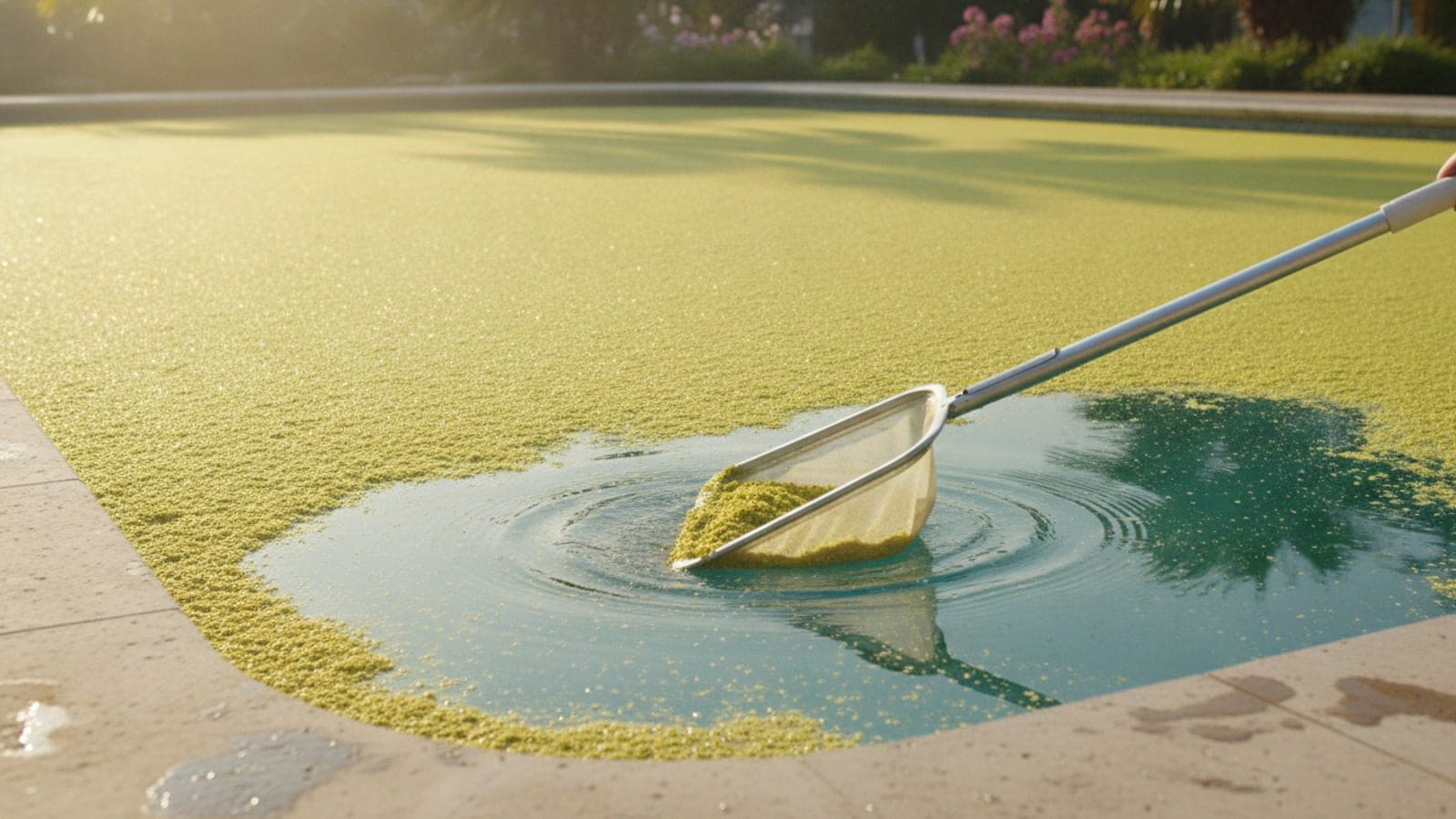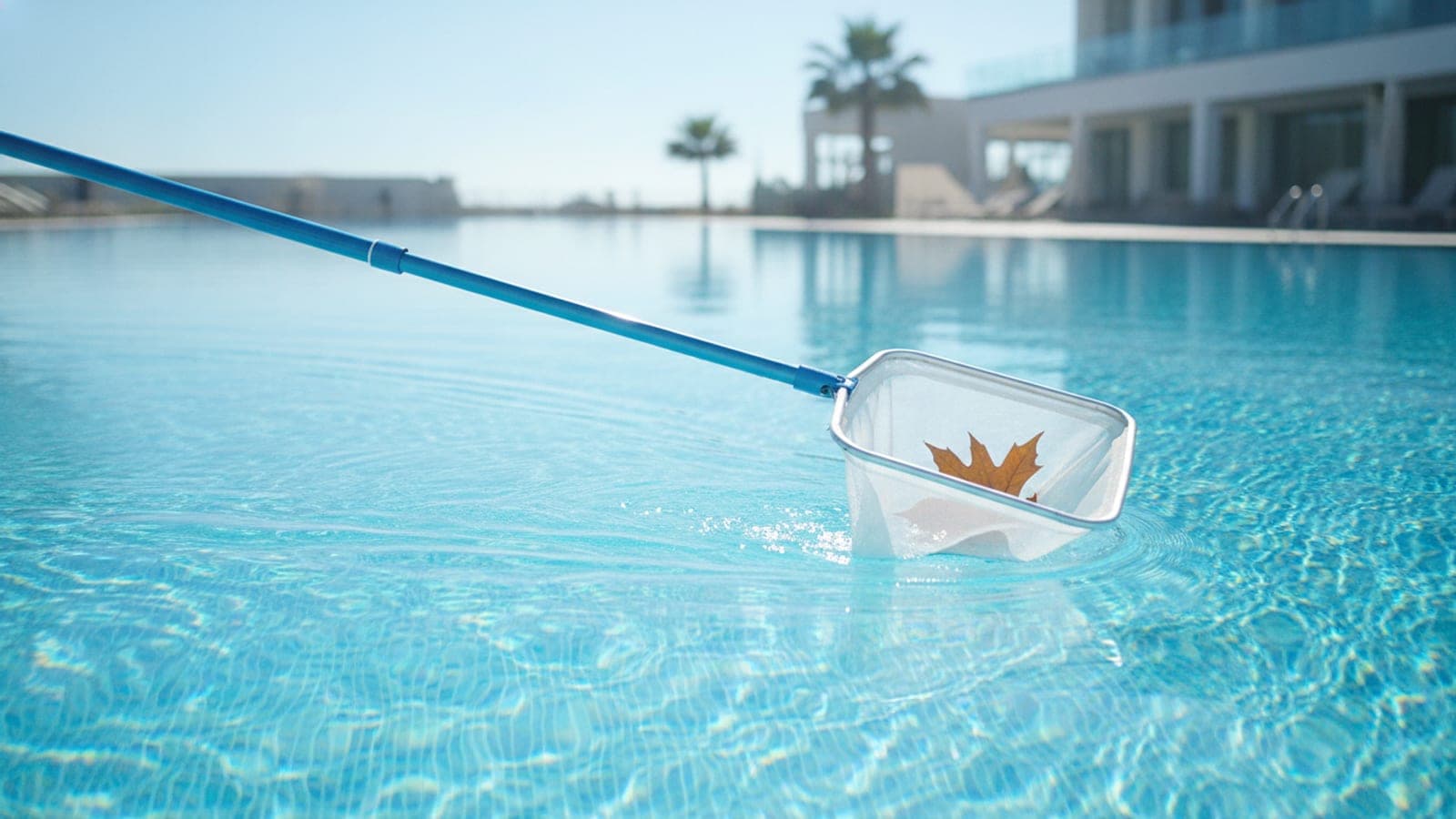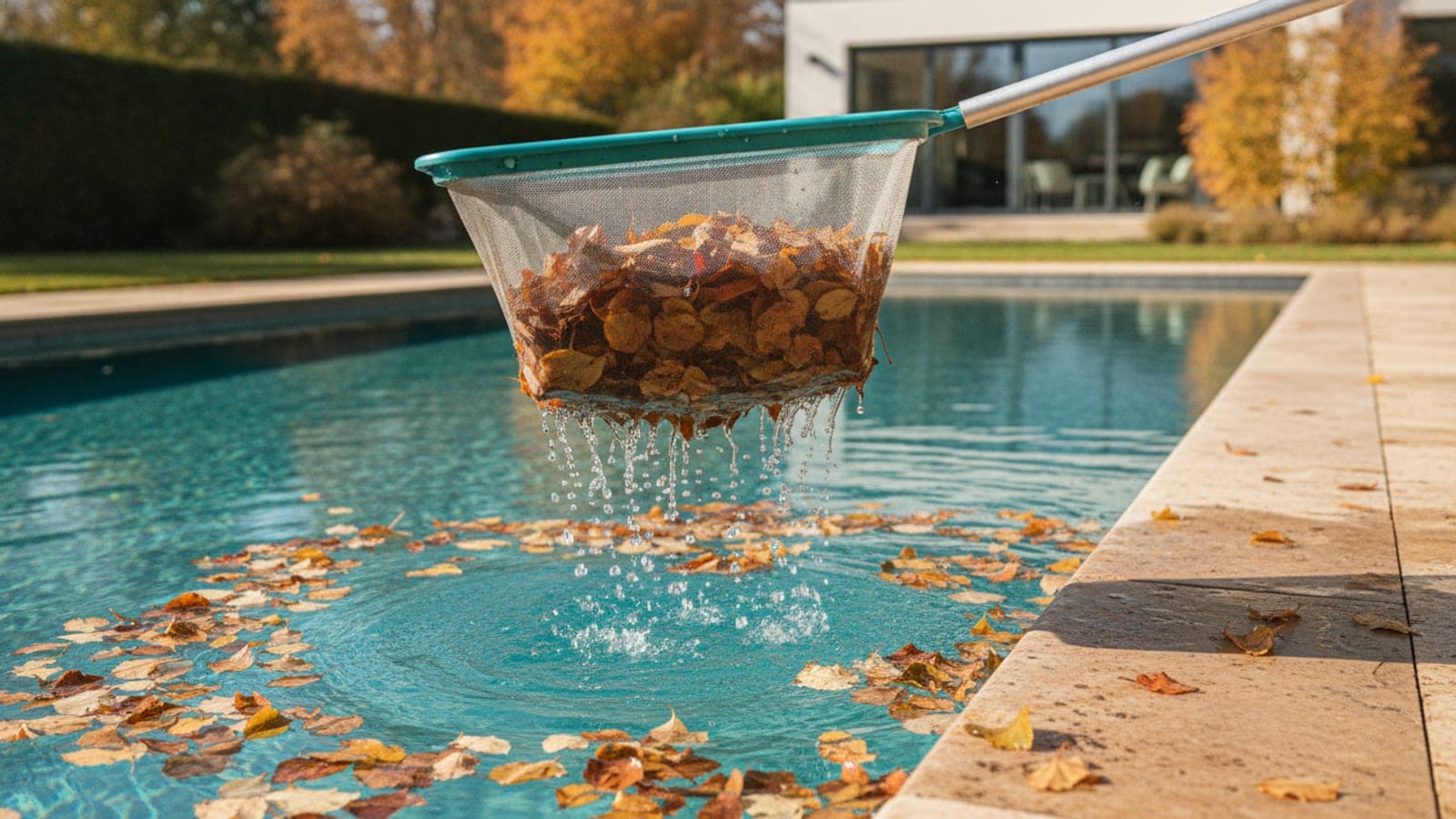
How to clean leaves out of pool water without making it worse starts with removing the big stuff before it sinks, clogs baskets, or stains the surface. Use a deep leaf rake for piles, a flat skimmer for floating leaves, and filtration only after you have taken the heavy debris load off the system.
Leaves are not just ugly. They break down, release tannins, clog baskets, feed cloudy water, and turn a clear pool into something that looks like it was brewed behind a gas station.
Key takeaways
- Remove floating leaves first, then scoop bottom piles, then run the filter.
- Use a deep leaf rake for heavy leaves instead of forcing the pump and filter to handle everything.
- Empty skimmer and pump baskets often during cleanup because flow drops fast when leaves pack in.
- Test the water after a big leaf event before adding shock, clarifier, or other chemicals.
- If leaves are a weekly battle, consider a better skimmer setup, a leaf-focused robot, or a cover strategy.
Table of contents
- What is the fastest way to clean leaves out of a pool?
- Should you remove floating leaves or bottom leaves first?
- What tools work best for leaves?
- Can a robotic pool cleaner handle leaves?
- How do you protect the pump and filter during leaf cleanup?
- Can leaves stain the pool?
- Should you shock the pool after a leaf storm?
- How do you keep leaves from coming back?
- What should you buy for leaf season?
- What is the leaf cleanup routine?
What is the fastest way to clean leaves out of a pool?
The fastest way to clean leaves out of a pool is to remove them in layers: floating debris first, sunken piles second, baskets third, filtration last. If you start by running the system hard while the pool is full of leaves, you can clog the easy parts and stress the expensive parts.
Start with the surface. Leaves that are still floating are the cheapest leaves to remove. Once they sink, they get wetter, heavier, and more likely to stain or collect in corners.
Then use a deep leaf rake for the floor. Keep the net open, push it slowly along the surface, and scoop under the pile. Do not jab at the leaves like you are angry at a salad.
After the big debris is gone, empty baskets and run the pump/filter. That is when circulation helps clear the smaller pieces that escaped the net.
A good fast cleanup looks like this:
- Turn off automatic cleaners if they are in the way.
- Skim floating leaves.
- Scoop bottom piles with a deep leaf rake.
- Empty the skimmer basket.
- Empty the pump basket if it is loaded.
- Brush steps, corners, and benches.
- Run filtration.
- Test the water.
- Adjust chemistry from test results.
For the hand-net part, read how to skim a pool. It covers how to work with wind and surface flow instead of chasing leaves in circles.
Should you remove floating leaves or bottom leaves first?
Remove floating leaves first unless there is already a thick pile on the floor that could stain. Floating leaves are easier to catch and have not yet become a heavier bottom problem.
Use this decision table:
| Leaf situation | First move | Why |
|---|---|---|
| Light leaves on surface | Flat skimmer net | Fast and simple |
| Heavy floating leaves | Deep leaf rake at surface | Holds more debris |
| Bottom piles | Deep leaf rake | Prevents staining and clogging |
| Leaves in steps | Hand net plus brush | Steps trap debris |
| Leaves in skimmer throat | Clear basket and opening | Restores surface pull |
| Green or cloudy water too | Remove leaves, then test | Chemistry depends on actual readings |
If leaves are both floating and sitting on the floor, do a quick surface pass first. Then attack the piles. Otherwise, the floating leaves will keep sinking while you work.
Wind matters too. If one side of the pool is collecting leaves, start there. If the return jets are pushing leaves toward the skimmer, let that happen and clean the basket often.
What tools work best for leaves?
The best tool for leaves is a deep bag leaf rake on a sturdy telescoping pole. A flat skimmer net is helpful, but it fills too quickly during real leaf season.
Here is the practical tool list:
- Deep bag leaf rake: Best for heavy leaves and sunken piles.
- Flat skimmer net: Good for light surface passes.
- Leaf vacuum: Helpful for larger pools or recurring leaf piles.
- Manual vacuum: Better after big debris has been removed.
- Robotic cleaner with large basket: Useful for routine leaf control.
- Robotic surface skimmer: Helps catch leaves before they sink.
- Skimmer socks: Useful for smaller leaf bits and pollen, but clog fast.
A deep leaf rake is the first buy because it solves the ugly problem. A robotic cleaner is the convenience buy because it keeps the problem from becoming ugly as often.
Do not expect a tiny fine-mesh net to handle wet leaf piles. It may catch them, but it will drag, bend, and make you question your hobbies.
Can a robotic pool cleaner handle leaves?
A robotic pool cleaner can handle leaves if it has the right basket, intake size, and cleaning path for your pool. But it should not be your first tool after a major storm.
Robots are good at maintenance. They are less charming when asked to eat a whole tree.
Look for these features if leaves are your main problem:
- Large debris basket.
- Wide intake opening.
- Easy top-loading basket.
- Standard and fine filter options.
- Strong floor coverage.
- Wall cleaning if leaves stick around steps and slopes.
- Easy basket rinse.
- Good retrieval handle.
If your pool gets big leaves, seed pods, acorns, or palm debris, read product specs carefully. “Cleans debris” is not enough. You want to know what kind of debris the basket is built to handle.
This article should internally support best robotic pool cleaners for leaves. That future page should compare models by basket size, intake design, filter options, weight, and ease of cleaning, not just star ratings.
How do you protect the pump and filter during leaf cleanup?
Protect the pump and filter by removing large debris manually before running long filtration cycles. The skimmer and pump baskets are there to catch debris, but they are not meant to be ignored while packed full.
During heavy cleanup, check baskets more than once. A skimmer basket can fill quickly when leaves are being pulled across the surface. A pump basket can also load up if debris slips past the skimmer.
Signs the system is struggling:
- Weak return flow.
- Skimmer stops pulling strongly.
- Pump sounds different.
- Pump basket looks packed.
- Pressure rises on the filter.
- The robot loses suction or fills quickly.
- Debris keeps floating because water movement is poor.
If pressure rises after cleanup, follow your filter type’s maintenance instructions. Cartridge filters may need rinsing. Sand filters may need backwashing if your system calls for it. DE filters have their own rules. Do not treat every filter the same.
ENERGY STAR notes that certified pool pumps can save energy compared with standard pumps, but even an efficient pump needs clear baskets and proper flow. A clogged basket can make a good pump look lazy.
Can leaves stain the pool?
Leaves can stain a pool if they sit on surfaces long enough, especially on steps, corners, benches, and light-colored finishes. The risk grows when wet leaves pile up and organic material stays in one spot.
Organic stains often look brownish, tea-colored, or shadowy. They may show up where leaves sat against the surface. Brushing early helps. Removing the pile early helps more.
If you see a fresh leaf mark:
- Remove all debris.
- Brush the area.
- Test the water.
- Balance pH and sanitizer.
- Give circulation time.
- Avoid adding random stain products before identifying the stain type.
Not every mark is a leaf stain. Metals, algae, dirt, scale, and surface wear can all look suspicious. If the mark does not respond to normal cleaning and balanced water, slow down before buying stain chemicals.
Should you shock the pool after a leaf storm?
You should shock only when testing and water condition say it is needed. Heavy leaves can consume chlorine, but adding shock blindly can waste money and create new problems.
Test these first:
- Free chlorine.
- Combined chlorine if your kit measures it.
- pH.
- CYA/stabilizer.
- Water clarity.
- Filter pressure or flow.
CDC guidance for home pools includes pH between 7.0 and 7.8 and minimum chlorine guidance, with higher minimum free chlorine when cyanuric acid is used. That is a testing conversation, not a guessing conversation.
Use the pool shock calculator only after you know pool volume and current readings. If you do not know volume, use the pool volume calculator first.
Chemical safety matters here. EPA and CDC both warn about pool chemical storage and handling risks. Add chemicals according to the product label, keep products dry and separate, and do not mix chemicals in a bucket unless the label specifically directs it.
How do you keep leaves from coming back?
You cannot stop trees from being trees, but you can reduce how many leaves become pool problems. The goal is to catch leaves before they sink and to make cleanup predictable.
Practical prevention options:
- Trim problem branches where appropriate.
- Use a pool cover during heavy leaf windows.
- Empty skimmer baskets daily during peak season.
- Aim return jets to improve surface movement.
- Use a robotic surface skimmer for daily debris.
- Run a leaf-focused robot before debris piles up.
- Keep a deep rake nearby instead of buried in the garage.
A pool cover can help during storms or seasonal leaf drops, but it also has to be removed, cleaned, stored, and managed safely. Read is a pool cover worth it before assuming it solves everything.
What should you buy for leaf season?
For leaf season, buy the simple tools first: a strong pole, a deep leaf rake, and a reliable skimmer net. Upgrade to a robotic cleaner or robotic skimmer if leaves are constant, not occasional.
What you need
- Deep bag leaf rake: The main tool for big leaf loads.
- Flat skimmer net: Quick surface passes before leaves sink.
- Telescoping pole: Strong enough for wet leaves.
- Skimmer basket socks: Good for fine debris after leaf cleanup.
- Pool brush: Moves leaves and stains from steps and corners.
- Leaf canister or leaf vacuum: Helpful for certain vacuum setups.
- Robotic pool cleaner for leaves: Worth comparing if manual cleanup is constant.
- Robotic surface skimmer: Helps catch debris before it becomes bottom debris.
[Affiliate product module: deep leaf rakes, telescoping poles, leaf vacuums, robotic leaf cleaners, robotic skimmers, filter baskets]
Make the product module situational. A homeowner with two maple trees needs a different kit than someone with one sad leaf drifting in every Thursday.
What is the leaf cleanup routine?
The best leaf cleanup routine is quick, boring, and repeated before the leaves sink. The longer leaves sit, the more you deal with staining, cloudy water, clogged baskets, and extra chemical demand.
Use this routine:
- Skim floating leaves as soon as practical.
- Scoop sunken piles with a deep rake.
- Empty skimmer and pump baskets.
- Brush steps and corners.
- Run filtration.
- Clean or backwash the filter if pressure/flow says to.
- Test the water.
- Adjust chemistry based on readings.
- Run the robot for leftovers if appropriate.
- Recheck the next day if the storm was heavy.
The best time to remove leaves is before they become tea. The second-best time is before the pump basket looks like a compost bin.
Frequently asked questions
What is the best way to clean leaves out of a pool?
The best way to clean leaves out of a pool is to remove floating leaves first with a skimmer net, scoop bottom piles with a deep leaf rake, empty baskets often, then run filtration after the large debris is out.
Can I use my pool robot to clean lots of leaves?
You can use a pool robot for leaves if it has a large basket and wide intake, but remove heavy piles manually first. A robot should not be treated like a storm-debris dumpster.
Will leaves stain my pool?
Leaves can contribute to organic staining if they sit on surfaces long enough, especially on steps, corners, and light-colored finishes. Remove piles quickly and brush affected areas.
Should I shock the pool after removing leaves?
Test first. Heavy leaf debris can consume chlorine, but the right dose depends on pool volume, free chlorine, combined chlorine, pH, CYA, and water condition.
How do I keep leaves out of the pool?
Use a cover when practical, trim problem branches where appropriate, empty skimmer baskets often, aim returns to improve surface movement, and consider a robotic skimmer or leaf-focused pool robot.