How to clean pollen from pool water is a two-part job: remove what is floating, then filter what is too fine for a normal net. Skim first, use fine filtration, brush the waterline, run the pump, and test the water before reaching for clarifier or shock.
Pollen is sneaky because it looks like dust, algae, dirt, or somebody sprinkled yellow cake mix across the water. The fix is not to panic. The fix is to figure out whether it is floating pollen, settled pollen, cloudy water, or algae pretending to be pollen.
Key takeaways
- Pollen often floats, gathers near the waterline, or collects where wind pushes surface debris.
- A normal pool net may miss pollen, so fine mesh, skimmer socks, and good filtration matter.
- Brush steps, corners, and the waterline because pollen can stick where water movement is weak.
- Test the water before adding shock or clarifier, because pollen is not always a chemistry problem.
- If the “pollen” keeps coming back on shaded surfaces, check for mustard algae instead.
Table of contents
- What is the best way to clean pollen from a pool?
- How do you tell pollen from algae?
- Should you skim pollen or filter it?
- Do skimmer socks work for pollen?
- Can a pool robot pick up pollen?
- Should you use clarifier?
- What if pollen keeps coming back every day?
- What should you buy for pollen season?
- How does pollen connect to cloudy water?
- What is the simple pollen cleanup routine?
What is the best way to clean pollen from a pool?
The best way to clean pollen from a pool is to skim the surface, improve fine filtration, brush sticky areas, and keep circulation moving long enough to catch what your net cannot. Pollen is light and fine, so brute force is not the move.
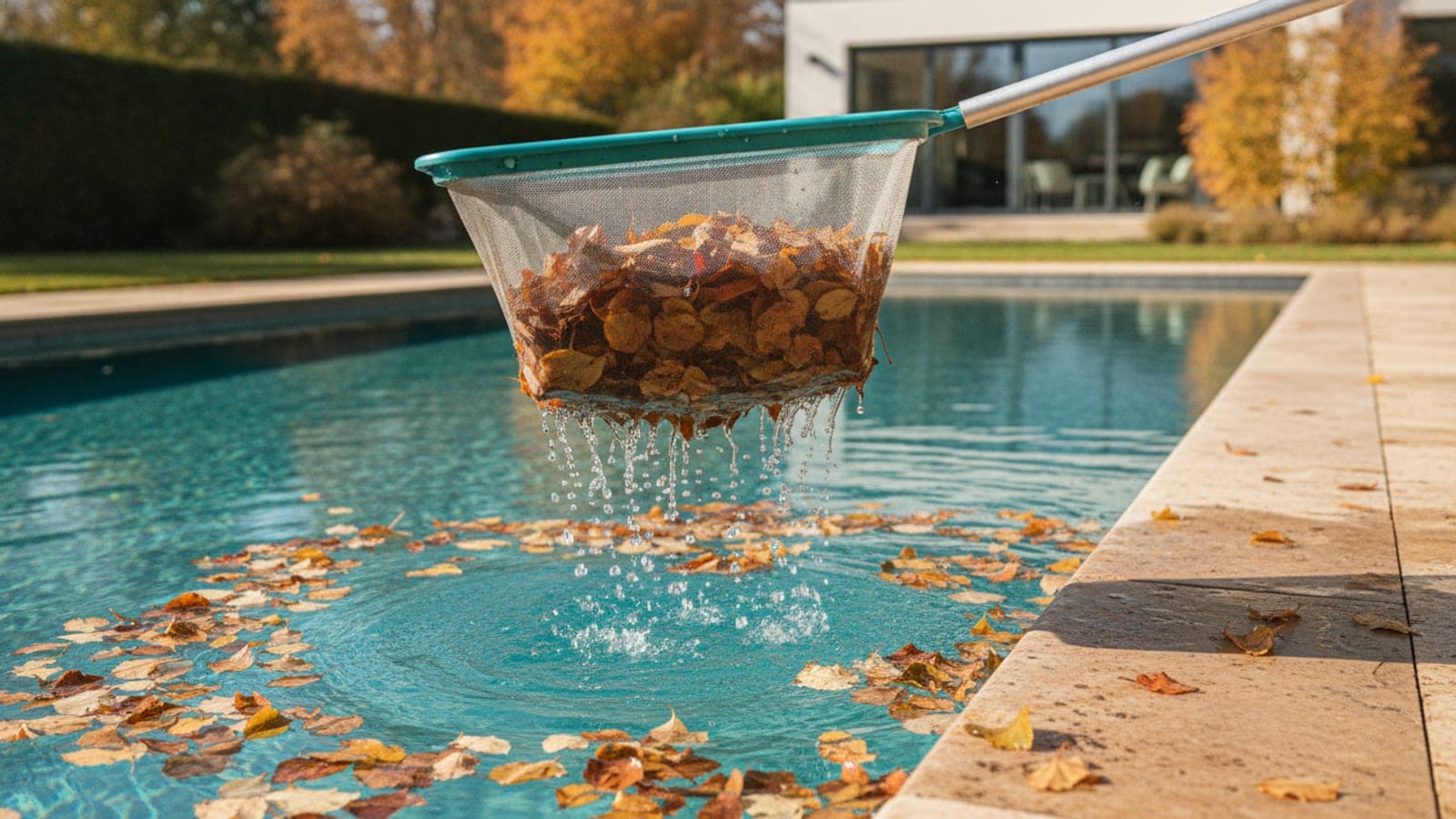
Start with the visible layer. If yellow dust is floating on top, skim slowly with a fine mesh net. If your net is too coarse, you may just stir the pollen around and feel betrayed by a stick.
Then use filtration. Skimmer socks can catch fine debris before it reaches the filter. Cartridge filters, sand filters, and DE filters all handle fine particles differently, so watch pressure and flow.
Use this order:
- Skim the surface with a fine mesh net.
- Empty skimmer and pump baskets.
- Add skimmer socks if your system can use them safely.
- Brush the waterline, steps, and corners.
- Run the pump/filter.
- Clean the filter when pressure or flow says it is time.
- Test pH and sanitizer.
- Use clarifier only if filtration and chemistry call for it.
CDC guidance for home pools focuses on maintaining proper disinfectant and pH, including pH between 7.0 and 7.8. That matters because a clean-looking surface does not prove the water is properly sanitized.
How do you tell pollen from algae?
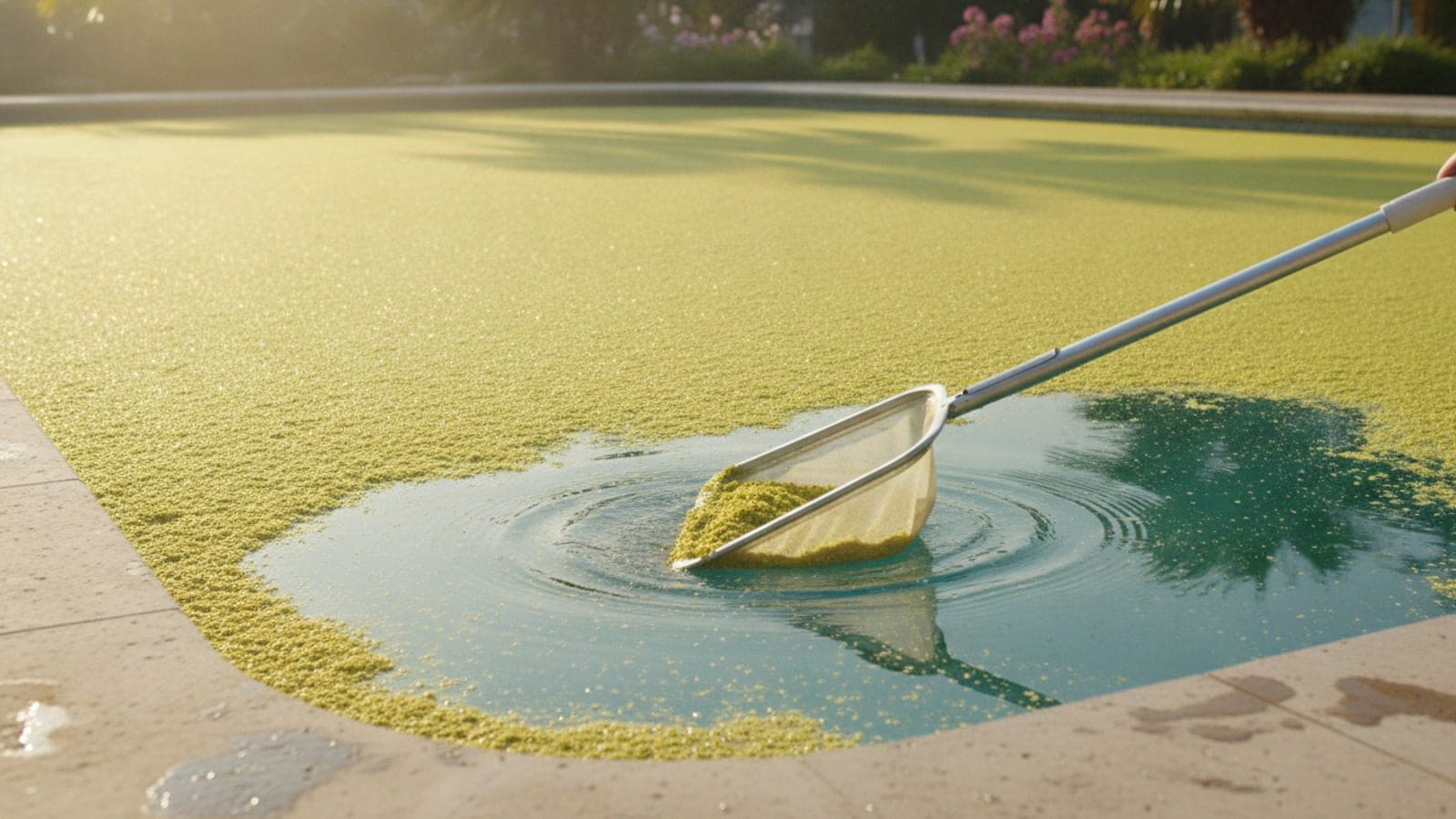
Pollen usually appears after seasonal blooms, floats on the surface, and gathers along the waterline or in wind-driven corners. Algae is more likely to cling to surfaces, feel slimy, and return after brushing when sanitizer, circulation, or filtration is weak.
Use this table before you start dumping products into the water:
| Sign | More likely pollen | More likely algae |
|---|---|---|
| Appears after trees/flowers bloom | Yes | Not necessarily |
| Floats like dust on surface | Yes | Sometimes, but less typical |
| Gathers at waterline | Yes | Can happen |
| Clings to shaded walls | Less likely | More likely |
| Feels slimy | No | Often |
| Returns after brushing same spots | Maybe, if still falling | Yes, if not treated |
| Water tests poorly | Could be unrelated | Often part of the problem |
Mustard algae can look yellowish or dusty, so do not rely on color alone. Look at behavior. Pollen drifts. Algae grows.
If the water is cloudy, greenish, or the yellow stuff returns in patches on shaded surfaces, read how to clear cloudy pool water and pool chemistry basics before assuming it is only pollen.
Should you skim pollen or filter it?
You should do both. Skimming removes the floating layer, while filtration catches fine particles that are suspended in the water or too small for a normal net.
A standard skimmer net is not always fine enough. If pollen slips through, use a finer mesh net or let the circulation system carry the particles to the filter.
The right approach depends on where the pollen is:
| Pollen location | Best first move | Follow-up |
|---|---|---|
| Floating on surface | Fine mesh skimming | Skimmer sock and pump run |
| At waterline | Brush and skim | Filter run and basket check |
| Suspended in water | Filtration | Test and clean filter as needed |
| On pool floor | Robot or vacuum | Fine filter cleaning |
| In steps/corners | Brush toward circulation | Skim and filter |
Do not brush everything first if the surface is covered. Brushing can mix floating pollen into the water column, which makes filtration work harder. Skim the easy layer first.
Do skimmer socks work for pollen?
Skimmer socks can work very well for pollen because they catch fine debris before it reaches the filter. The tradeoff is that they clog faster than a normal basket, especially during heavy pollen days.
Use skimmer socks when:
- The pool has fine yellow dust on the surface.
- Your filter is catching pollen but needs help.
- You see small debris passing through normal baskets.
- You want to reduce filter cleanings.
- You can check the basket often.
Avoid using skimmer socks as a set-and-forget tool. During heavy pollen season, check them daily or even more often if flow drops. A clogged sock can reduce surface pull and make the pool skimmer less effective.
Simple rule: if the sock looks like it made soup, rinse or replace it.
This is also a good place to link to pool filter cartridge cleaner, because pollen can make filter care feel endless. The answer is not always more chemicals. Sometimes it is just a dirty filter doing dirty-filter things.
Can a pool robot pick up pollen?
A pool robot can pick up pollen that settles on the floor if it has fine or ultra-fine filter panels. A robot will not solve all surface pollen unless it is a robotic surface skimmer or the pollen has already sunk.
For floor pollen, look for:
- Fine or ultra-fine filter options.
- Easy filter basket cleaning.
- Good floor coverage.
- Active brushing.
- Enough runtime for your pool size.
- A filter design that does not dump debris back when lifted.
A standard leaf basket may miss fine pollen. This is where product details matter. The same robot that eats leaves nicely may shrug at powdery debris unless you install finer filters.
If fine debris is your regular enemy, connect this guide to best robotic pool cleaners for fine dirt and sand. That page should compare filter options, not just robot names.
Should you use clarifier?
Use clarifier only after skimming, brushing, filtering, and testing. Clarifier can help small particles clump so the filter can catch them, but it is not the first tool for every pollen problem.
Clarifier makes the most sense when:
- Water is slightly cloudy after debris removal.
- Chemistry is in a reasonable range.
- The filter is clean enough to do its job.
- You follow the product label exactly.
- You give the filter time to work.
Clarifier is less helpful when:
- The surface is still covered in pollen.
- The filter is dirty.
- Chlorine is too low.
- pH is out of range.
- You already overdosed a different product.
- The problem is actually algae.
Pool owners often reach for a bottle because a bottle feels productive. Sometimes the productive thing is skimming, cleaning the filter, and waiting for circulation to do its boring little job.
If you use chemicals, follow the label. EPA and CDC pool chemical safety guidance warns against careless storage and handling, including keeping chemicals dry, separated, and away from incompatible materials.
What if pollen keeps coming back every day?
If pollen keeps coming back every day, you may not be failing. You may just live near trees that are currently being dramatic. During peak pollen season, the goal is control, not one perfect cleanup.
Use a seasonal routine:
- Skim briefly each morning or evening.
- Use skimmer socks during peak days.
- Run the pump long enough for fine filtration.
- Brush the waterline every few days.
- Clean filters before flow gets weak.
- Keep sanitizer and pH in range.
- Cover the pool when practical.
- Expect repeat cleanup after wind.
Wind direction matters. If pollen always gathers in the same corner, adjust return jets if appropriate or make that corner your first skimming stop.
If the water keeps turning cloudy even after surface pollen is gone, look beyond pollen. Check filtration, sanitizer, pH, CYA, and bather load. Start with how to clear cloudy pool water.
What should you buy for pollen season?
For pollen season, buy fine-filtration helpers before specialty chemicals. A fine mesh net, skimmer socks, a clean filter, and a reliable test kit will solve more pollen headaches than a shelf full of mystery bottles.
What you need
- Fine mesh skimmer net: Better for powdery surface debris than a coarse net.
- Skimmer basket socks: Helpful for catching pollen before the filter.
- Pool test kit: Confirms whether the problem is only pollen or also chemistry.
- Filter cleaner: Useful when pollen loads up cartridge elements.
- Ultra-fine robot filters: Helps floor robots catch fine debris.
- Pool brush: Breaks pollen film from steps and waterline.
- Clarifier: Optional, after testing and filtration basics.
[Affiliate product module: fine mesh nets, skimmer socks, cartridge cleaner, ultra-fine robot filters, test kits, clarifier]
Label the affiliate cards honestly. “First buy,” “nice to have,” and “only if cloudy water remains” is more useful than putting six products in a row and hoping the reader guesses.
How does pollen connect to cloudy water?
Pollen can contribute to cloudy water because it adds fine organic debris that filtration has to remove. But cloudy water can also come from poor filtration, low sanitizer, high pH, high calcium, heavy use, algae, or too many products added too quickly.
Do not diagnose cloudy water by vibes.
Use this quick split:
| Water condition | Likely next step |
|---|---|
| Surface dust only | Skim and use fine filtration |
| Slight haze after pollen | Run filter and clean filter if needed |
| Cloudy plus low chlorine | Correct sanitizer based on testing |
| Cloudy plus high pH | Use pH calculator guidance |
| Yellow patches on walls | Check for algae |
| Cloudy after clarifier | Stop adding products and filter |
If you need chemistry help, use the pool pH calculator, pool chlorine calculator, and pool volume calculator in that order.
What is the simple pollen cleanup routine?
The simple pollen routine is skim, filter, brush, test, and repeat lightly during peak season. Do not turn every yellow dusting into a chemical event.
Use this checklist:
- Skim visible pollen with a fine mesh net.
- Add or rinse skimmer socks if using them.
- Brush the waterline and steps.
- Run the pump/filter.
- Clean the filter if pressure or flow says to.
- Test chlorine and pH.
- Adjust chemistry only from test results.
- Use clarifier only when the water remains hazy and the label supports it.
- Repeat short cleanups during peak pollen days.
Pollen season is annoying, but it is usually temporary. Do the boring things consistently and you can keep the pool usable without sacrificing the weekend to yellow dust.
Frequently asked questions
What is the best way to clean pollen from a pool?
The best way to clean pollen from a pool is to skim the surface, use skimmer socks or fine filtration, brush sticky areas, run the filter, and test the water before adding chemicals.
Is yellow stuff in my pool pollen or algae?
Pollen often floats, gathers at the waterline, and appears after seasonal blooms. Mustard algae usually clings to shaded surfaces and comes back after brushing if sanitizer or circulation is weak. Test the water before deciding.
Do skimmer socks help with pollen?
Yes, skimmer socks can help catch pollen and other fine debris before it reaches the filter, but they clog quickly and need frequent checking during heavy pollen days.
Should I use clarifier for pool pollen?
Clarifier can help in some cases after you have skimmed, filtered, and tested, but it should not be the first move. Too much clarifier can create its own cloudy-water problem.
Can a pool robot clean pollen?
A pool robot can help with pollen that settles on the floor if it has fine or ultra-fine filters. Surface pollen still needs skimming, skimmer socks, or a robotic surface skimmer.