How to skim a pool without doing the same leaf twice is mostly about timing, water movement, and using the right net for the mess. Start where the wind and return jets are already pushing debris, pull slowly, empty the net often, and let the skimmer basket do part of the job.
Skimming looks simple until you spend ten minutes chasing one leaf like it owes you money. The trick is not speed. The trick is making the pool bring the junk to you.
Key takeaways
- Skim from the side where wind and circulation collect debris instead of starting randomly.
- Use a flat skimmer net for bugs and light surface debris, and a deep leaf rake for leaves, acorns, and heavier messes.
- Keep the pump running when water level is correct, because surface flow helps move debris toward the skimmer.
- Empty skimmer baskets and nets before they clog, sag, or dump debris back into the pool.
- A few quick skimming sessions per week usually beat one dramatic swamp rescue.
Table of contents
- What is the right way to skim a pool?
- Should you skim before or after running the pump?
- Which skimmer net should you use?
- How do you stop chasing the same leaves around?
- What should you do before skimming heavy leaves?
- How do skimmer baskets help?
- Can a robotic pool skimmer help?
- What should you buy for easier skimming?
- How does skimming fit into weekly pool care?
- What is the simple skimming routine?
What is the right way to skim a pool?
The right way to skim a pool is to start where debris is already collecting, then use slow overlapping pulls instead of fast splashing. You are trying to guide floating debris into the net, not launch it into a new career across the pool.
Walk around the pool first. Look for the debris line. Most pools have a spot where leaves, bugs, pollen clumps, grass, and mystery backyard crumbs gather because of wind and return-jet direction.
Start there.
Use the net like a broom, not a fishing spear. Keep the leading edge just under the water surface. Pull in long lanes. Slightly overlap each pass. If the net gets loaded, lift it gently and dump it before dragging it around like a wet grocery bag.
A good skimming pass usually follows this order:
- Empty the pump and skimmer baskets if they are already loaded.
- Check the water level so the built-in skimmer can pull correctly.
- Start on the downwind side of the pool.
- Skim the surface in slow lanes.
- Hit corners, steps, benches, and ladders.
- Empty the net often.
- Brush sticky debris toward circulation if needed.
- Recheck the skimmer basket after the session.
That last step matters. Skimming by hand can stir debris toward the skimmer. If the basket is packed, flow drops and the pool stops helping.
For a full routine, connect this with the weekly pool maintenance checklist. Skimming is the quick chore. Testing, brushing, cleaning baskets, and filter care are what keep it from turning into a bigger chore.
Should you skim before or after running the pump?
Skim while the pump is running if the water level is correct and the skimmer is pulling normally. Circulation helps move floating debris into predictable lanes, which makes your net work faster.
There are a few exceptions.
If the water level is too low, do not let the pump suck air through the skimmer. Add water first. If the skimmer basket is packed, turn the system off if needed, clean the basket safely, and restart circulation.
If the pool is full of a huge leaf load after a storm, skim the worst of it before asking your filter system to deal with the rest. Your pump is not a wood chipper. Be kind.
| Situation | Pump on or off? | Why |
|---|---|---|
| Light bugs and leaves | On | Circulation moves debris toward the skimmer |
| Heavy storm debris | Start with manual removal | Protects baskets, pump, and filter flow |
| Low water level | Off until corrected | Skimmer can suck air |
| Cleaning skimmer basket | Off if your setup requires it | Safer and less messy |
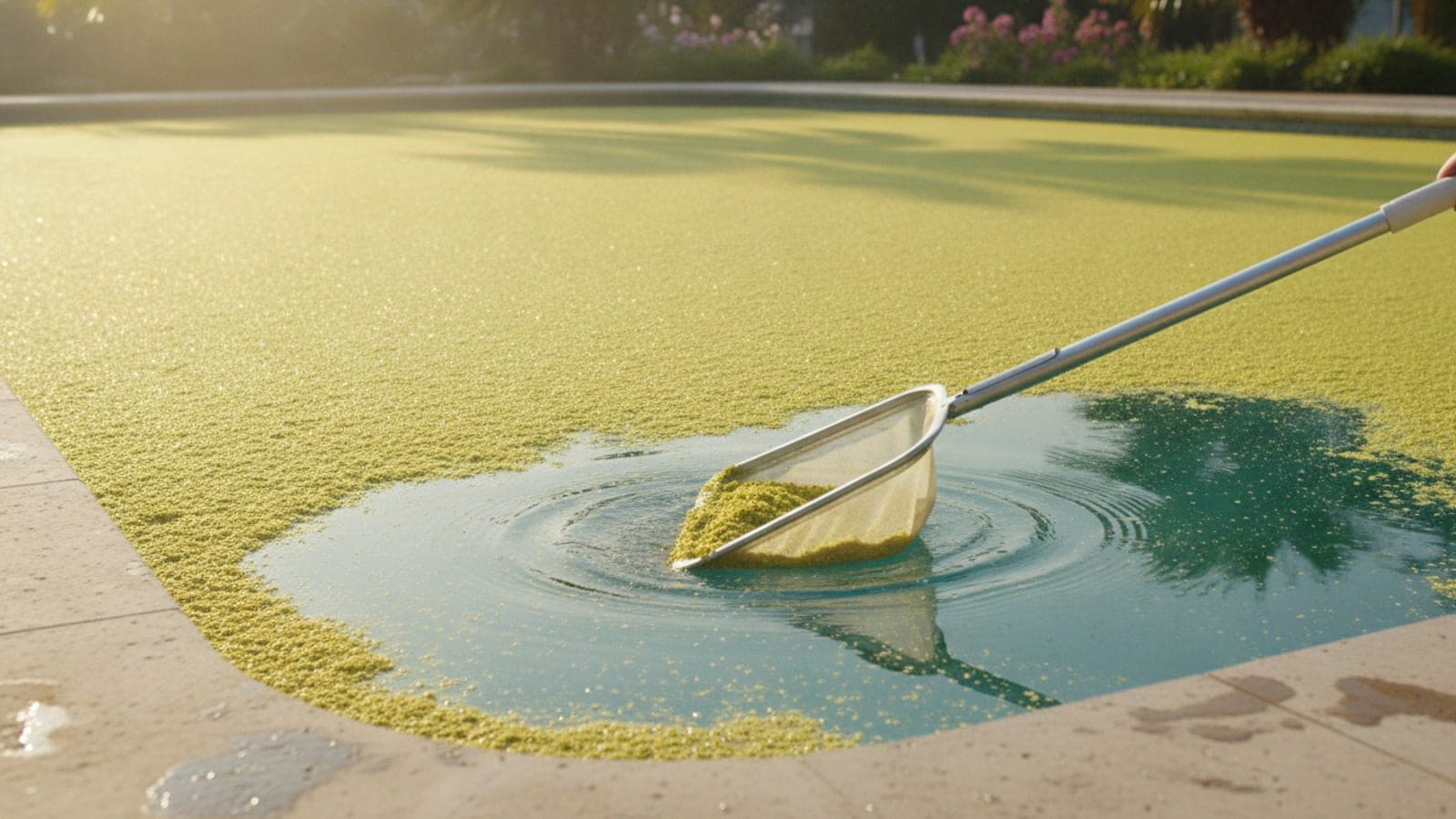
| Pollen film | On, plus fine filtration | Surface flow and filtering both matter |
Pool water safety still matters after cleaning. CDC home pool guidance recommends checking disinfectant and pH regularly, with pH in the 7.0 to 7.8 range and free chlorine guidance based on whether cyanuric acid is used. If the pool looks clean but tests poorly, it is not ready just because the leaves are gone.
Which skimmer net should you use?
Use a flat skimmer net for light surface junk and a deep leaf rake for heavy debris. The wrong net can make a two-minute cleanup feel like a backyard punishment.
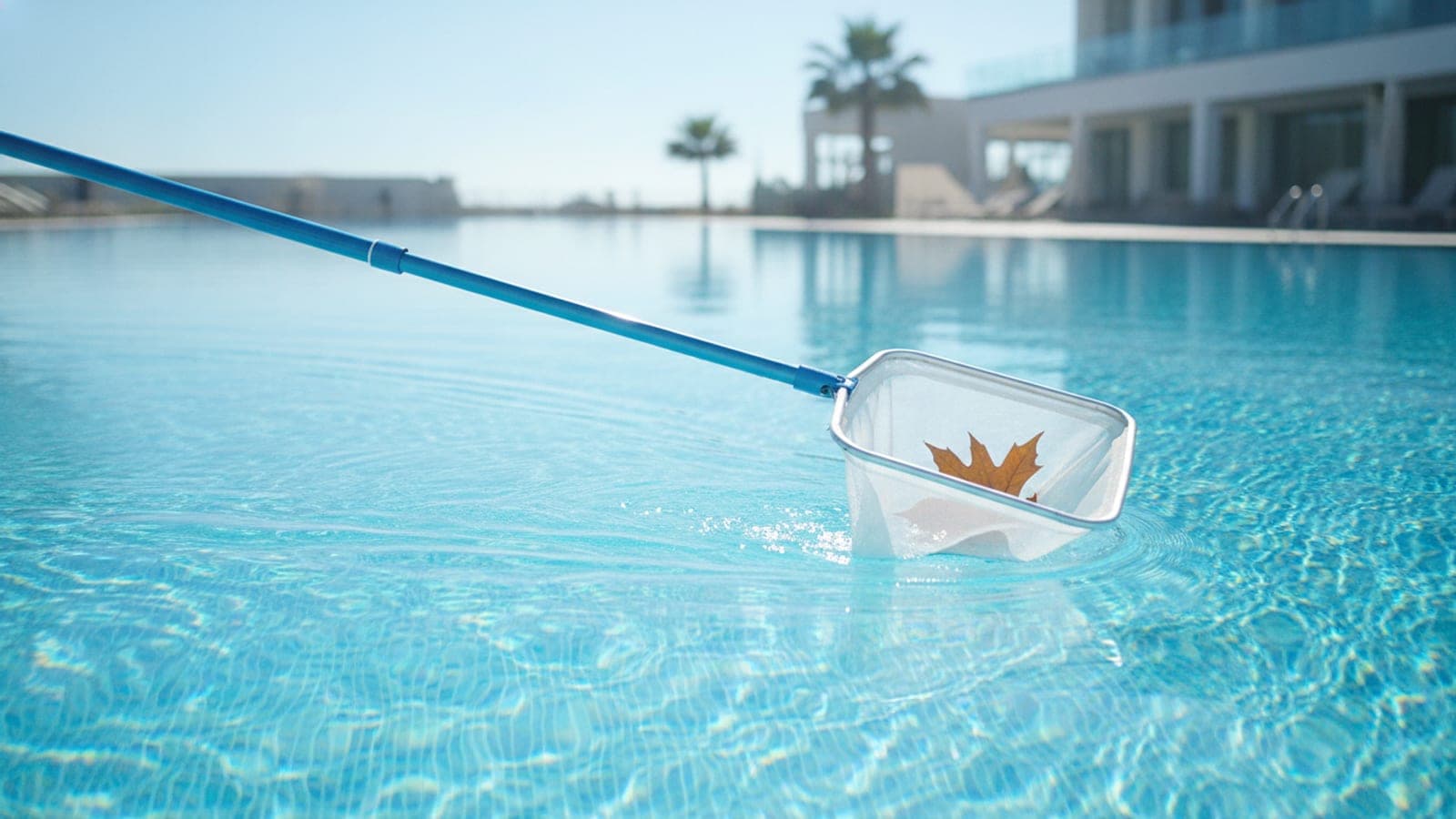
A flat skimmer net is shallow and easy to glide across the surface. It is great for:
- Bugs.
- Grass clippings.
- A few leaves.
- Flower petals.
- Floating mulch crumbs.
- Quick daily touch-ups.
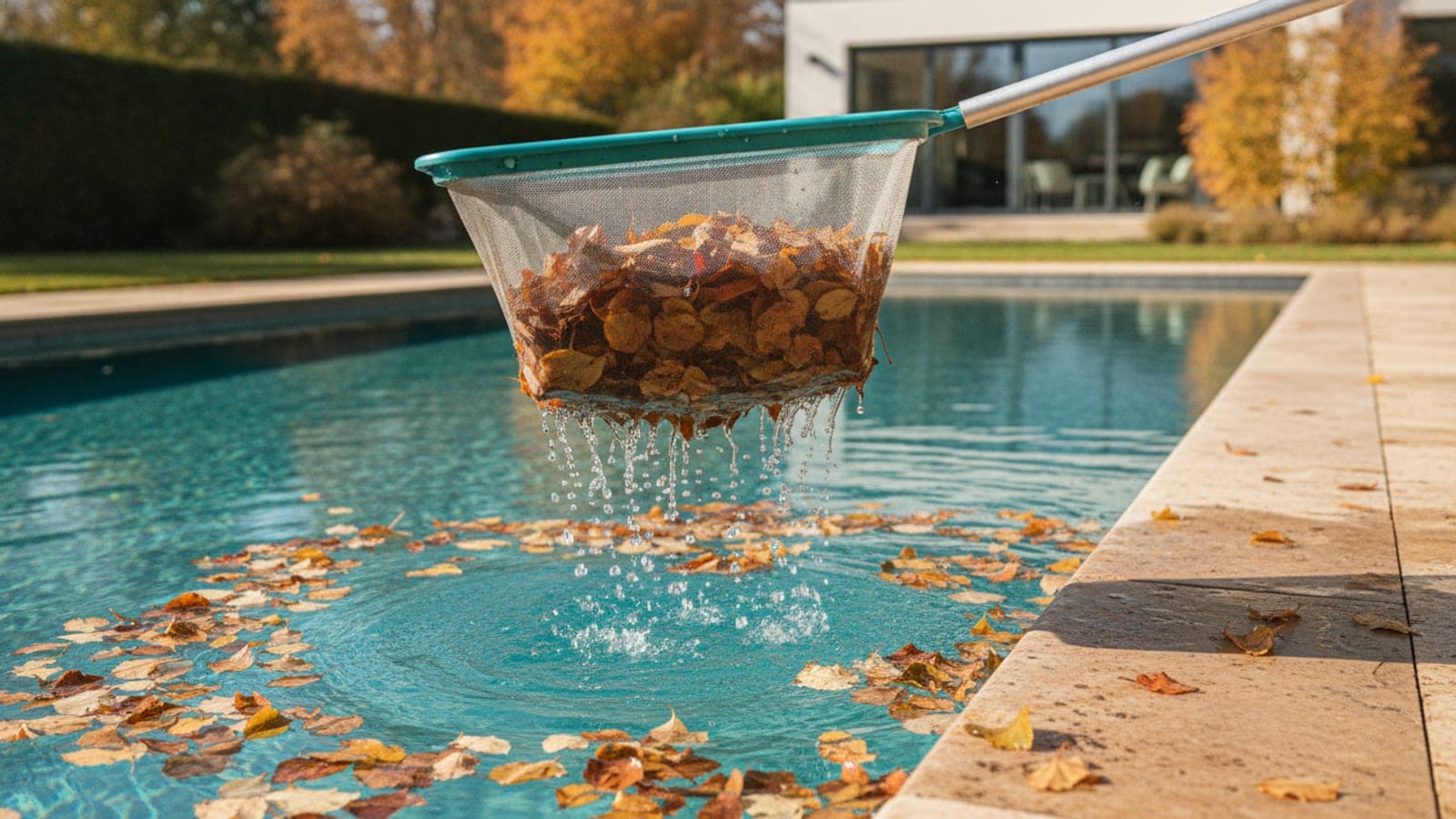
A deep leaf rake has a bag-style net. It holds more and works better when debris has weight. Use it for:
- Oak leaves.
- Magnolia leaves.
- Acorns.
- Seed pods.
- Twigs.
- Wet clumps.
- Debris sitting below the surface.
| Tool | Best for | Not great for |
|---|---|---|
| Flat skimmer net | Fast surface cleanup | Heavy leaves and acorns |
| Deep leaf rake | Big debris loads | Tiny surface film |
| Fine mesh net | Pollen and small particles | Heavy debris that can tear mesh |
| Robotic skimmer | Daily surface help | Corners, steps, and severe storms |
| Manual vacuum | Debris already on floor | Fast surface cleanup |
If you only buy one, get a sturdy deep leaf rake and a good telescoping pole. It can handle light debris well enough, and it saves you when the trees decide to redecorate your pool.
For surface-product comparisons later, link this page to best pool skimmers. That page should compare manual nets, skimmer socks, solar skimmers, and robotic surface skimmers without pretending every pool needs the most expensive gadget.
How do you stop chasing the same leaves around?
Stop chasing leaves by changing your angle, slowing down, and using the wall as a trap. Fast swipes push water ahead of the net and can shove debris away before the mesh reaches it.
The better move is to corner the debris.
Push leaves gently toward a wall, step, or already-calm patch of water. Then scoop under them. If you swipe from the middle of the pool with a fast motion, the water wave tells the leaves to scatter. Leaves are very committed to being annoying.
Try this pattern:
- Stand on the side where debris is drifting.
- Face the return flow instead of fighting it.
- Put the net just under the surface.
- Pull slowly toward you.
- Lift only when the debris is inside the bag.
- Dump before the net gets too heavy.
For corners, turn the net sideways and scoop along the wall. For steps, skim the surface first, then use the net like a shallow shovel on each step. For ladders, pull debris away from the ladder before trying to scoop it.
If leaves keep coming back to the same corner, that is a circulation clue. Your return jets may be creating a dead zone. That is not always bad. A predictable collection spot can make skimming easier. But if the dead zone grows algae or traps pollen, adjust the return eyeballs or run the pump schedule through the pool pump run time calculator.
What should you do before skimming heavy leaves?
Before skimming heavy leaves, empty baskets, remove big debris by hand with a leaf rake, and avoid forcing everything through the skimmer line. Heavy organic debris can clog baskets fast and reduce circulation.
After a storm, work in layers:
- Remove floating leaves first.
- Scoop submerged piles next.
- Empty the net often.
- Check the skimmer basket.
- Check the pump basket.
- Brush steps and corners.
- Run the filter after the worst debris is gone.
- Test and adjust water after cleanup.
Do not shock the pool just because leaves fell in. Test first. Leaves add organic load, but the right fix depends on chlorine, pH, CYA, water clarity, and how long the debris sat there.
If the pool has turned green or cloudy, go to how to clean a green pool or how to clear cloudy pool water. Skimming removes the visible mess. Chemistry and filtration finish the job.
How do skimmer baskets help?
Skimmer baskets catch debris before it reaches the pump basket and filter. A clean basket helps water move. A packed basket turns your circulation system into a lazy straw.
Check the basket during heavy skimming sessions. A basket can look fine from above and still be clogged with leaves, flower petals, hair, pine needles, or skimmer-sock sludge.
Skimmer socks can help catch fine debris before it reaches the filter. They are useful during pollen season, after landscaping, or when tiny debris keeps passing through standard baskets. But they clog faster than an open basket, so check them often.
Use skimmer socks carefully:
- Do not leave them ignored for days during heavy debris season.
- Do not let them choke flow.
- Replace or rinse them when they look loaded.
- Never rely on them as a substitute for filter maintenance.
- Keep chlorine tablets out of the skimmer unless your system manual specifically allows it.
That last point matters because concentrated chemicals in one place can be rough on equipment. Follow the product label and your equipment manual.
EPA and CDC both publish pool chemical safety guidance, including storing chemicals separately and preventing pool chemicals from getting wet or mixing with incompatible materials. Skimming is simple. Chemical handling is not the place to freestyle.
Can a robotic pool skimmer help?
A robotic pool skimmer can help if your pool constantly collects leaves, pollen, bugs, or surface film. It is not mandatory, but it can reduce the small daily chores that make pool ownership feel like a part-time job with no coffee breaks.
A robotic skimmer makes sense if:
- Trees hang near the pool.
- Wind drops debris every afternoon.
- Bugs collect overnight.
- You travel often.
- You dislike daily net work.
- Your built-in skimmer has weak surface pull.
- You want surface cleaning separate from floor cleaning.
A robotic skimmer is not magic. It may miss tight corners. It may need charging or solar exposure. It may struggle with very heavy leaf dumps. And it still needs to be emptied.
But for many pools, surface cleaning is where the daily annoyance lives. A floor robot can clean the bottom. A robotic skimmer can patrol the top. A manual net fills in the gaps.
For affiliate pages, this article should link to best robotic pool skimmers and pool skimmer reviews once those pages are ready.
What should you buy for easier skimming?
The best skimming setup is simple: a sturdy pole, a deep leaf rake, a flat skimmer net, and optional skimmer socks for fine debris. Add a robotic skimmer only if surface debris is a daily problem.
What you need
- Telescoping pool pole: Buy one that locks firmly and does not flex like a fishing rod in a thunderstorm.
- Deep bag leaf rake: Best first purchase for leaves, twigs, and heavier debris.
- Flat skimmer net: Nice for fast surface cleanup and bugs.
- Fine mesh net: Useful for pollen and tiny debris.
- Skimmer basket socks: Helpful during pollen season, but check them often.
- Robotic surface skimmer: Worth considering for high-debris pools.
- Pool brush: Moves sticky debris from walls, steps, and corners into circulation.
[Affiliate product module: manual pool skimmer nets, deep leaf rakes, telescoping poles, skimmer socks, robotic surface skimmers]
The affiliate module should not pretend everyone needs every item. Label them by situation: “best basic kit,” “for heavy leaves,” “for pollen,” and “for people tired of net duty.” That is more helpful and more trustworthy.
How does skimming fit into weekly pool care?
Skimming is the visible part of pool maintenance, but it is not the whole job. A pool can look clean on top and still have bad pH, low sanitizer, poor circulation, or a dirty filter.
Use skimming as the first pass:
- Skim the surface.
- Empty baskets.
- Brush steps and trouble spots.
- Run the pump/filter.
- Test the water.
- Adjust chemistry only from test results.
- Vacuum or run the robot as needed.
This order keeps you from treating debris as a chemistry problem. If the pool has leaves floating on top, the first chemical you need is probably a net.
For water safety, link readers to is my pool safe to swim in. It is a strong internal bridge from cleaning advice to testing advice.
What is the simple skimming routine?
The simple routine is five minutes on normal days and a more careful pass after storms. Skim early before debris sinks, and let the pump help when the water level is right.
Use this quick checklist:
- Look for the debris collection side.
- Empty the skimmer basket if needed.
- Turn on circulation if safe and appropriate.
- Skim slowly in overlapping lanes.
- Use a deep rake for heavy debris.
- Scoop corners and steps last.
- Empty the net before it gets overloaded.
- Recheck the skimmer basket.
- Test the water if debris was heavy or the pool looks off.
The win is not having a perfect pool every second. The win is catching small messes before they become Saturday morning stories.
A pool with trees will always get leaves. A pool near grass will always get clippings. A pool in spring will always get pollen. Skimming is not a failure of ownership. It is just pool life with a stick and a net.
Frequently asked questions
What is the fastest way to skim a pool?
The fastest way to skim a pool is to work with the wind and surface flow instead of fighting them. Start at the downwind side where debris collects, use long slow pulls, and empty the net before it gets heavy.
Should the pool pump be on while skimming?
Usually yes, as long as the water level is high enough for the skimmer to work correctly. The pump helps pull floating debris toward the skimmer opening, but you still need a net for corners and dead spots.
Is a flat skimmer net or deep leaf rake better?
A flat skimmer net is better for light surface debris, bugs, and quick touch-ups. A deep leaf rake is better for heavy leaves, acorns, seed pods, and anything that sinks fast.
How often should I skim my pool?
Skim whenever debris is visible, and daily during leaf, pollen, or storm season. Five quick minutes at the right time often beats one miserable cleanup later.
Can a robotic skimmer replace manual skimming?
A robotic skimmer can reduce manual skimming a lot, especially for surface debris, but most pools still need a net sometimes for corners, steps, and heavy storm messes.