To lower pH in a pool, test first, confirm gallons, check total alkalinity, then use the right acid product in small measured doses. The goal is not to attack high pH like it insulted your family. The goal is to bring the water down safely without overshooting.
Key takeaways
-
High pH can contribute to scale, cloudiness, and uncomfortable water.
-
Acid products can lower pH and total alkalinity, so test both before dosing.
-
Muriatic acid and dry acid are common pH-lowering options, but product labels matter more than internet shortcuts.
-
Protective gear is not dramatic. Acid deserves respect.
-
If pH keeps rising after every correction, look for high alkalinity, aeration, salt systems, fill water, or new surface materials.
When should you lower pH in a pool?
Lower pH when a reliable test shows the water is above the recommended range or repeatedly drifting high. CDC recommends pool pH between 7.0 and 7.8, so a reading above 7.8 deserves attention.
High pH is common. It does not mean you failed pool ownership. It means your water has opinions.
You may need to lower pH if you see:
- pH above the recommended range
- Cloudy or dull water
- Scale on tile, spillways, salt cells, or heaters
- High total alkalinity
- Chlorine that seems less effective than usual
- Eye irritation when sanitizer is otherwise in range
- pH that keeps climbing after adjustment
High pH is especially worth watching in saltwater pools, pools with waterfalls or spillovers, and pools with new plaster. Aeration and new surface chemistry can push pH upward, which is rude but not mysterious.
For the big-picture target, link readers back to what is the ideal pool pH.
What should you test before adding acid?
Before adding acid, test pH, total alkalinity, free chlorine, and pool volume. Acid dosing without those numbers is how a small correction becomes a whole afternoon.
Here is the pre-acid checklist:
| Check | Why it matters |
|---|---|
| pH | Confirms whether acid is needed |
| Total alkalinity | Tells whether acid may lower the buffer too far |
| Pool volume | Controls dose size |
| Free chlorine | Confirms water is also sanitized |
| Water clarity | Cloudy water may need broader troubleshooting |
Pool volume is not optional. If you are unsure whether the pool is 13,000 or 18,000 gallons, your dose estimate can be off by a lot. Use the pool volume calculator before opening the bottle.
Then use the pool acid calculator as a conservative guide. The calculator should never override the product label.
Should you use muriatic acid or dry acid?
Muriatic acid and dry acid can both lower pH, but they handle differently. The better choice depends on your comfort, product label, storage situation, pool surface, equipment, and local availability.
| Option | Pros | Watch out for |
|---|---|---|
| Muriatic acid | Common, effective, often economical | Fumes, splash risk, storage safety |
| Dry acid | Easier to handle for some owners | Product-specific impacts, label limits |
| Acid alternatives | Sometimes marketed as gentler | Still need label-based dosing and retesting |
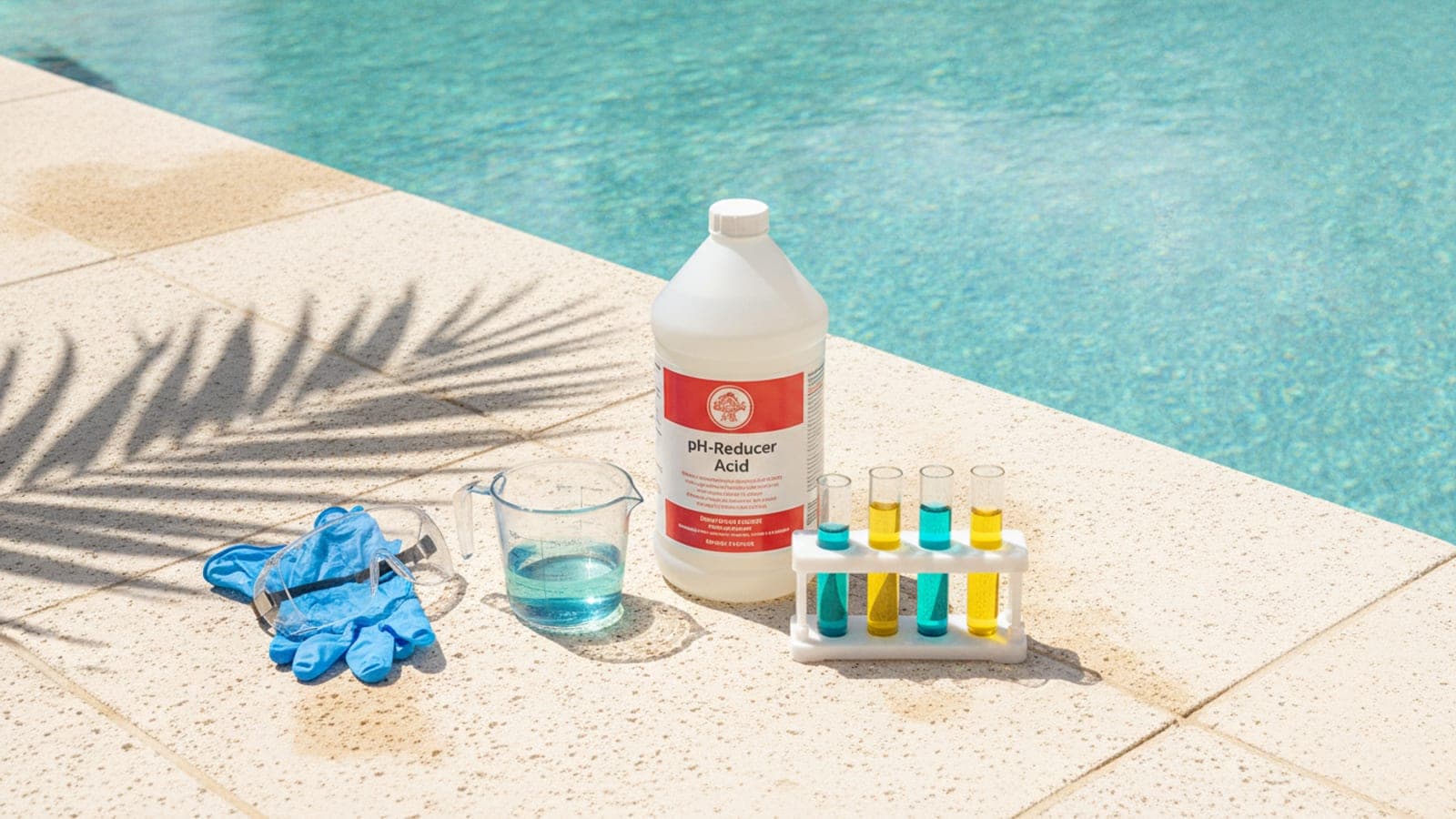
Muriatic acid should be treated seriously. Use gloves and eye protection, work in a ventilated outdoor area, and avoid breathing fumes. Keep it away from chlorine products. Do not store incompatible chemicals together. This is where “I am just being careful” is the correct personality.
Dry acid is still a chemical, not fairy dust. Read the label, avoid mixing, and store it according to the manufacturer directions.
How do you lower pH step by step?
Lower pool pH by testing, calculating, adding acid carefully, circulating, and retesting. Small measured corrections beat one heroic pour.
A practical process:
- Keep swimmers out of the pool.
- Test pH and total alkalinity.
- Confirm pool gallons.
- Choose a labeled pool acid product.
- Put on gloves and eye protection.
- Read the label, including wait times and dosing instructions.
- Add a conservative measured dose with the pump running.
- Brush if the label allows and circulation needs help.
- Let the water circulate.
- Retest pH and alkalinity before adding more.
Worked example: your 16,000-gallon pool tests at pH 8.1 and total alkalinity is normal. That is a cleaner pH correction than if alkalinity were also high. Use the acid calculator for a smaller starting dose, circulate, and retest. If pH lands at 7.7, you may be done for now.
Second example: your 20,000-gallon pool tests at pH 8.2 and total alkalinity is high. Acid may lower both, but this may take more than one correction. Do not chase pH every thirty minutes. Make a controlled adjustment, circulate, retest, and use the pool alkalinity calculator if alkalinity is the real driver.
How do you avoid overshooting?
Avoid overshooting by using a smaller dose than the calculator estimate when the pool has been unstable, then retesting after circulation. It is easier to add a little more acid than to undo a dramatic overcorrection.
Overshooting can create low pH, low alkalinity, swimmer discomfort, and corrosion concerns. It can also start the annoying loop where you lower pH too far, raise it too much, and eventually own enough chemicals to stock a very sad lemonade stand.
Use these rules:
- Never dose from a guess.
- Never dose from an old test.
- Never add acid and pH increaser on the same impulse.
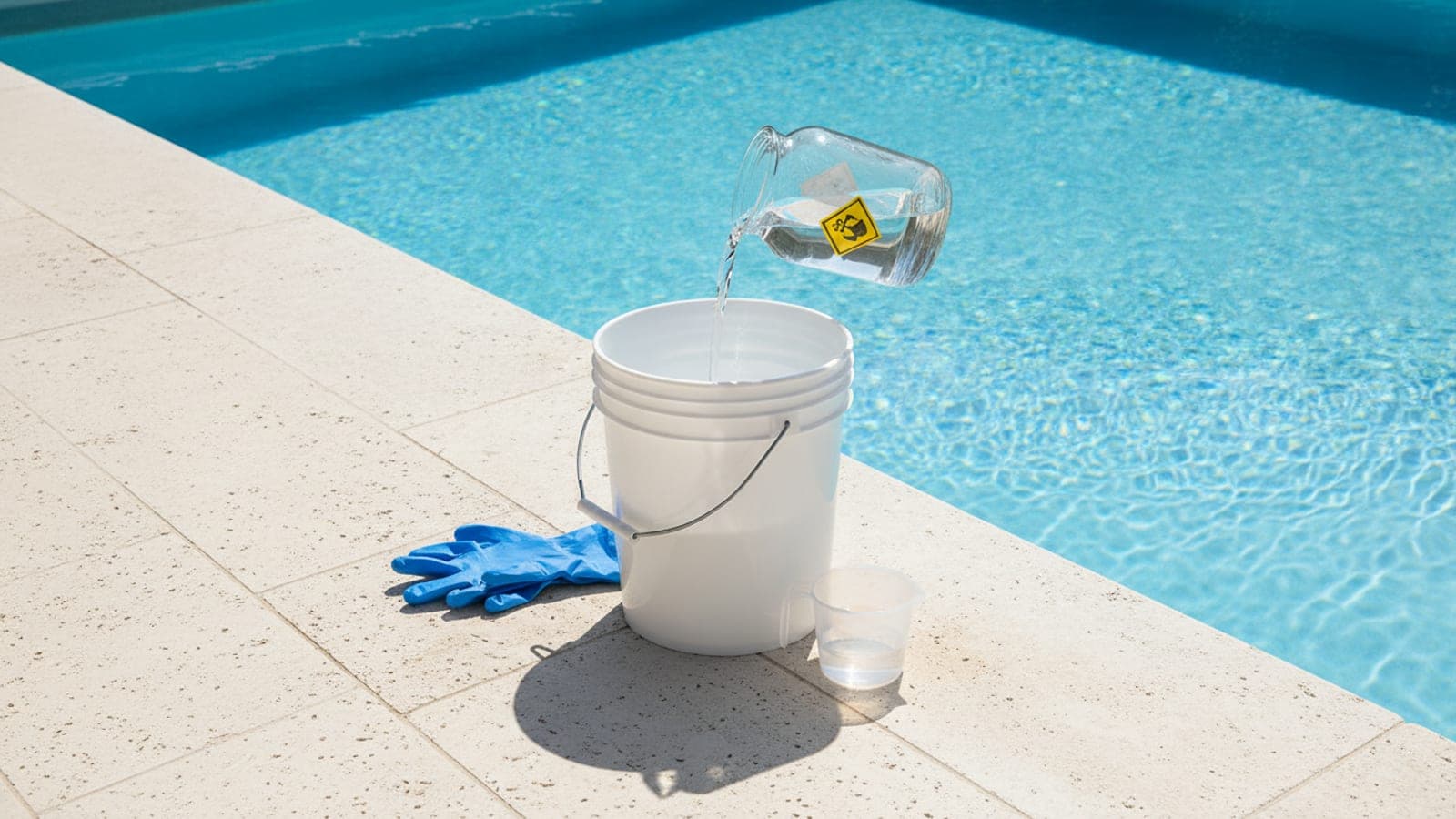
- Never mix chemicals in a bucket unless the product label explicitly tells you to prepare it that way.
- Never assume more acid means faster success.
- Retest after circulation before deciding the first dose failed.
If your pH is slightly high, correct slightly. If your pH is wildly high, still correct carefully. The number may be dramatic, but the handling should not be.
What if pH and alkalinity are both high?
If pH and total alkalinity are both high, acid may help both readings, but it should be handled as a water-balance process rather than a one-time pH fix. High alkalinity can keep pushing pH back up.
This is where many pool owners get stuck. They lower pH, the pH rises again, they add more acid, and the pool becomes a chemistry treadmill.
| pH | Alkalinity | What it means | Better action |
|---|---|---|---|
| High | Normal | Direct pH correction may work | Lower pH carefully |
| High | High | Buffer may be pushing pH up | Lower in stages and retest alkalinity |
| High | Low | Unusual, verify test result | Retest before dosing |
| Normal | High | Do not add acid just because alkalinity annoys you | Watch trend and surface needs |
Use the pool acid calculator for pH, but do not ignore the alkalinity page. The best article cluster should guide people from pH to alkalinity and back without making them feel dumb.
Why does pool pH keep rising?
Pool pH keeps rising when something in the system is constantly pushing it upward. Acid fixes the reading; it does not always fix the reason.
Common causes include:
- High total alkalinity
- Saltwater chlorine generator operation
- Waterfalls, spillovers, bubblers, and returns pointed upward
- New plaster or curing surfaces
- High-pH fill water
- Heavy aeration from swimmers and features
- Chemical additions that move pH upward
For saltwater pools, rising pH is common enough that owners should expect monitoring. That does not mean saltwater is bad. It means “less annoying” does not mean “no testing.” Pair this page with saltwater pool maintenance for beginners and saltwater vs chlorine pool.
A good pH log helps:
| Date | pH | Alkalinity | Notes |
|---|---|---|---|
| Monday | 8.0 | High | Waterfall ran all weekend |
| Wednesday | 7.7 | Slightly high | Acid correction, pump ran |
| Saturday | 8.0 | High | pH rose again |
That table points to the real issue faster than memory does.
What should you buy for lowering pH?
The useful shopping list for high pH is safety gear, accurate testing, and the correct acid product. Skip novelty fixes and “mystery blue bottle” energy.
Recommended product cards:
- Full drop test kit
- Digital pH meter
- Muriatic acid
- Dry acid
- Chemical-resistant gloves
- Safety goggles
- Acid-safe measuring container used only for pool chemicals
- Pool brush
- Storage bin for separating incompatible pool products
Disclosure: We may earn a commission if you buy through product links on this page. As an Amazon Associate, we earn from qualifying purchases.
Put the affiliate module after the safety and diagnosis sections. That earns more trust and gives buyers a reason to choose the correct product instead of the first bottle with “pH” on it.
When is high pH really a bigger pool problem?
High pH is a bigger problem when it comes with cloudy water, scale, high alkalinity, weak chlorine performance, salt-cell buildup, or recurring drift. In those cases, the pH number is a clue, not the whole case.
Move into deeper troubleshooting if:
- The water is cloudy
- Scale keeps coming back
- The salt cell needs frequent cleaning
- pH rises every few days
- Alkalinity is high
- Calcium hardness is high
- Fill water has high alkalinity or pH
- The pool is new plaster or recently resurfaced
Start with pool chemistry basics, then use specific guides for pH, alkalinity, chlorine, and calcium. A clean internal link path makes the site feel like help, not a pile of articles wearing the same hat.
External sources to verify before publishing
- CDC — Home Pool and Hot Tub Water Treatment and Testing: https://www.cdc.gov/healthy-swimming/about/home-pool-and-hot-tub-water-treatment-and-testing.html
- EPA — Safe Storage and Handling of Swimming Pool Chemicals: https://www.epa.gov/rmp/chemical-safety-alert-safe-storage-and-handling-swimming-pool-chemicals
- NPIC — Pool and Spa Chemicals Fact Sheet: https://npic.orst.edu/factsheets/pool-chemicals.html
Frequently asked questions
How do I lower pH in a pool?
Test pH and alkalinity, confirm pool volume, then use a labeled acid product such as muriatic acid or dry acid according to the product label. Add slowly, circulate, and retest before adding more.
What is the safest way to lower pool pH?
The safest way is to wear protective gear, read the label, avoid mixing chemicals, add small measured doses with the pump running, and keep people out of the water until the product label and retest results say it is safe.
Does muriatic acid lower alkalinity too?
Yes, acid can lower both pH and total alkalinity. That is helpful when both are high, but it can create a new problem if alkalinity is already low.
Can I use vinegar to lower pool pH?
Vinegar is not a normal pool pH treatment and is not the right choice for most pools. Use products labeled for pool pH adjustment and follow the label.
Why does my pool pH keep rising?
High alkalinity, aeration, water features, saltwater chlorine generators, new plaster, and some fill-water chemistry can push pH upward repeatedly.
Can I swim after adding acid to lower pH?
Follow the product label. In general, circulate thoroughly, retest pH and sanitizer, and do not swim until the water is clear and readings are in range.