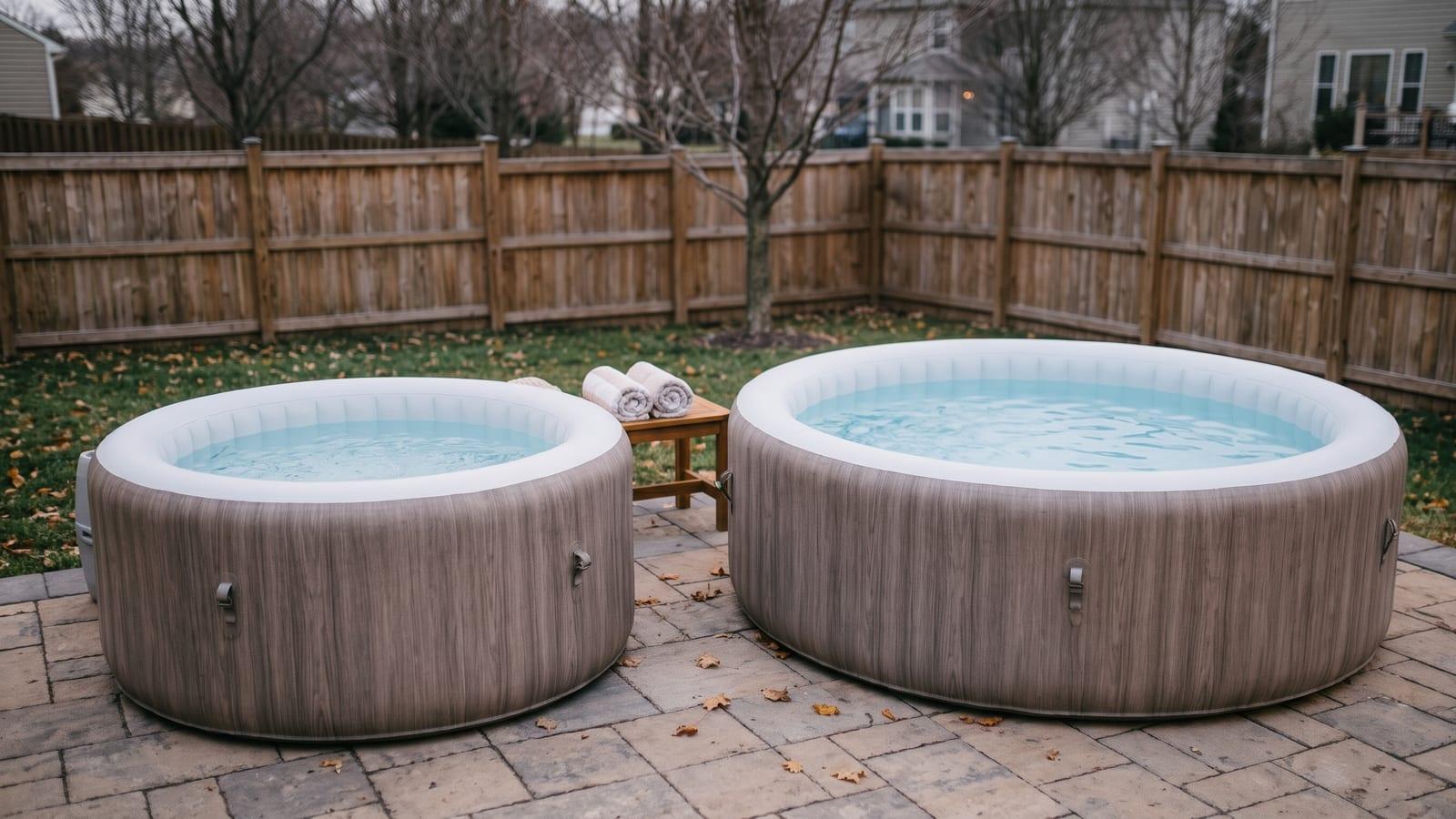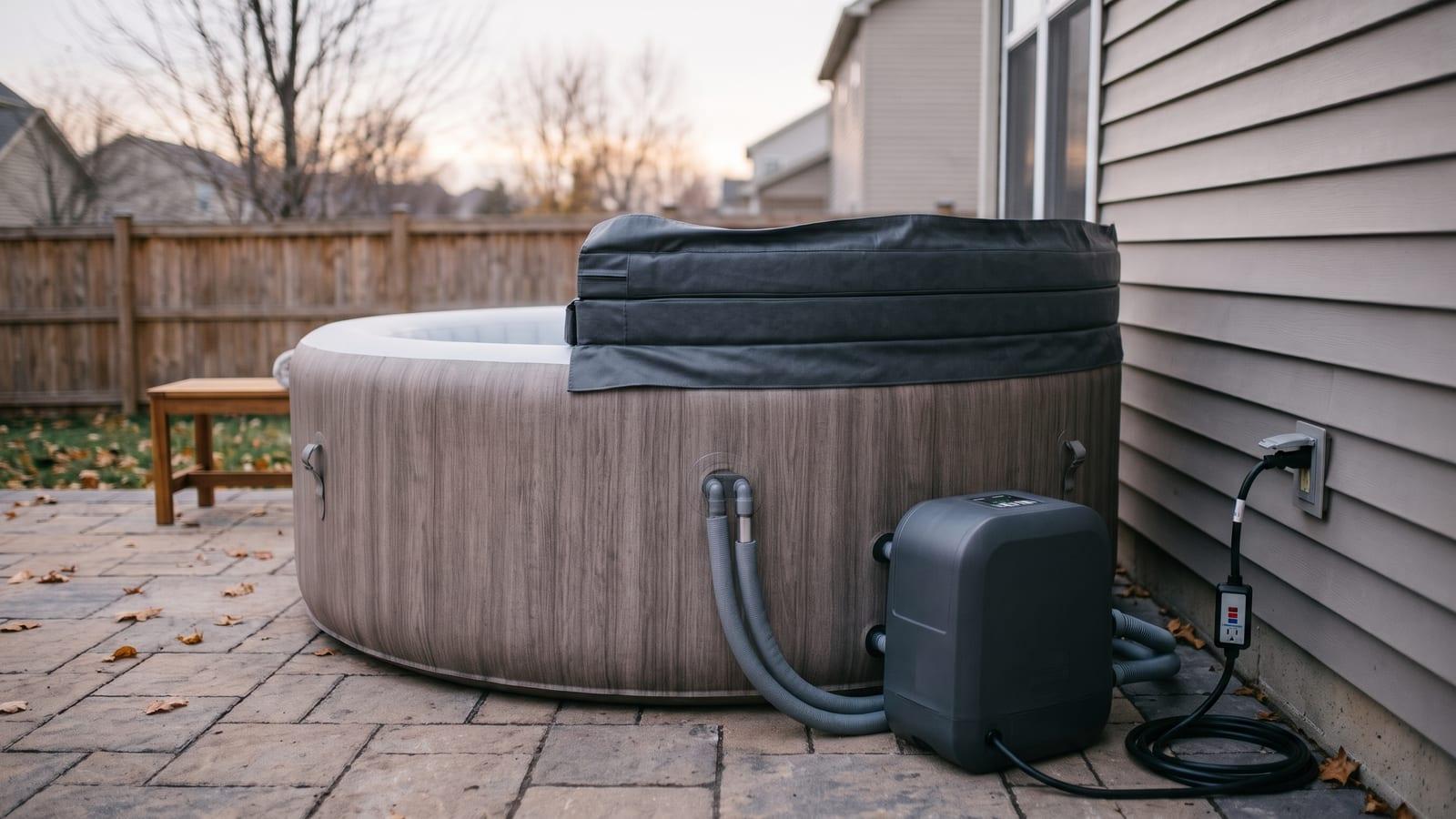
The real difference in a 120V vs 240V hot tub is heater size. According to Jacuzzi's wiring guide, a 120V plug-in spa typically runs a heater of about 1 to 1.5 kW, while a 240V hardwired spa typically runs 4 to 5.5 kW. That extra power heats water faster and lets heat and jets run together in cold weather. It also means a dedicated circuit, an outdoor disconnect, usually a permit, and a licensed electrician. Voltage is not a quality score. It is a question of how much power your backyard can deliver safely.
Key takeaways
- Inflatable hot tubs are 120V plug-in units. The Bestway SaluSpa manual we reviewed rates its pump at 110 to 120V AC, 12A, which is roughly 1,440 watts for the whole unit.
- A 240V tub gets more heater, faster recovery, and usually heat plus jets at the same time. It does not use less energy per degree.
- A 120V tub still needs a grounded, GFCI-protected outdoor outlet on a suitable circuit. Never an extension cord.
- Any 240V work goes to a licensed electrician. Jacuzzi notes a panel service upgrade alone can run $2,000 or more.
- Choose by how often you soak and how cold your winters get, not by the bigger number on the box.
What does voltage actually change in a hot tub?
Voltage sets the size of the power budget, and the heater is the biggest thing spending it. Watts equal volts times amps, so a pump rated at 120V and 12A has about 1,440 watts to share between the heater, the filter pump and the air blower.
That small budget explains a quirk owners notice on inflatable tubs: on many models the heater pauses while the bubbles run. There is not enough power to run everything at full tilt at once, and the blower is pushing cool air through the water anyway. Your manual tells you exactly how your model behaves.
A 240V circuit changes the math. Jacuzzi says most of its full-size hot tubs need a dedicated 240V circuit with a 50-amp GFCI breaker, with some models calling for 40 or 60 amps depending on heater size and pumps. That headroom is what pays for a 4 to 5.5 kW heater plus jet pumps running together.
The takeaway: voltage does not make water hotter or cleaner. It decides how big a heater the tub can carry and how many things can run at once.
How much faster does a 240V hot tub heat?
Roughly three to four times faster on heater size alone. Here is the worked example, using a 210-gallon tub (the size Intex uses for its 4-person spa in its own care guide) heated from 64°F to 104°F.
- Water weight: 210 gallons × 8.34 lb per gallon = about 1,751 lb.
- Heat needed: 1 BTU raises 1 lb of water 1°F, so 1,751 lb × 40°F = about 70,000 BTU.
- Convert: 70,000 BTU ÷ 3,412 BTU per kWh = about 20.5 kWh.
Divide that by heater size and you get the best-case heat-up time with zero heat loss: about 15.8 hours at 1.3 kW, 5.1 hours at 4 kW, and 3.7 hours at 5.5 kW. Real tubs are slower, because heat leaks out through the cover, the walls and the ground the whole time. That is why Jacuzzi lists 8 to 12 hours for its 120V models, and why a cold inflatable fill can take most of a day.
If you like this kind of math, our pool heater size calculator runs the same BTU logic for pools.
| Factor | 120V plug-in hot tub | 240V hardwired hot tub |
|---|---|---|
| Typical heater size (Jacuzzi) | About 1 to 1.5 kW | About 4 to 5.5 kW |
| Typical circuit (Jacuzzi) | 15 to 20 amps, dedicated, NEMA 5-15 or 5-20 outdoor receptacle, GFCI in the cord | Dedicated 240V, usually 50-amp GFCI breaker (some 40 or 60) |
| Ideal heat time, 210 gal, 40°F rise | About 15.8 hours at 1.3 kW | About 5.1 hours at 4 kW |
| Heat and jets together | Often one or the other | Usually both |
| Cold-weather recovery | Can fall behind with jets running | Holds temperature better |
| Installation | Existing compliant outlet, checked by an electrician if unsure | Licensed electrician, disconnect, usually a permit and inspection |
| Typical tub types | Inflatables, compact plug-and-play shells | Most full-size acrylic spas |
Is a 240V hot tub cheaper to run?
No, not by voltage alone. Raising 210 gallons by 40°F takes about 20.5 kWh no matter which plug delivers it, and your utility charges per kWh, not per volt.
What drives the bill is heat loss: how warm you keep the water, how well the cover seals, wind, ground contact and air temperature. A well-insulated 240V spa can cost less to hold at temperature than a thin-walled inflatable, but that is the insulation doing the work, not the voltage. Our guide to what an inflatable hot tub costs to run breaks down the monthly math.
There is one case where 120V gets expensive. In a hard freeze, a small heater can run almost nonstop and still lose ground, especially with the bubbles on. If you live somewhere cold, read whether inflatable hot tubs hold heat in winter before you buy.
What does a 120V plug-in hot tub need from your outlet?
A grounded, GFCI-protected, outdoor-rated outlet within reach of the cord, on a circuit that can handle the load. "Plug and play" does not mean any outlet will do.
The Bestway SaluSpa manual is blunt about this. It says to connect only to a grounded receptacle, test the GFCI plug before each use, and never use the pump if the GFCI test fails. It calls extension cords and multi-plug adapters strictly prohibited, says the tub must sit within cord length of the wall socket, and recommends a socket resistant to humidity and capable of high-power loading. If you are unsure about your electrical supply, it tells you to consult a qualified electrician.
In practice, that means:
- No extension cords, adapters, power strips or spliced cords. Voltage drop and overheated connections are a fire risk, not a minor annoyance.
- Avoid sharing the circuit with a freezer, space heater or garage tools. Jacuzzi describes its 120V models as running on a dedicated circuit.
- If the nearest outlet is too far away, a licensed electrician installs a new outdoor receptacle. That is the fix, not a longer cord.
- Test the GFCI every time. If it trips repeatedly, stop and find out why.
If your tub keeps tripping or will not warm up, our hot tub not heating troubleshooting guide covers the outlet and GFCI checks. Bestway and Coleman owners should also check whether their pump is covered by the 2024 CPSC AirJet and HydroJet pump recall, which involved a fire hazard.
What does a 240V installation involve?
A licensed electrician, a dedicated circuit from your panel, a GFCI disconnect near the tub, and in most places a permit and inspection. This is not a weekend project, and it is not one to price after the spa is already on a truck.
Jacuzzi's guide describes a weatherproof, lockable GFCI spa disconnect mounted outdoors, typically 5 to 15 feet from the hot tub and within line of sight, per the National Electrical Code and local rules. Wiring usually runs in conduit, and trenching through concrete, decks or landscaping adds labor.
The biggest wild card is your panel. If it does not have room for a 50-amp breaker, you may need a service upgrade, which Jacuzzi says can cost $2,000 or more by itself. Get a written quote based on the exact model's electrical spec sheet before you buy the tub, and ask whether the permit is included.
Can you convert a 120V hot tub to 240V?
Only if the manufacturer built that model to be converted and documents how. Some hard-shell plug-and-play spas are sold that way; the manual will say so, and the conversion is electrician work.
Inflatable hot tub pumps are 120V plug-in appliances. Do not swap the plug, hardwire the pump or remove the cord's GFCI. If you want 240V performance, that is a different tub.
Which one should you choose?
Pick a 120V tub if you soak a few times a week, live somewhere with mild winters, rent your home, or want to spend hundreds rather than thousands. Pick a 240V tub if you soak daily, want heat and strong jets at the same time in January, and plan to stay put long enough to justify the electrical work.
For most first-time buyers in the inflatable aisle, 120V is the honest fit, as long as the outlet is right. Models like the Intex PureSpa Plus 4-Person Inflatable Hot Tub (140 Jets) or the Coleman SaluSpa Miami AirJet Inflatable Hot Tub (2-4 Person) are built around that plug-in setup; compare them on our inflatable hot tubs page. If you are still deciding between soft and hard shells, our inflatable vs hard-shell hot tub guide weighs space, budget and lifespan.
Whichever you choose, keep a cover on it when nobody is in the water. The CPSC drowning-prevention toolkit applies to hot tubs as much as pools.
Frequently asked questions
Is a 240V hot tub cheaper to run than a 120V hot tub?
Not automatically. Heating a gallon of water by one degree takes the same energy at any voltage, and your bill is mostly driven by heat loss, set temperature, cover quality and weather. A 240V tub heats faster, but faster is not the same as cheaper.
Can I plug an inflatable hot tub into an extension cord?
No. The Bestway SaluSpa manual says extension cords and multi-plug adapters are strictly prohibited and that the plug must go directly into a grounded socket. If your outlet is too far from the spot you want, have a licensed electrician add a proper outdoor receptacle.
Can I convert a 120V hot tub to 240V?
Only if the manufacturer designed that model to be converted and its manual describes the procedure, and only by a licensed electrician. Inflatable hot tub pumps are built as 120V plug-in units, so do not rewire, swap plugs or hardwire one yourself.
Does a 120V hot tub need a dedicated circuit?
Plan on one. Jacuzzi says its 120V models draw 15 to 20 amps on a dedicated circuit, and an inflatable spa pump rated around 12 amps leaves little room for anything else on a shared line. Check your model's rating, then have an electrician confirm the outlet and circuit.
How long does a 120V hot tub take to heat up?
Jacuzzi puts its 120V models at roughly 8 to 12 hours to reach temperature, and inflatable tubs commonly heat about 1 to 2 degrees Fahrenheit per hour. A cold fill in winter can take most of a day or longer, so start heating the day before you want to soak.