A brand-new saltwater pool needs roughly 3,200 parts per million (ppm) of salt, which works out to about 27 pounds of pool salt per 1,000 gallons of water if you are starting from zero. So a 20,000 gallon pool needs somewhere around 540 pounds, or about fourteen 40-pound bags. That is the short answer, but your exact number depends on your pool volume and how much salt your fill water already contains.
Use the calculator above to size this to your pool. Punch in your gallons and your current salt reading, and it will tell you how many pounds and bags to buy instead of making you do the arithmetic in the driveway.
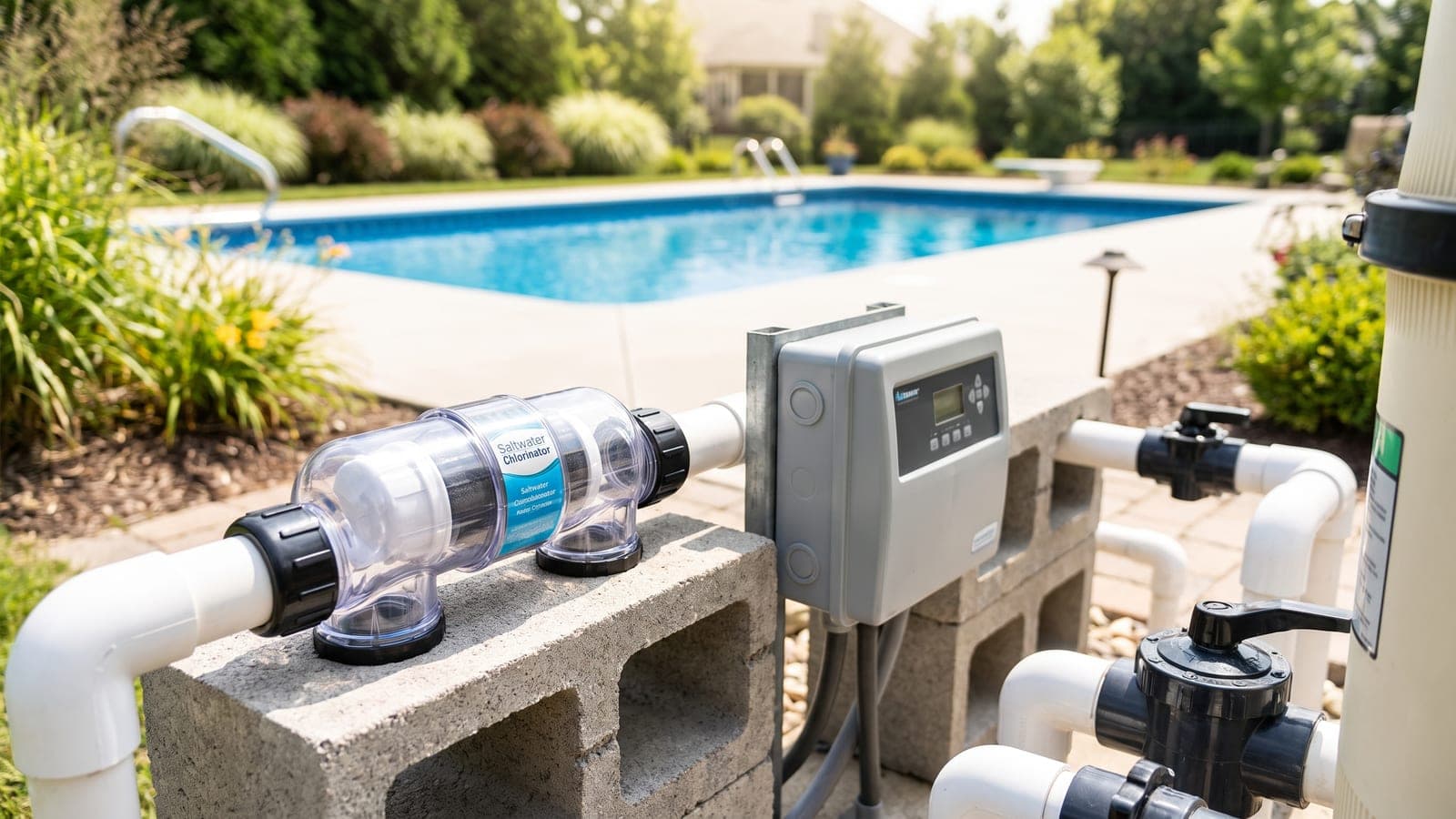
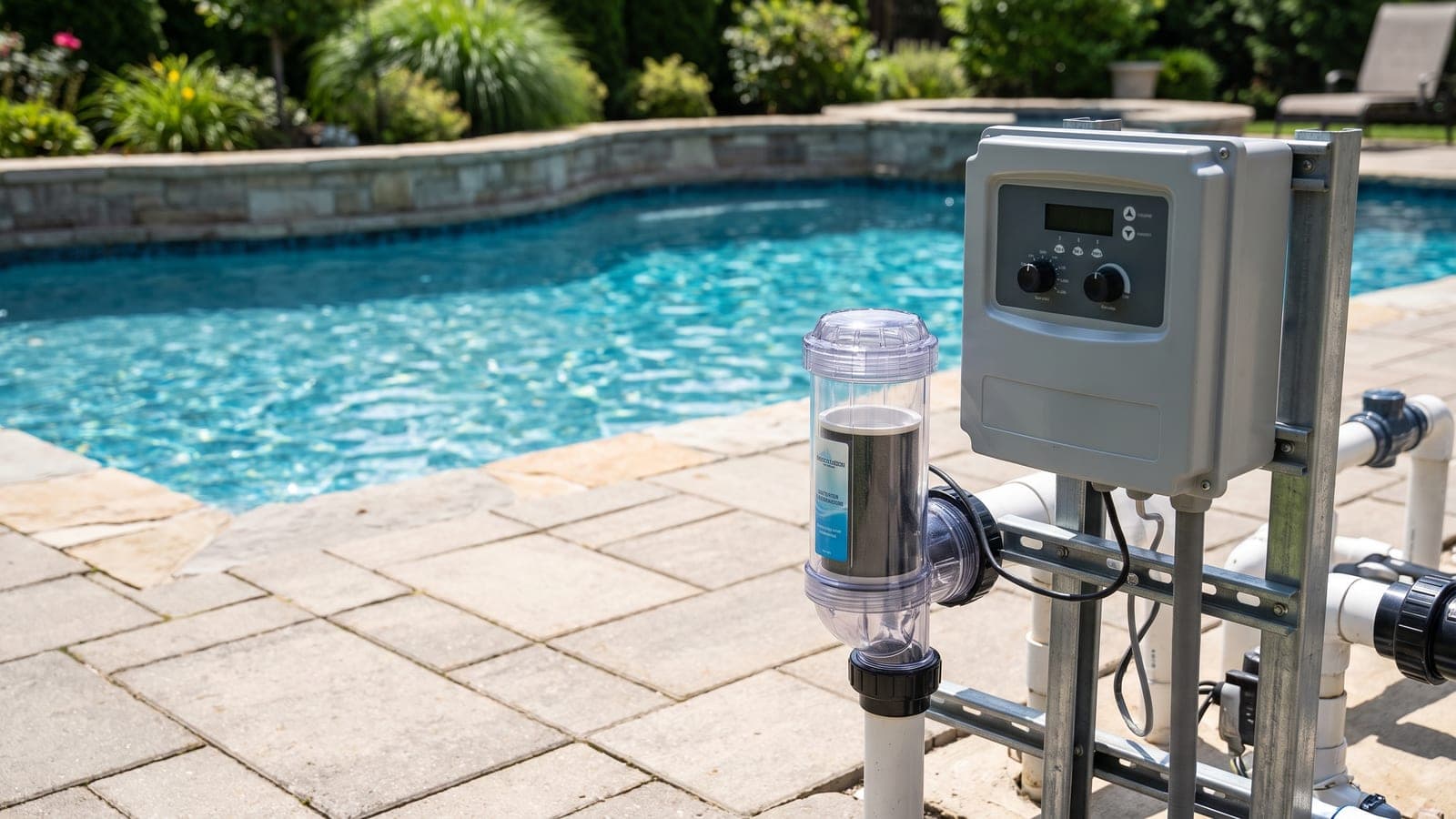
Salt (sodium chloride, the same stuff as table salt) is the fuel your salt chlorine generator turns into chlorine. The generator, sometimes called a salt cell or salt system, passes a small current through the salty water and splits it into chlorine that sanitizes the pool. No salt, no chlorine, so getting the level right on day one matters.
What salt level does a saltwater pool actually need?
Most residential salt systems want the water between 2,700 and 3,400 ppm, with 3,200 ppm being the common sweet spot. Check your own manual, because the target varies by brand. A Hayward AquaRite Salt System (40,000 gal) and a Pentair IntelliChlor IC40 Salt System, for example, each list their own ideal range, and running outside it is the number one cause of a cell that will not produce chlorine.
For context, that level is roughly a tenth as salty as the ocean, so you should not taste it much. Human taste picks up salt around 3,500 to 4,000 ppm, which is why a well-tuned salt pool feels silky rather than briny.
Going too low starves the cell and it stops making chlorine. Going too high can trigger a "high salt" fault and, over time, accelerate corrosion on some fixtures. The manufacturers, including Hayward's own guidance on how much salt to add, all point to the same idea: hit the target range, then leave it alone.
How do I calculate how much salt to add?
Start with three numbers: your pool volume in gallons, your target ppm, and your current salt reading. The basic math is that 1 ppm across 1 million gallons is about 8.34 pounds, but nobody wants to run that by hand.
The everyday shortcut is that raising a pool by 1,000 ppm takes about 8.3 pounds of salt per 1,000 gallons. Starting from a true zero (fresh fill water) and aiming for 3,200 ppm, that is roughly 27 pounds per 1,000 gallons.
If your pool is already partway there, subtract. A pool sitting at 2,000 ppm that wants 3,200 only needs to climb 1,200 ppm, which is a much smaller haul. This is exactly the subtraction the calculator handles, and it is why testing before you buy saves you money and a sore back.
Not sure of your pool's gallons? A rough formula for a rectangular pool is length times width times average depth times 7.5. For odd shapes, your builder's paperwork or a pool store can give you a solid number.
What kind of salt should I buy, and how do I add it?
Buy pool-grade salt that is at least 99 percent pure sodium chloride, usually labeled solar or evaporated salt and sold in 40-pound bags. Purer salt dissolves cleaner and leaves fewer minerals behind that can stain or cloud the water.
Skip rock salt with visible dirt and skip water-softener pellets that list anti-caking or iron-removal additives. Those extras can tint your water or gum up the cell.
Here is the routine most owners follow:
- Test your current salt with a kit or a digital tester, and balance the basics first (the CDC's pool water guidance is a good primer on why sanitizer and pH matter).
- Turn the pump on and leave the salt cell off for now.
- Pour the salt slowly across the deep end or into the pool, not into the skimmer or through the equipment.
- Brush the pile around so it does not sit in a mound on the floor.
- Let the pump run 24 hours to fully dissolve and mix.
- Retest, then turn the salt cell on once the reading is stable.
For lower-volume pools, an Intex Krystal Clear Saltwater System (15,000 gal) or a Pentair IntelliChlor LT15 Salt System (15,000 gal) will list a smaller target volume, so scale your salt to the pool, not to the biggest bag on the shelf. If you are still choosing a system, our roundup of salt systems walks through sizing.
Should I add all the salt at once?
No, add about 80 percent of the calculated amount, let it mix, then retest and top up. It is easy to add more salt and genuinely annoying to remove it, since the only way down is draining and refilling with fresh water.
This is where new owners get burned. They dump every bag, get a "high salt" fault, and spend a weekend partially draining a pool they just filled. Undershoot on purpose and creep up to target.
Salt is not used up the way chlorine tablets are. It stays in the water, and you mostly lose it to splash-out, backwashing your filter, and rain pushing water over the edge. So after the initial fill, you are usually adding a little at season start rather than every week.
When should I test and adjust after the first fill?
Retest 24 hours after adding, once everything has circulated. A single early reading taken before the salt dissolves will read low and tempt you to overshoot.
After that, checking salt every couple of weeks in season is plenty, plus a check after heavy rain, a big splash-out day, or a filter backwash. Many salt cells show an onboard salt readout, but treat that as a gauge and confirm with a real test now and then, since cells drift as they age.
Keep the rest of your chemistry in line too. Salt only makes chlorine, it does not manage pH, alkalinity, or stabilizer (CYA), and Pentair's own IntelliChlor documentation notes the cell works best when the water is balanced. Our pool chemistry basics without the lab coat guide covers the supporting numbers.
The quick version
From zero, plan on about 27 pounds of pool salt per 1,000 gallons to reach 3,200 ppm, but always test first and let your volume and existing salt level set the real number. Add most of it, mix for a day, retest, and top up gently.
For the season-long picture of running the system, see saltwater pool maintenance for beginners. And if you are also caring for a spa, hot tub maintenance for beginners without the chemical panic uses the same test-first mindset on a smaller scale.
Frequently asked questions
How many bags of salt do I need for a 15,000 gallon pool?
Starting from zero salt, a 15,000 gallon pool needs roughly 400 lbs to reach 3,200 ppm, which is about 10 forty-pound bags. If your fill water already carries some salt, you will need less, so always test first and let the calculator do the math for your exact volume.
What kind of salt should I buy?
Use pool-grade sodium chloride that is at least 99 percent pure, sold as evaporated or solar salt. Avoid rock salt with additives, and skip water-softener pellets unless the bag clearly says pure NaCl, since binders and anti-caking agents can cloud your water.
How long before I can turn on the salt cell?
Wait until all the salt has fully dissolved and circulated, which usually takes 24 hours with the pump running. Turning the generator on before the salt is mixed can give a false low reading and stress the cell.
Can I add too much salt to my pool?
Yes, and overshooting is a hassle because the only fix is draining and refilling to dilute. Add about 80 percent of what the calculator suggests, retest, then top up, because it is far easier to add more salt than to remove it.
Does the salt get used up over time?
Salt is not consumed by the generator, so it stays in the water and mostly leaves through splash-out, backwashing, and rain overflow. You usually only add a bit at the start of the season or after heavy dilution, not on a regular schedule.