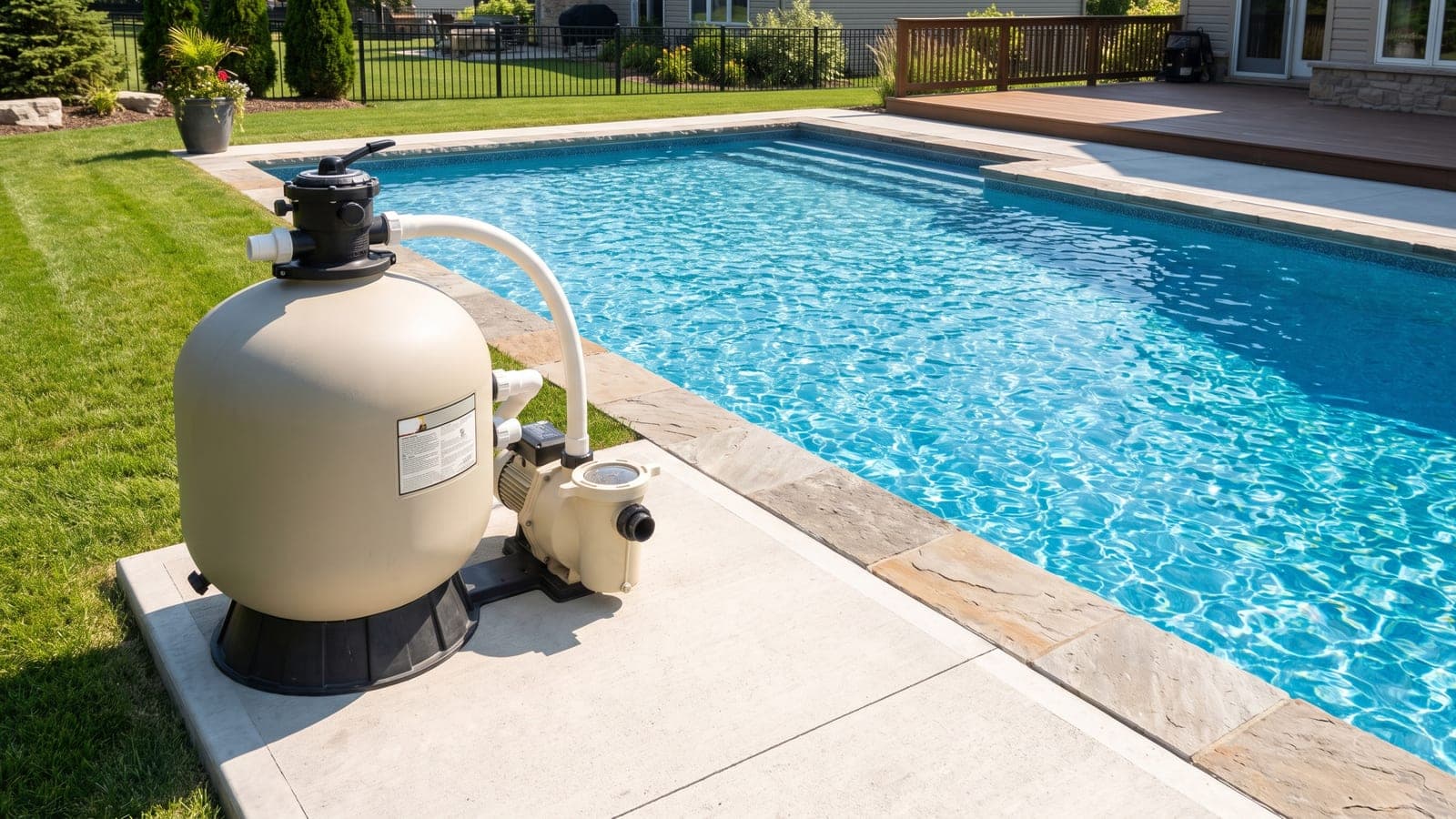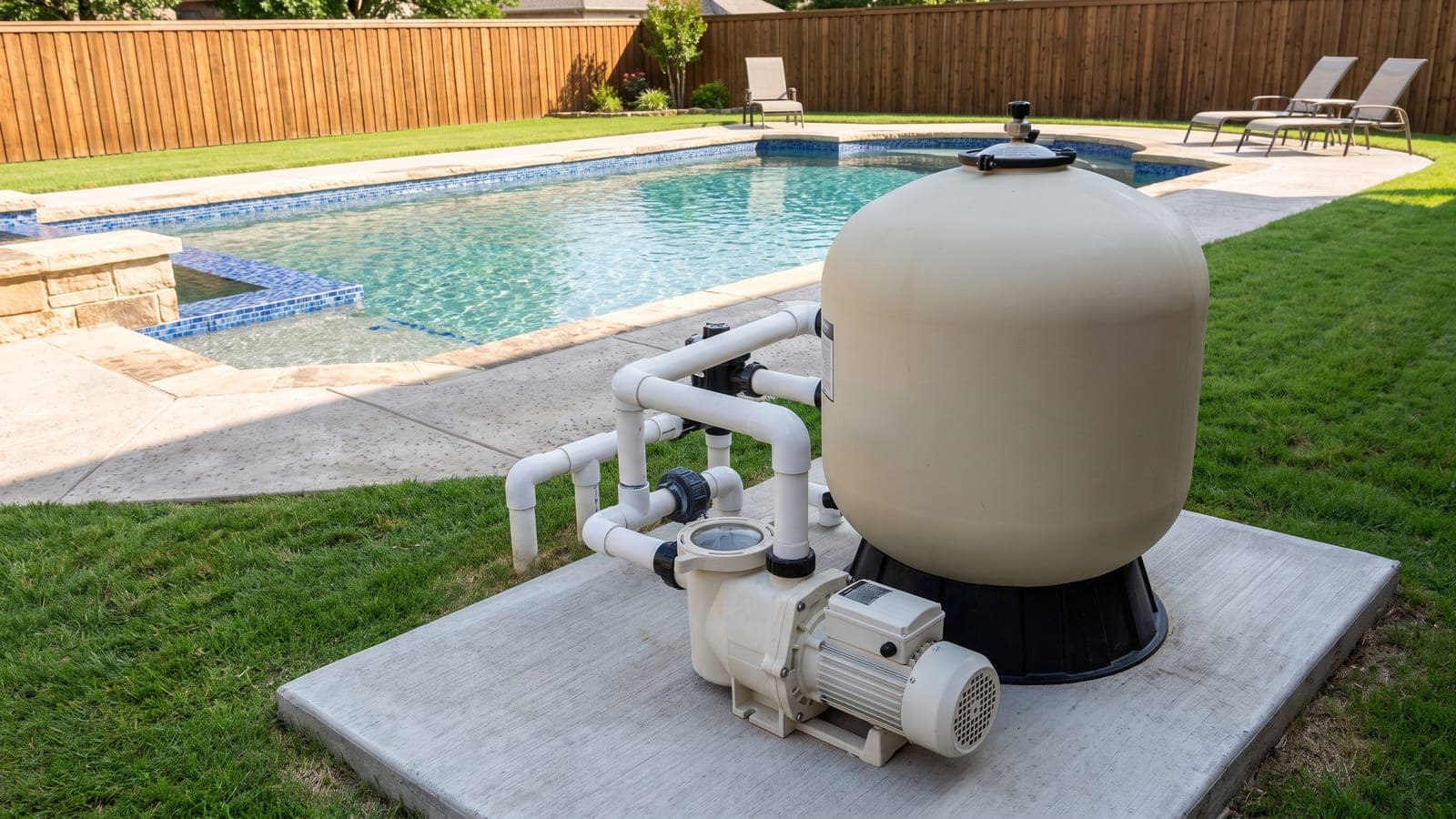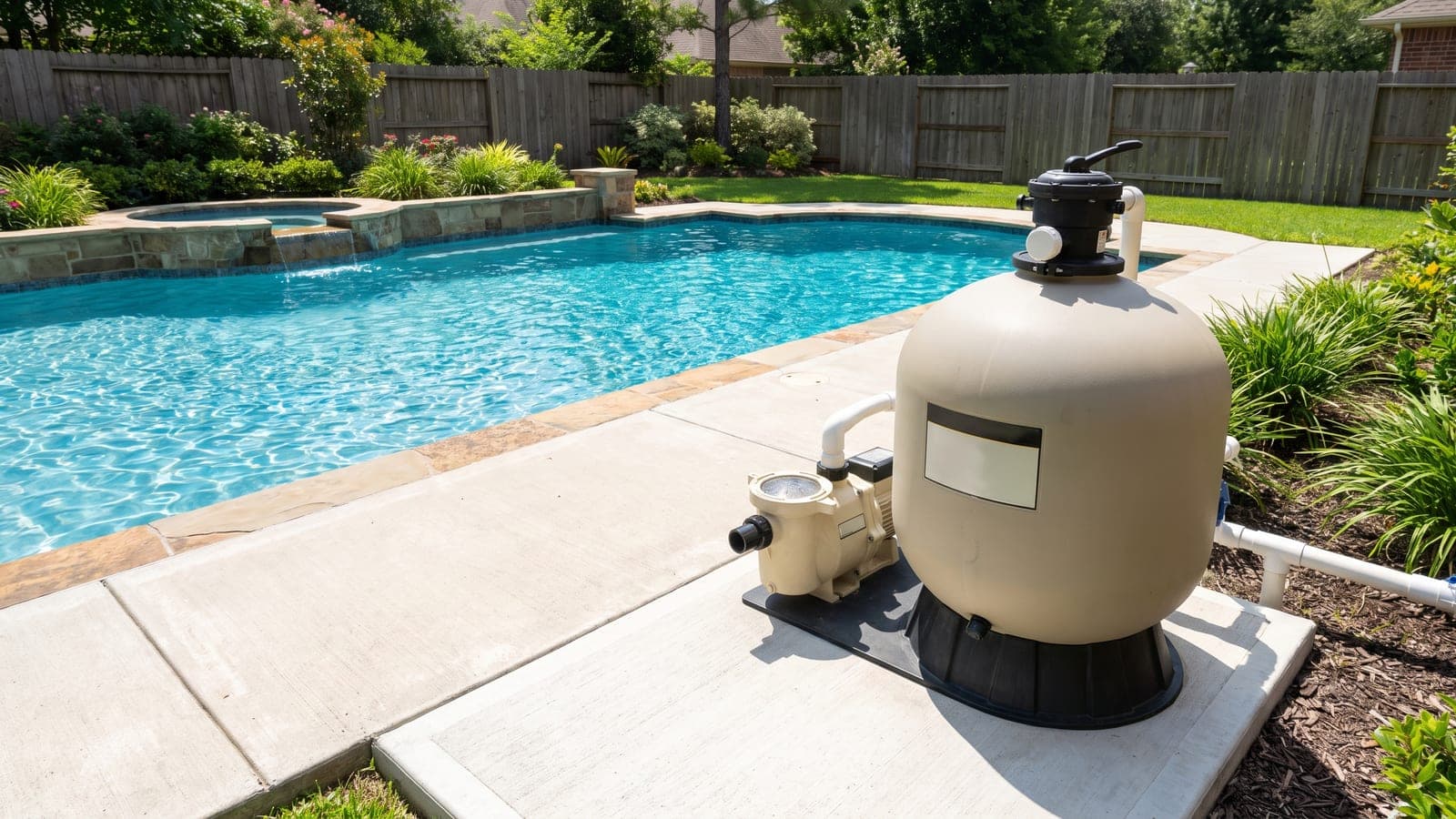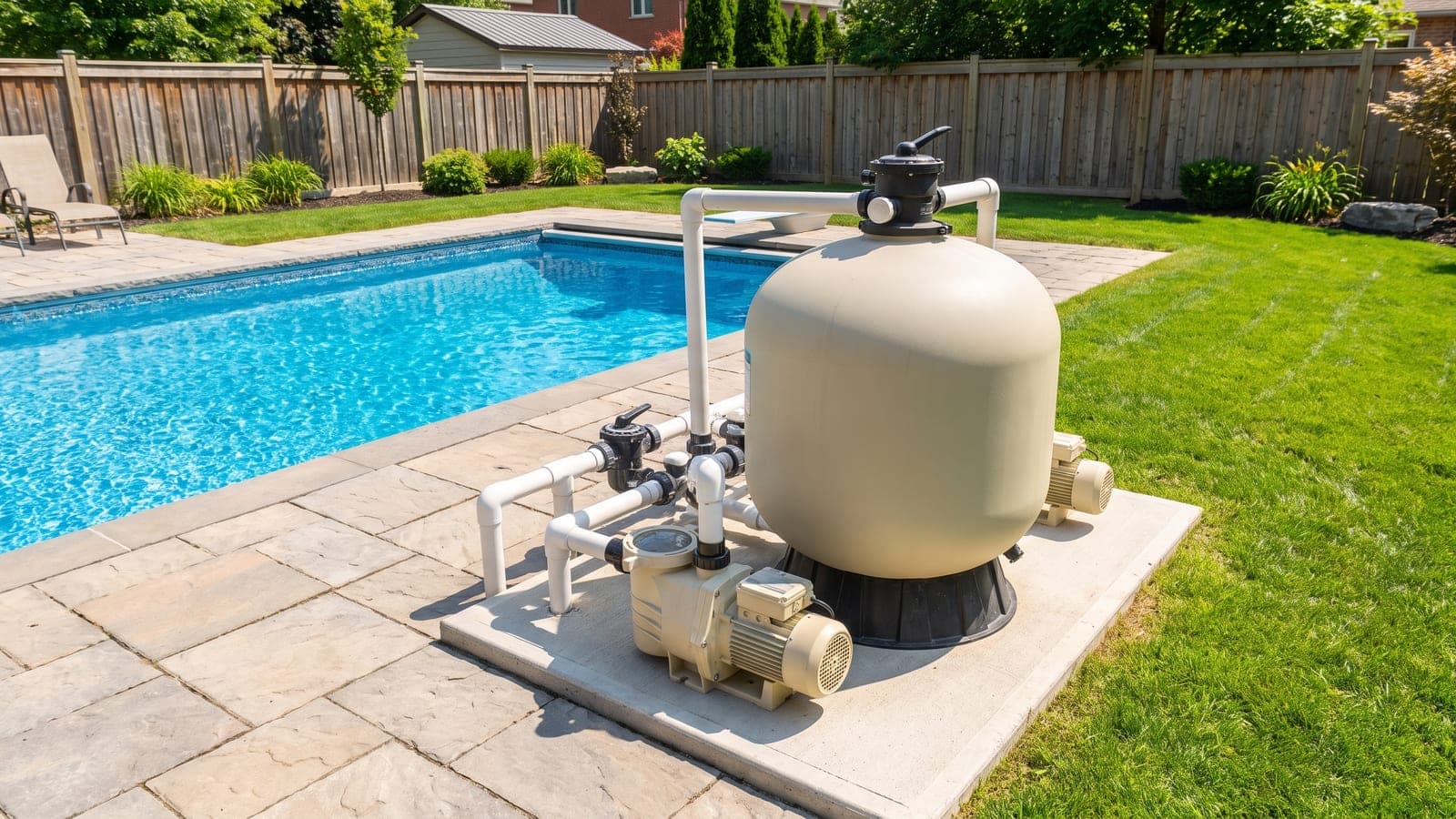
The short answer: pick a filter whose flow rating (measured in gallons per minute, or GPM) is equal to or higher than your pump's flow rate, and whose surface area can handle your pool's volume without needing a cleaning every few days. Get those two things right and the filter type almost matters less than the sizing.
Filter sizing is really a matching problem between three numbers: how many gallons your pool holds, how much water your pump pushes, and how much water the filter can process cleanly. Use the calculator above to size this to your pool, since your turnover time drives most of the decision.
What does filter size actually mean?
Filter size is not just the physical dimensions of the tank. It is the amount of filtering surface inside, rated in square feet for cartridge and D.E. filters, or in tank diameter and effective area for sand filters. More surface area means the filter traps more debris before it clogs and needs cleaning.
Every filter also carries a maximum flow rate in GPM. That number is the ceiling. Push more water through than the rating allows and the media does a worse job, because the water moves too fast to leave its dirt behind.
How do I figure out my pool's gallons?
Start with volume, because everything downstream depends on it. For a rectangular pool, multiply length by width by average depth, then by 7.5. A 32 by 16 pool averaging 5 feet deep holds about 19,200 gallons.
Round pools use diameter times diameter times average depth times 5.9. Average depth means you add the shallow and deep ends and divide by two. If your shape is irregular, break it into rough rectangles and circles, then add the pieces and accept that the total is an estimate.
How does turnover decide the size?
Turnover is the time your system needs to push a volume equal to the whole pool through the filter once. Most pool pros aim to turn the water over once or twice in a running day. The CDC notes that good filtration and circulation are a core part of keeping pool water safe to swim in, alongside chemistry (see the CDC water treatment guidance linked below).
To hit that, your pump's flow rate has to move your gallons in your target window. Divide gallons by the minutes you want to run, and you get the GPM your pump needs to deliver. The filter then has to accept at least that many GPM without exceeding its rating. The pool pump run time calculator does this arithmetic so you are not guessing.
Sand, cartridge, or D.E.: which size logic applies?
Each filter type is sized a little differently, so pick the type first, then the size.
Sand filters are rated by tank diameter and the square footage of sand inside. A larger diameter handles more flow. For a mid-size in-ground pool, something in the 22 to 24 inch range is common, like the Pentair Sand Dollar SD60 Sand Filter (22 in) or the Hayward Pro Series S244T Sand Filter (24 in). Sand filters to roughly 20 to 40 microns, which is fine for most backyards.
Cartridge filters are rated purely in square feet of pleated media, and they run at lower flow per square foot, so they are the most forgiving to size. Bigger pool, more square feet. A large cartridge such as the Hayward SwimClear C3030 Cartridge Filter (325 sq ft) covers big pools with long stretches between cleanings, while a mid-size unit handles a smaller pool comfortably.
D.E. filters use a powder coating over grids and filter the finest, down to a few microns. They are sized in square feet too, but they ask for the most maintenance because you recharge the powder after each backwash. If crystal water is the priority and you do not mind the extra steps, D.E. earns its keep.
Should I oversize on purpose?
Usually, yes, lean one size up. A slightly larger filter runs longer between cleanings, clogs more slowly, and creates less resistance for your pump to fight. Lower resistance can let a variable speed pump run at a gentler, cheaper speed, which lines up with the Department of Energy's guidance on efficient pool pumps linked below.
The limit is your pump. A filter rated far above your pump's flow is money spent on capacity you cannot use, and it takes up more pad space. Go up a step, not three.
What if I have an above-ground or small pool?
Small and above-ground pools follow the same logic with smaller numbers. An above-ground sand unit like the Pentair Sand Dollar SD40 Above-Ground Sand Filter suits many of these setups. For a compact seasonal pool, an all-in-one like the Intex Krystal Clear C2500 Cartridge Filter Pump bundles pump and filter, which keeps sizing simple as long as it matches your gallons.
The one thing not to do is reuse a tiny cartridge on a pool it was never meant for. If you find yourself hosing the cartridge every few days, the filter is undersized, not defective.
Where to go from here
Nail down your gallons, run them through the calculator to set your turnover, then shop by flow rating and surface area rather than by price alone. You can compare options on the pool filters page once you know your target numbers.
Filter sizing works hand in hand with balanced water, so it helps to keep your pool chemistry basics in order too. Salt pools follow the same filter math, covered in saltwater pool maintenance for beginners, and if you also run a spa, the hot tub maintenance guide scales these ideas down to a smaller tank.
When in doubt on a complex plumbing setup or a pool with unusual features, a local pool pro can confirm your pump and filter pairing before you buy.
Frequently asked questions
Can a pool filter be too big?
Bigger is usually the safe direction, so a filter can rarely be too big in a way that hurts your water. An oversized filter runs longer between cleanings and clogs more slowly, though you do pay more upfront and it takes up more space. The real mistake is going too small, which forces frequent cleaning and can push water past the media.
How do I know my pool's gallons?
For a rectangle, multiply length times width times average depth times 7.5 to get gallons. Round pools use diameter times diameter times average depth times 5.9. If your pool is an odd shape, estimate the pieces and add them up, then treat the number as a close approximation rather than an exact figure.
Do I match the filter to the pump or the pool?
You match all three, but the filter's flow rating must be equal to or higher than your pump's flow at operating speed. Then confirm the pump can actually turn over your pool volume in a reasonable window. The calculator above helps you check the turnover side of that math.
Which filter type is easiest to size?
Cartridge filters are the most forgiving because they run at lower flow per square foot and you simply pick more square footage for a bigger pool. Sand is simple too but filters to a coarser level. D.E. filters the finest but needs the most hands-on maintenance, so ease depends on how you weigh cleaning time versus water clarity.
Will a bigger filter save money on running costs?
It can, because a larger filter has more surface area and creates less resistance, so your pump moves water with less effort. That can let a variable speed pump run slower for longer at lower wattage. The savings depend on your pump, your rates, and your run schedule, so treat it as a helpful side effect rather than the main reason to upsize.