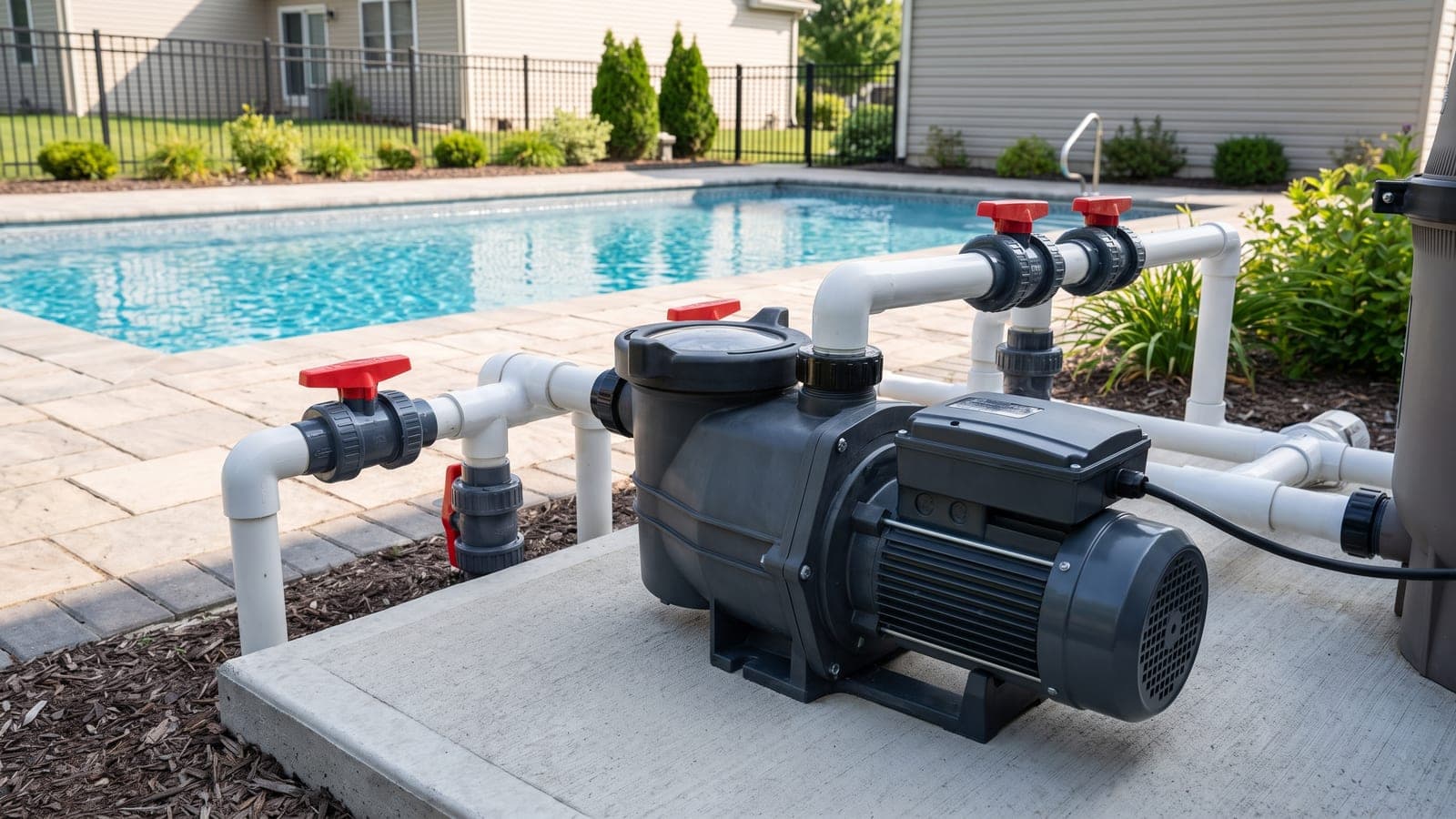
A humming pool pump that will not spin almost always means one thing: the motor is getting power but the shaft cannot turn, either because something is physically jamming it or because the start circuit (the part that kicks the motor into motion) has failed. Before you touch anything, turn the breaker off. The two usual suspects are a jammed impeller and a dead start capacitor, and you can narrow it down in about ten minutes.
First, why does a hum mean the motor cannot start?
An electric motor needs a shove to get going. On most pool pumps a small part called the start capacitor stores a burst of energy and releases it to get the shaft spinning, then hands off to the run winding. If the shaft is blocked, or if that starting shove never arrives, the motor sits there energized and buzzing.
That buzz is the sound of electricity going in with nowhere to go. Leave it humming and the motor can overheat, so do not keep flipping the switch hoping it catches. Kill the power and diagnose instead.
How do I make this safe before I check anything?
Turn off the breaker at the panel, not just the timer. If someone else could flip it back on, tape a note over it or lock the panel.
Give the motor time to cool if it has been humming. And know this going in: the start capacitor can hold a charge even with the breaker off, which is why the capacitor step is the one most owners hand to a pro. Clearing debris is a reasonable DIY job. Poking at capacitor terminals is not, unless you know how to discharge one safely.
Is the impeller jammed?
This is the cheapest fix, so check it first. The impeller is the little finned wheel inside the pump that actually moves the water. Pebbles, acorns, a chunk of leaf, or a broken piece of basket can wedge it.
With the power off, open the pump lid and clear the strainer basket. Then, at the back of the motor, most units have a slot or shaft you can turn by hand or a way to reach the impeller. Try to rotate it. If it will not move or feels gritty, you have found your jam. Clear the debris, spin it to confirm it turns freely, and try the pump again.
If the impeller spins fine by hand but the pump still only hums under power, the problem is electrical. Move on.
Could it be the start capacitor?
If the shaft turns freely but the motor just buzzes and maybe trips the breaker after a minute, the start capacitor is the prime suspect. It is a common failure and often shows a bulged or leaking top when it goes bad. On many motors it lives under a small cover on top or on the back end of the motor housing.
Testing it means using a multimeter and safely discharging the stored voltage first, which is exactly the step where a lot of owners decide to call someone. If you are comfortable with that work and the capacitor reads bad or looks swollen, a replacement is inexpensive. If you are not, this is a legitimate service call, not a failure on your part.
What else makes a pump hum?
A few other causes are worth ruling out:
- Seized bearings. If the shaft grinds or squeals when you turn it, the motor bearings may be failing. That is usually a motor replacement conversation.
- Low or single-leg voltage. A loose wire or a failing breaker can feed the motor partial power, enough to hum but not run. This is electrical work best left to a pro.
- A frozen or gummed-up shaft after a long off-season. Sometimes a stuck shaft just needs to be freed by hand.
- Wrong pump settings. On a variable-speed pump, a very low programmed speed or a scheduling glitch can look like a no-start. Check the control panel before assuming hardware.
Should I repair this pump or replace it?
If the motor is old, this is a good moment to think ahead. A single-speed pump that is eight to ten years old and now needs a capacitor plus maybe bearings is often not worth chasing. Both the Department of Energy and the ENERGY STAR pool pump program note that variable-speed models run far more efficiently, and the electricity savings can offset the cost of the new pump over a few seasons.
If you decide to upgrade, match the new pump to your pool's volume and plumbing (check the listing and your equipment pad for flow needs). Popular variable-speed options owners cross-shop include the Pentair SuperFlo VS Variable-Speed Pump for many residential pools, the Hayward MaxFlo VS Variable-Speed Pump as a common mid-size pick, and the higher-flow Pentair IntelliFlo3 VSF Pump for larger systems. You can also browse fittings and starter parts under pool accessories.
When should I just call a pro?
Call someone if the shaft grinds, the breaker trips repeatedly, you smell burning, or the fix involves the capacitor or wiring and you are not trained for it. There is no shame in it. Electrical work near stored voltage is one of the few pool tasks where the safe move is to step back.
Once your pump is spinning again, get your water back on track with pool chemistry basics. Salt-system owners can check saltwater pool maintenance for beginners, and if you also run a spa, hot tub maintenance for beginners covers the same no-panic approach.
The short version: power off, check the impeller, then suspect the capacitor, and know which steps are yours and which belong to a pro.
Frequently asked questions
Why does my pool pump hum but not spin?
A hum means the motor is getting power but cannot turn, so the shaft is stuck or the start circuit failed. The two most common causes are a jammed impeller (debris) and a dead start capacitor. Which one it is depends on whether the shaft turns freely by hand.
Can a bad capacitor make a pool pump hum?
Yes. The start capacitor gives the motor the jolt it needs to begin spinning, and when it fails the motor just hums and often trips the breaker after a minute. Capacitors are a common, relatively cheap failure, but replacing one means working near stored voltage, so many owners hand this to a pro.
Is it safe to fix a humming pool pump myself?
Basic checks like clearing debris are fine once the breaker is off and locked out. Anything involving the capacitor or internal wiring carries a real shock risk even when the power is off, because capacitors hold a charge. If you are not confident testing and discharging it, call a pool or appliance technician.
How do I know if it is the impeller or the motor?
Cut power, remove the motor cover or access the shaft, and try to spin it by hand. If it will not budge or grinds, suspect a jammed or seized impeller or bearings. If it spins freely but only hums under power, the problem is more likely electrical, such as the capacitor.
Should I repair or just replace the pump?
It depends on the pump's age and type. A single-speed motor more than eight to ten years old is often not worth a big repair, and upgrading to a variable-speed pump can pay for itself in energy savings. A newer or higher-end pump with one bad part is usually worth fixing.