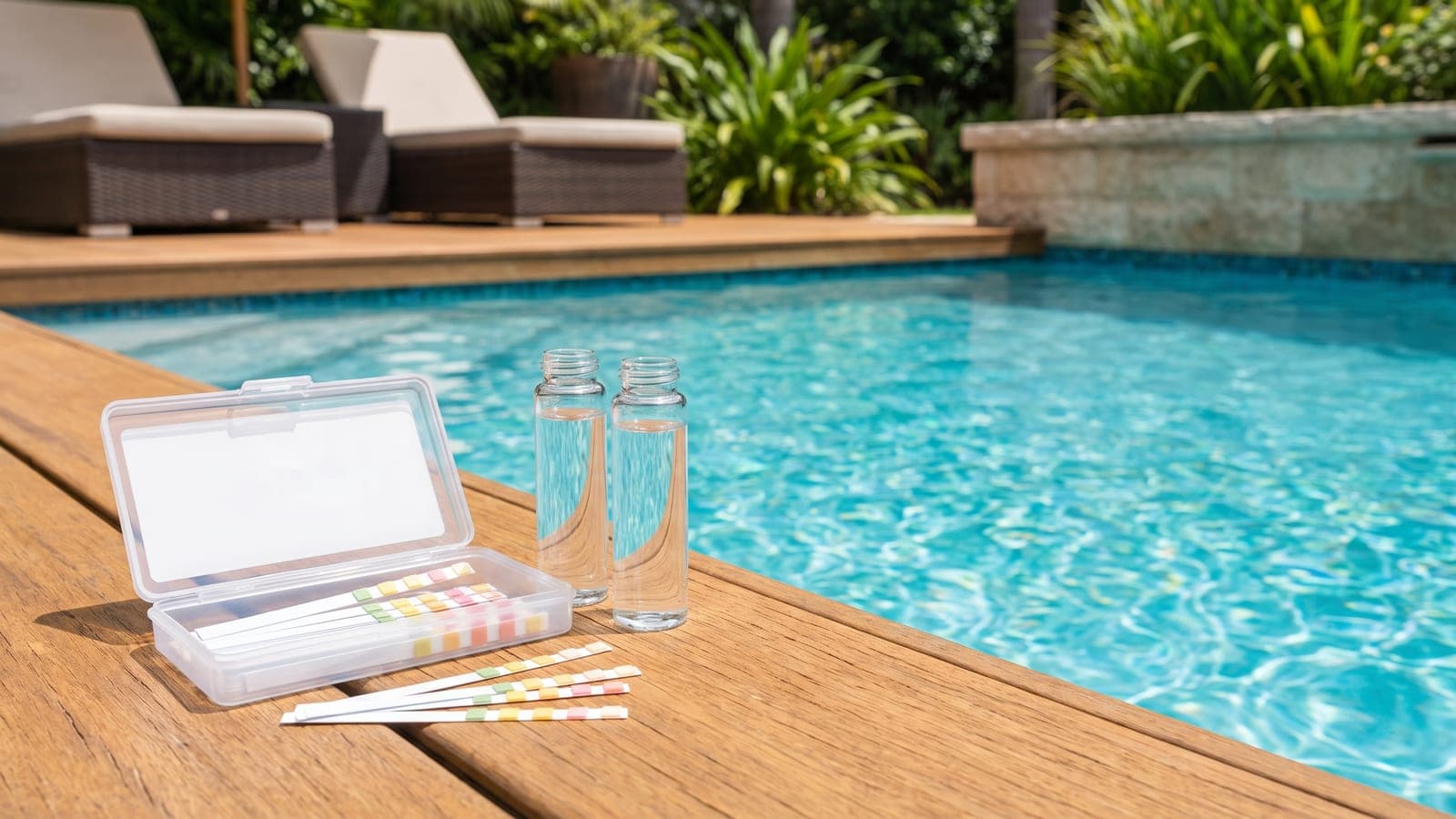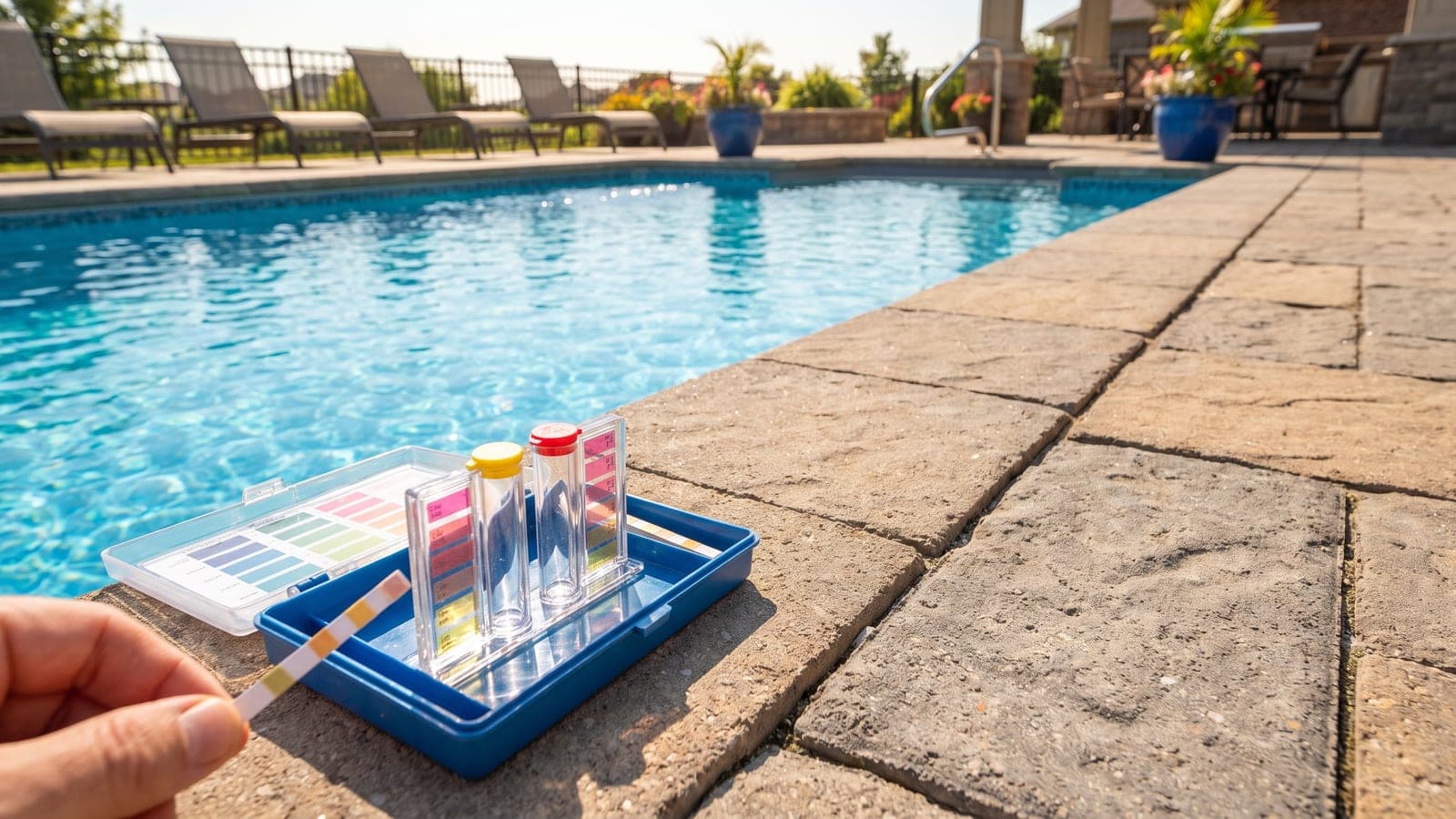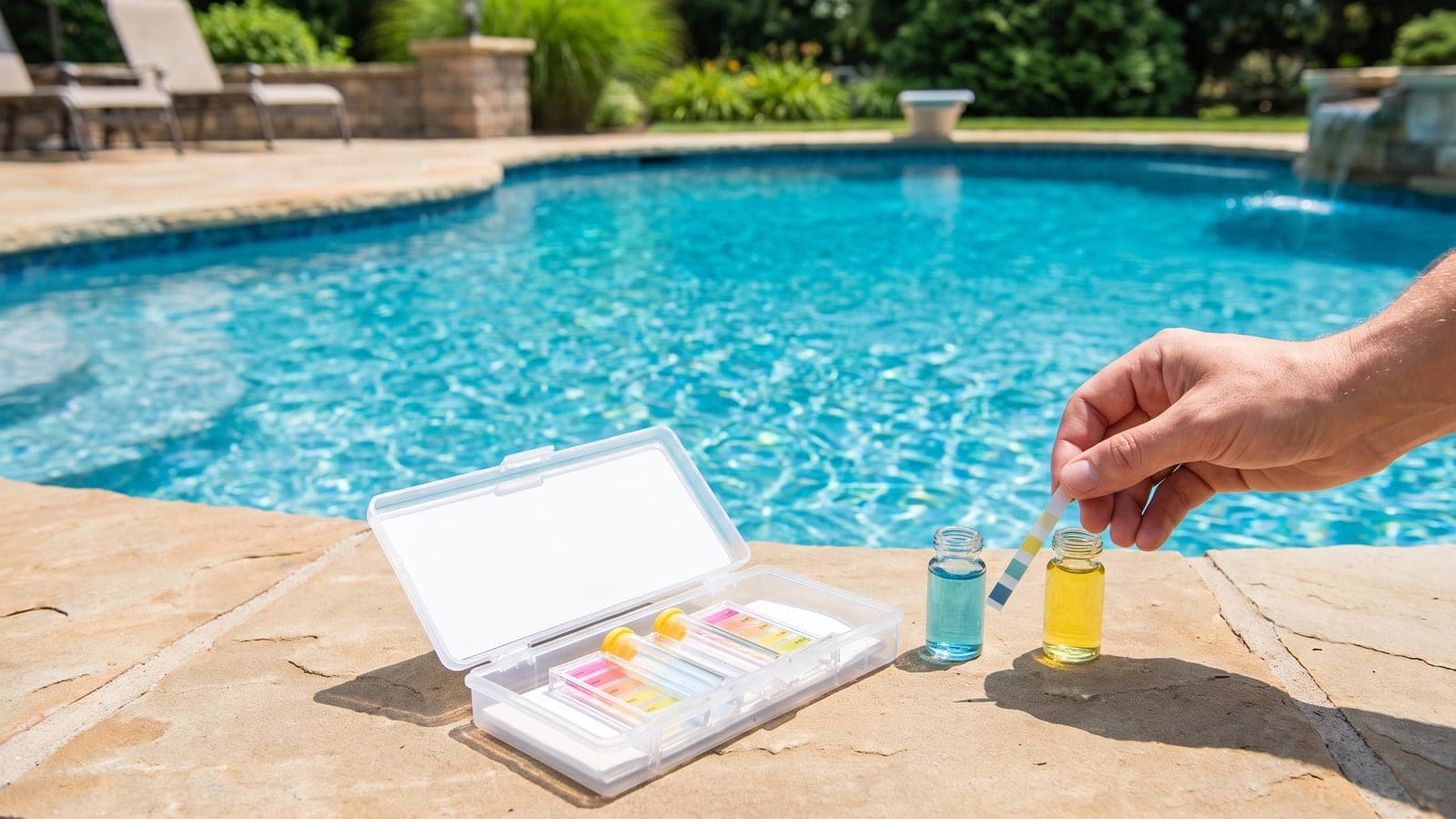
Trust the liquid test kit for accuracy, and trust strips for speed. Liquid drop kits read closer to the true chemistry of your water, while test strips give you a fast, good-enough snapshot for routine checks. Most pool owners are best served by owning both and knowing when to reach for each.
Water testing is how you keep chlorine (your sanitizer) and pH (how acidic or basic the water is) in the safe zone. The CDC recommends checking free chlorine and pH at least twice a day for commercial pools, and home owners should test several times a week during swim season. The tool you pick decides how confident you can be in the number you act on.
How do pool test strips actually work?
You dip a strip in the water for a second, pull it out, and compare the colored pads to a printed chart. Each pad changes color based on a chemical level, usually free chlorine, pH, total alkalinity, and sometimes cyanuric acid (CYA, the sunscreen that keeps chlorine from burning off in daylight).
Strips are fast and cheap, and that is their real value. When testing takes ten seconds, you actually do it, and a mediocre test you run often beats a perfect test you skip.
The tradeoff is resolution. Strips read in broad bands, so a pad might tell you chlorine is "somewhere between 3 and 5" rather than exactly 4.2. Color matching by eye adds error, and readings drift once the bottle is exposed to moisture or heat. A dependable multi-parameter option like the AquaChek Select 7-Way Test Strips covers seven levels in one dip, which is plenty for a weekly glance.
How do liquid test kits work?
You collect a water sample in a vial, add a set number of reagent drops, and read the result from the color that develops or the drops it takes to trigger a change. Because you are measuring an actual reaction, the numbers land closer to reality.
Two testing methods matter here. DPD kits produce a color you match to a chart, which is quick and clear at normal chlorine levels. FAS-DPD kits count drops until the color clears, which reads chlorine in fine steps and stays reliable even when chlorine is very high, such as during a shock or an algae fight.
The Taylor K-2006 Complete Test Kit (FAS-DPD) is a common pick for owners who want that drop-count precision, while the Taylor K-2005 Complete Test Kit (DPD) uses the faster color-match approach. Both need fresh reagents, so keep a Taylor Reagent Refill Set on hand rather than trusting drops that have sat open for two summers.
Which one should I trust when the numbers disagree?
Trust the liquid kit, then confirm. Strips and liquid tests will not always match, and that is normal because they measure in different resolutions. When a strip says something looks off, retest with a liquid kit before you add a single chemical.
There is one trap worth naming. Very high chlorine can bleach a strip pad (and even some DPD tests) so badly that the reading comes back looking low or blank. If your strip shows almost no chlorine but the water smells strongly of it, dilute a sample with tap water and retest, or switch to an FAS-DPD kit that handles high levels honestly.
When you are dosing chemicals, adjusting a salt system, or troubleshooting cloudy water, lean on the liquid kit. When you just want to confirm the pool is swimmable before guests arrive, a strip is fine.
What about digital and smart testers?
If reading color charts by eye frustrates you, a digital tester removes that step. A photometer like the LaMotte ColorQ 2X Pro 7 Digital Tester runs the same reagent chemistry as a liquid kit but reads the color electronically and shows a number on a screen. That helps with repeatability and is genuinely useful for anyone with color-vision trouble.
Smart monitors are a different tool. A floating unit such as the Sutro Smart Pool Monitor tests on a schedule and sends readings to your phone, which is convenient for catching drift between manual tests. Treat these as an early-warning system, not a replacement, and confirm anything unexpected with a manual kit before acting.
Digital gear still depends on fresh reagents and clean sample cells, and it costs more upfront. Match the spend to how much precision you actually need.
How do I get accurate results with either method?
Good technique beats good gear. A few habits keep both strips and kits honest.
- Sample correctly. Draw water elbow-deep, away from return jets, in a clean container. Surface water and jet water both skew results.
- Watch expiration. Strips and reagents both degrade. Store them cool, dry, and sealed, and replace strips that look discolored.
- Read in good light. Match colors under daylight, not yellow indoor bulbs, and read at the time the instructions specify.
- Rinse everything. Soap residue or leftover chemical in a vial throws off the next test. Rinse with pool water, not tap.
Handle reagents with care, since they are still pool chemicals. The CDC's pool chemical safety guidance is worth a read before you store or mix anything.
If you want to understand what the numbers mean once you have them, our pool chemistry basics guide breaks down each level in plain English. Salt pool owners have a couple of extra readings to watch, covered in our saltwater pool maintenance guide, and hot tub owners can start with hot tub maintenance for beginners.
So which should you buy?
Buy both if you can. Keep a bottle of strips for fast, frequent checks and a liquid kit for the moments that matter, like dosing, shocking, or diagnosing a problem. If your budget only stretches to one, and you are comfortable counting drops, a liquid kit is the more trustworthy tool.
Whatever you choose, the reagents and strips do expire, so restock from a reliable source. You can find current testing gear on our maintenance supplies page. The best test kit is the one you will actually use, on a schedule, before the water gives you a reason to.
Frequently asked questions
Are pool test strips accurate enough for a home pool?
For routine weekly checks, quality strips are usually accurate enough to confirm your chlorine and pH are in range. They read in bands rather than exact numbers, so when a value looks off, confirm it with a liquid kit before dosing chemicals.
Why does my strip and my liquid kit give different chlorine numbers?
Strips read color in ranges while liquid tests read a specific value, so some difference is normal. Bigger gaps usually mean expired strips, a very high chlorine level bleaching the pad, or a kit reagent that has gone bad. Retest with fresh materials before trusting either.
How often should I test my pool water?
Test chlorine and pH two to three times a week during swim season, and more often after heavy use, rain, or a big temperature swing. Check total alkalinity, calcium hardness, and cyanuric acid weekly to monthly depending on how stable your pool runs.
Do test strips expire?
Yes, and expired or moisture-damaged strips are a top cause of bad readings. Keep the bottle sealed, store it somewhere cool and dry, and replace strips once they pass the printed date or if the pads look discolored.
Is a digital tester better than both strips and liquid kits?
A digital photometer removes the guesswork of matching colors by eye, which helps if you struggle with color vision or want repeatable numbers. It still depends on fresh reagents and clean sample cells, and it costs more upfront, so it is best for owners who want precision without reading a color chart.