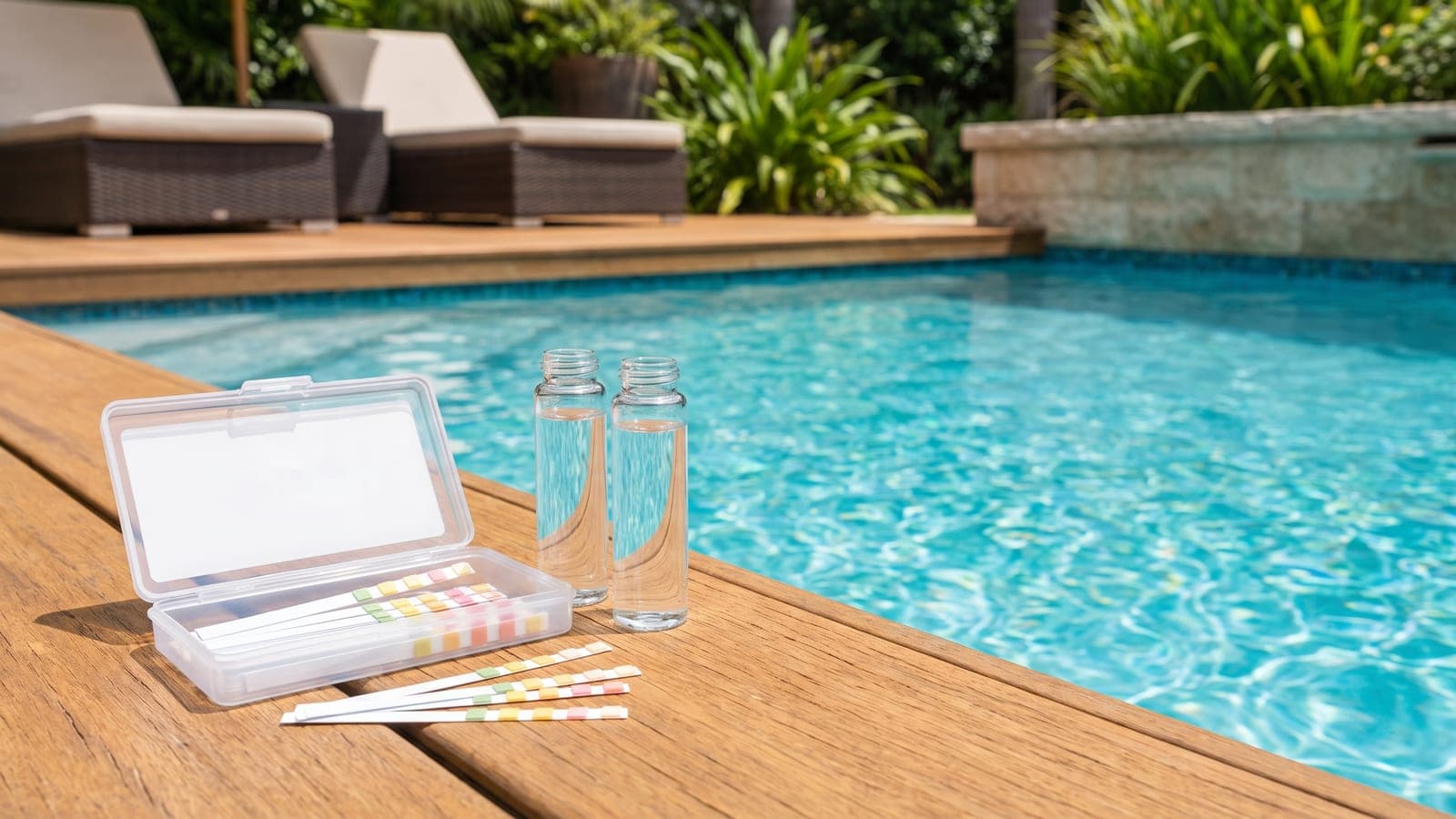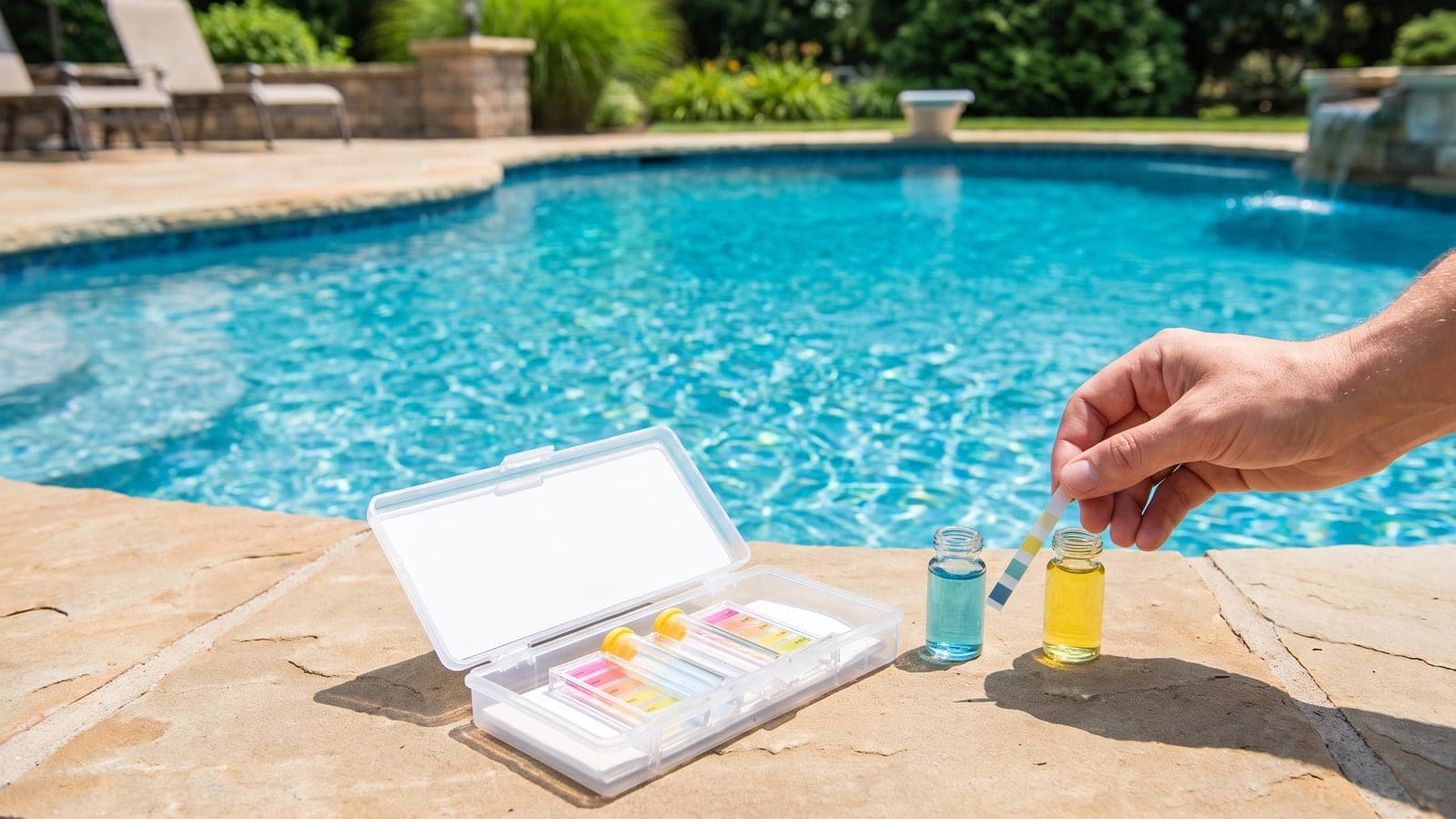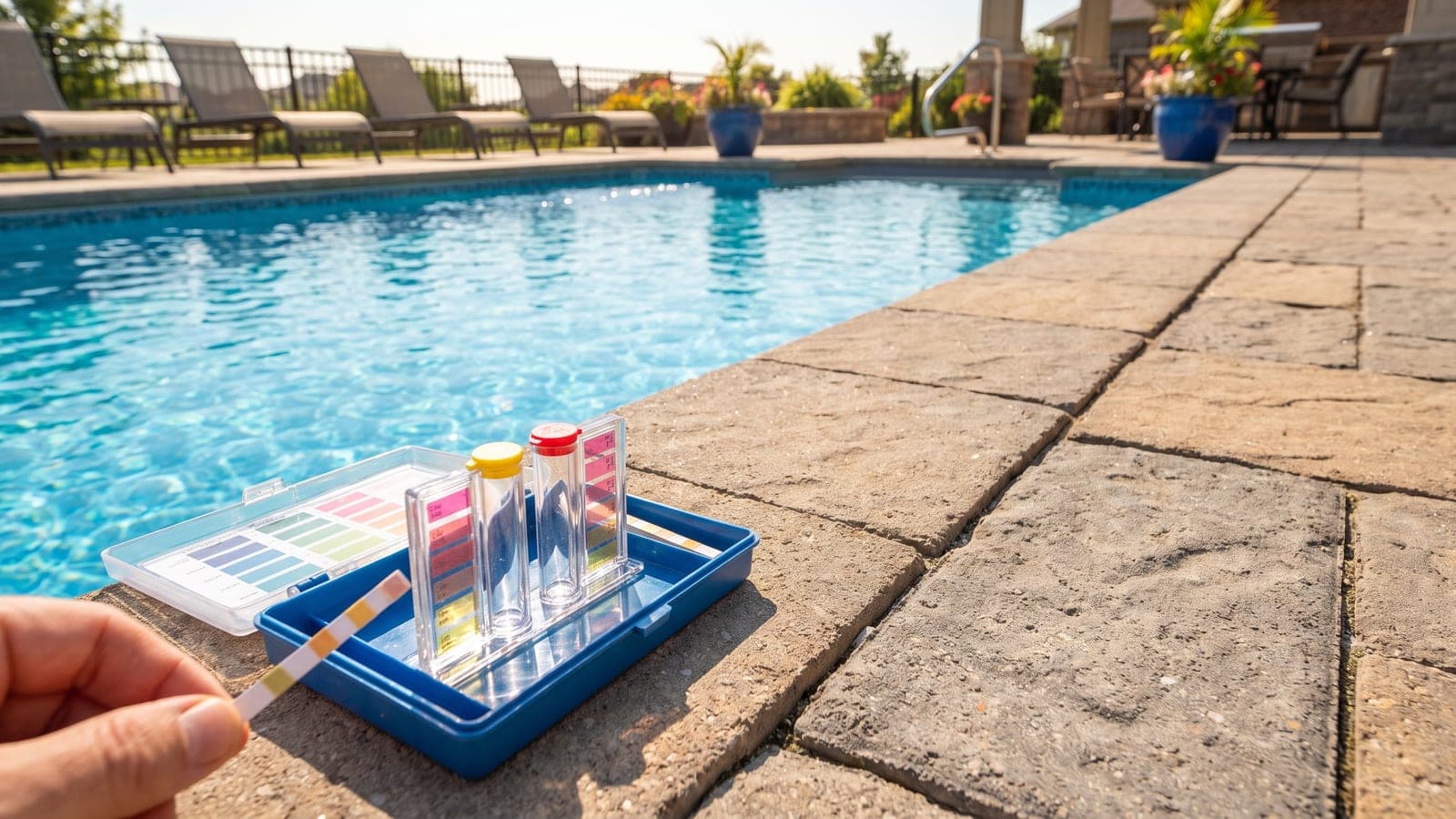
Get the Taylor K-2006 if you want precise chlorine readings and plan to actively manage your water. Get the Taylor K-2005 if you want a simpler, cheaper kit and you are fine with a close-enough chlorine number. That is the whole decision in one sentence, and the rest of this explains why.
Both are respected liquid test kits from the same company, and they test the same core group of things: free chlorine, pH, total alkalinity (the water's buffer against pH swings), calcium hardness, and cyanuric acid (CYA, the stabilizer that protects chlorine from sunlight). The single meaningful difference is how they measure chlorine.
What actually differs between the K-2006 and K-2005?
The chlorine test. Everything else is nearly identical.
The Taylor K-2005 Complete Test Kit (DPD) uses a DPD color-match method. You add reagent, the sample turns pink, and you compare that pink to a printed color block. It reads chlorine in jumps of roughly 0.5, 1, 3, 5 ppm and so on. Quick, but you are eyeballing a shade of pink.
The Taylor K-2006 Complete Test Kit (FAS-DPD) uses a FAS-DPD drop-count method. Your sample turns pink, then you add a titrating reagent one drop at a time until the pink disappears. You count the drops and multiply. Each drop equals 0.2 or 0.5 ppm depending on your sample size, so you get a real number instead of a best-guess color.
That drop-counting is the reason the K-2006 is the kit most experienced pool owners point new people toward.
Why does the FAS-DPD chlorine test matter so much?
Because chlorine is the one reading you act on the most, and DPD color tests have a well-known flaw: at high chlorine levels the pink bleaches back out. You can add reagent to heavily chlorinated water and watch it turn pink, then fade to clear, which reads as low or zero chlorine when the truth is the opposite.
If you ever shock your pool or run a SLAM (a sustained high-chlorine process to clear algae), the K-2005 can lie to you exactly when accuracy matters. The K-2006 handles high chlorine by simply needing more drops. No bleach-out, no guessing.
The K-2006 also lets you measure combined chloramines (the harsh, eye-stinging byproducts) with an extra reagent, which the CDC ties directly to that "pool smell" and irritation people blame on chlorine. If you are learning the why behind these numbers, our pool chemistry basics guide walks through what each reading means.
Who is the K-2005 actually right for?
Plenty of people, honestly. If you run a stabilized pool, keep chlorine in a normal 1 to 3 ppm range, and rarely shock, the DPD color test is fast and gets you close enough for day-to-day peace. It costs less and it is a little quicker to run.
It is also a reasonable pick for a small hot tub or spa where you are testing tiny volumes and mostly watching for "is there sanitizer or not." Our hot tub maintenance guide covers that lighter-touch routine.
The catch: once you get serious about chemistry, most people wish they had bought the K-2006 first and end up buying it anyway. If you already suspect you are the type to fuss over numbers, skip a step and start there.
Does salt or a big pool change the answer?
It can push you toward the K-2006. Saltwater pools still run on chlorine, just generated by a salt cell instead of a jug, so you still need to read free chlorine accurately. The precise FAS-DPD number helps you tune your salt cell output instead of chasing a color block. Our saltwater pool maintenance guide explains how the generator and chlorine relate.
Bigger pools also benefit because small chlorine errors get expensive fast when you multiply them across 20,000 or 30,000 gallons. A precise reading keeps you from over- or under-dosing.
What about smart monitors instead?
Devices like the Sutro Smart Pool Monitor or the WaterGuru Sense S2 Smart Monitor sit in your water and push readings and trends to your phone, and a digital option like the LaMotte ColorQ 2X Pro 7 Digital Tester removes color-matching by reading samples electronically. These are genuinely useful for catching drift between manual tests.
But they are companions, not replacements. When a monitor flags something odd, you still want a trusted drop-based number to confirm before you dump chemicals in. A liquid reference kit like the K-2006 is what you check against. Many owners keep a smart monitor for alerts and a Taylor kit for the truth.
What will it cost to keep running?
Both kits use consumable reagents, so budget for refills over time, not just the box. Exact prices vary by retailer and change often, so check the current listing. The FAS-DPD reagents in the K-2006 do get used up faster if you test chlorine frequently, which is a fair tradeoff for the accuracy.
You do not have to rebuy the whole kit when a bottle runs dry. A Taylor Reagent Refill Set replaces the individual reagents so you keep your comparator, tubes, and case. You can find both kits and refill reagents in our maintenance supplies roundup.
Whichever you choose, store reagents cool, dark, and tightly capped, and follow the CDC's basic guidance on safe chemical handling. Test kit chemicals are still chemicals, so keep them away from kids and never mix them together outside the test tube.
The short version
Buy the Taylor K-2006 Complete Test Kit (FAS-DPD) if you want accurate chlorine, plan to shock or run a saltwater pool, or just want the kit you will not outgrow. Buy the Taylor K-2005 Complete Test Kit (DPD) if you want a simpler, cheaper option and your chlorine stays in a normal range. When in doubt, the K-2006 is the safer long-term pick, and the small extra cost buys you a chlorine number you can actually trust.
Frequently asked questions
Is the K-2006 worth the extra money over the K-2005?
For most owners who want to dial in chlorine, yes. The K-2006 measures free chlorine in small, precise steps instead of matching a color block, which matters a lot when you are managing CYA and shocking. If you only glance at your water occasionally, the K-2005 may be enough.
What is the actual difference between the two kits?
The chlorine test method. The K-2005 uses a DPD color-match test, and the K-2006 uses a FAS-DPD drop-count test that reads in 0.2 or 0.5 ppm steps. Everything else (pH, alkalinity, calcium hardness, CYA) is essentially the same.
Can I test high chlorine or shock levels with the K-2005?
Not accurately. DPD color tests bleach out at high chlorine and can read falsely low or blank. The K-2006 FAS-DPD test handles high levels by just adding more drops, so it is the better choice if you ever shock or run a SLAM.
How long do the reagents last?
It depends on storage. Most Taylor reagents last a year or two if kept cool, dark, and tightly capped, though the DPD powder and some liquids degrade faster once opened. Replace reagents that have changed color or stopped giving sharp results.
Do I need either kit if I have a smart monitor?
A liquid kit is still useful as a reference check. Smart monitors are handy for trends and alerts, but a drop-based kit like the K-2006 gives you a confirmed number when a reading looks off. Many owners keep both.